Things to Do in the Val d'Elsa: A Complete Guide
Things to do in the Val d’Elsa is the question every traveller asks when they find themselves for the first time in this stretch of Tuscany between Florence and Siena. The answer is: much more than you might expect. The Val d’Elsa is not a single destination but an articulated territory that offers medieval villages, wineries, hiking trails, one of the oldest pilgrimage roads in Europe, and an exceptionally rich gastronomy. This guide collects the main activities, with practical tips for every season.
Medieval villages: the valley’s historic heritage
The most immediate answer to what to do in the Val d’Elsa is to visit the medieval villages that punctuate the hilly landscape. Each municipality has its own history, its own architecture, its own character.
San Gimignano is the absolute masterpiece: 14 medieval towers rising against the sky, declared a UNESCO World Heritage Site. Piazza della Cisterna and Piazza del Duomo form one of the best-preserved medieval urban complexes in Italy. Vernaccia, the DOCG white wine produced here for centuries, is the obligatory toast.
Monteriggioni has the most intact medieval walls in Tuscany: a perfect circle of 14 towers that Dante compared to the giants of the Inferno. The village inside is small, but the emotion of seeing these walls emerge from the Sienese countryside is unique.
Barberino Val d’Elsa is the least known and most authentic village: the Palazzo Pretorio with its heraldic coats of arms, the intact medieval walls, village life flowing slowly without too many tourists.
Colle Val d’Elsa surprises with its medieval upper town, the birthplace of Arnolfo di Cambio and a crystal-working tradition that has lasted 250 years.
Certaldo Alto, in the northern part of the valley, is Boccaccio’s city: the red brick houses and the Casa del Boccaccio are a fascinating chapter of medieval literature.
Hiking and trekking: the paths of the Val d’Elsa
The Val d’Elsa offers numerous opportunities for those who love walking. The trails are well signposted and pass through landscapes of great beauty: oak and cypress woods, vineyards and olive groves, panoramic ridges.
The Via Francigena
The most celebrated trail in the area is the Via Francigena, the ancient pilgrimage route from Canterbury to Rome that crosses Tuscany from north to south. The stretch that runs through the Val d’Elsa - passing through Barberino Val d’Elsa, Poggibonsi and San Gimignano - is considered among the most beautiful on the Italian route. You walk through cultivated fields and woods, encounter country churches and villages, and enjoy views over the Chianti hills.
Even those who do not want to undertake a long-distance walk can cover short sections of the Via Francigena as day excursions. From Barberino Val d’Elsa it is possible to walk to Poggibonsi (about 12 km) or towards San Gimignano (about 15 km) following the official waymarked route.
Cycling routes
The Val d’Elsa is very popular with cycle tourists, especially in spring and autumn. The secondary roads between the villages carry little traffic and offer routes for every level of difficulty. The climbs into the Chianti hills require good physical preparation, while the valley floors along the River Elsa are suitable even for less experienced cyclists.
Wine and gastronomy: the flavours of the Val d’Elsa
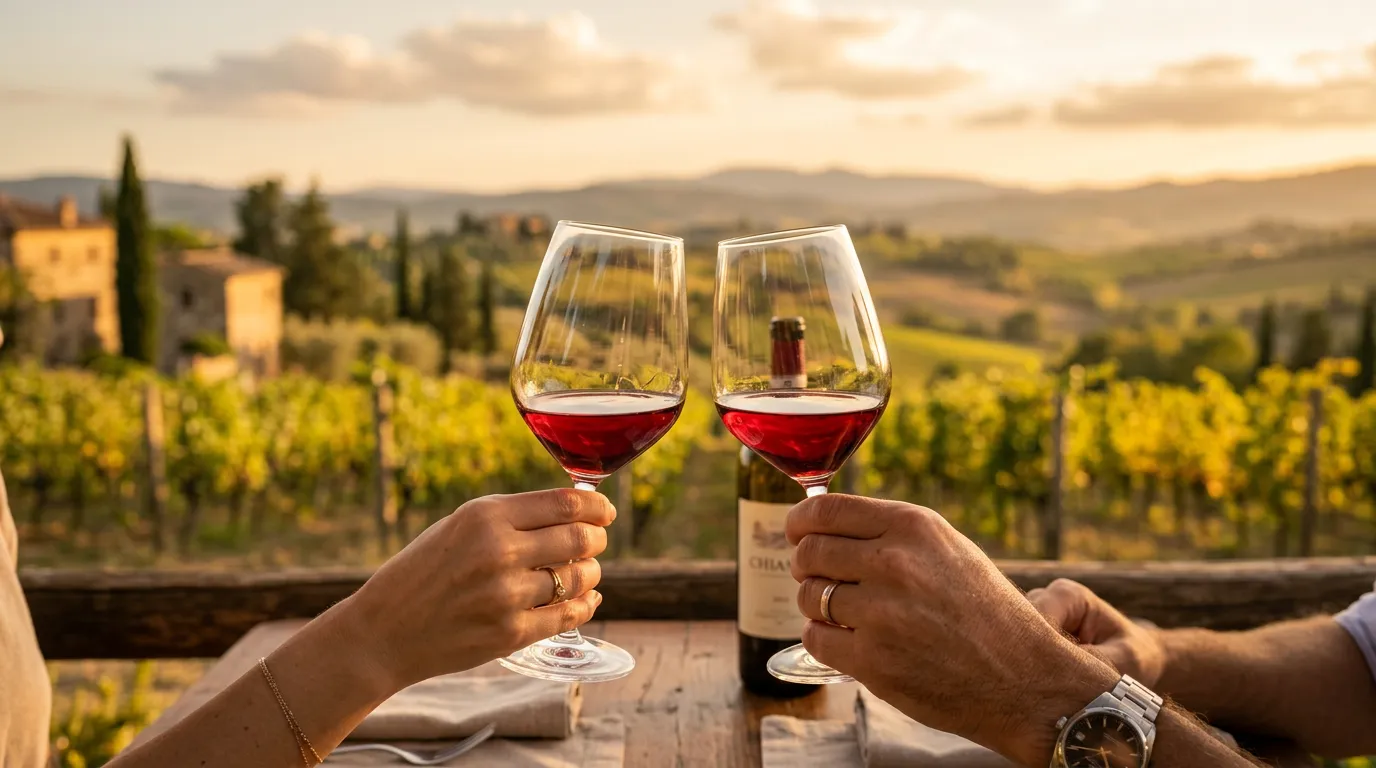
A visit to the Val d’Elsa without time devoted to wine and local cooking would be an incomplete journey. The territory borders the Chianti Classico zone, with wineries reachable in 20 minutes by car, but it also has its own productions of great quality.
The Chianti Classico wineries
The Chianti Classico wineries are a short distance away: from Barberino Val d’Elsa you reach the heart of the territory in under 30 minutes. Tastings at the winery let you meet the producers, understand the differences between vintages and buy directly from the farms. Sangiovese vinified in its pure form, Riserva aged in oak barrels, Gran Selezione from historic vineyards: each level of the denomination tells a different story.
Tuscan cuisine
The gastronomy of the Val d’Elsa reflects the Tuscan peasant tradition: simple dishes, quality ingredients, straightforward flavours. Pici with wild boar ragù is the signature first course of the area. Ribollita, panzanella, crostini with chicken liver paste complete a repertoire found in village trattorias at modest prices. The pecorino cheeses of the Sienese area, Tuscan cured meats, extra-virgin olive oil from the hills around Barberino are all products found at local markets and in the shops of the historic centres.
Markets and festivals
The festival season in the Val d’Elsa runs from May to October. Every village organises at least one local celebration dedicated to local products: festivals for panzanella, wild boar, new wine, steak. These are moments of authentic Tuscan life, with outdoor tables, live music and a popular festive atmosphere that has nothing staged for tourists.
Seasonal tips: when to come to the Val d’Elsa
Spring (April–May)
Spring is perhaps the most beautiful time to visit the Val d’Elsa. The vines bud, the wheat and sunflower fields are a brilliant green, red poppies flower along the white roads. Temperatures are mild, the days lengthen and tourists are still in manageable numbers. It is the ideal period for walking and cycling excursions and for visiting wineries to discover new vintages.
Summer (June–August)
Summer brings heat, intense light and a few more tourists, especially in July and August. Festivals and outdoor events animate the villages in the evenings. The landscapes are dry and golden - different from spring, but with their own charm. It is advisable to visit the villages in the early morning or late afternoon, avoiding the hottest hours.
Autumn (September–October)
Autumn is the season of the grape harvest and olive picking. The vineyards turn red and orange, the air smells of fermenting must, and wineries open for new-vintage tastings. The porcini mushroom season brings foragers into the woods, and local restaurants offer dedicated menus. Temperatures are still pleasant and the landscape is at its finest.
Winter (November–March)
Winter in the Val d’Elsa is quiet and authentic. The villages are almost free of tourists, restaurants serve the local community, markets offer seasonal produce. The morning mist wraps the cypress-lined hills in an almost surreal atmosphere. For those who love Tuscany unfiltered, away from the tourist construction of high season, winter is a revelation.
Where to stay
Homelink Sogno d’Oro is in the heart of the Val d’Elsa, at Barberino Val d’Elsa, and is the ideal base for all the activities described in this guide. The property is within walking distance of the Via Francigena, 15 minutes by car from San Gimignano, 20 minutes from the Chianti Classico wineries and 30 minutes from Siena. The rooms with balconies look out over the vineyards and Tuscan hills, and every morning breakfast is an introduction to the flavours of the territory.
Related property: Homelink Sogno d’Oro Link: /sogno-doro/
Where to stay
Dove dormire: Homelink Sogno d'Oro - Val d'Elsa · tra Firenze e Siena
Controlla la disponibilità