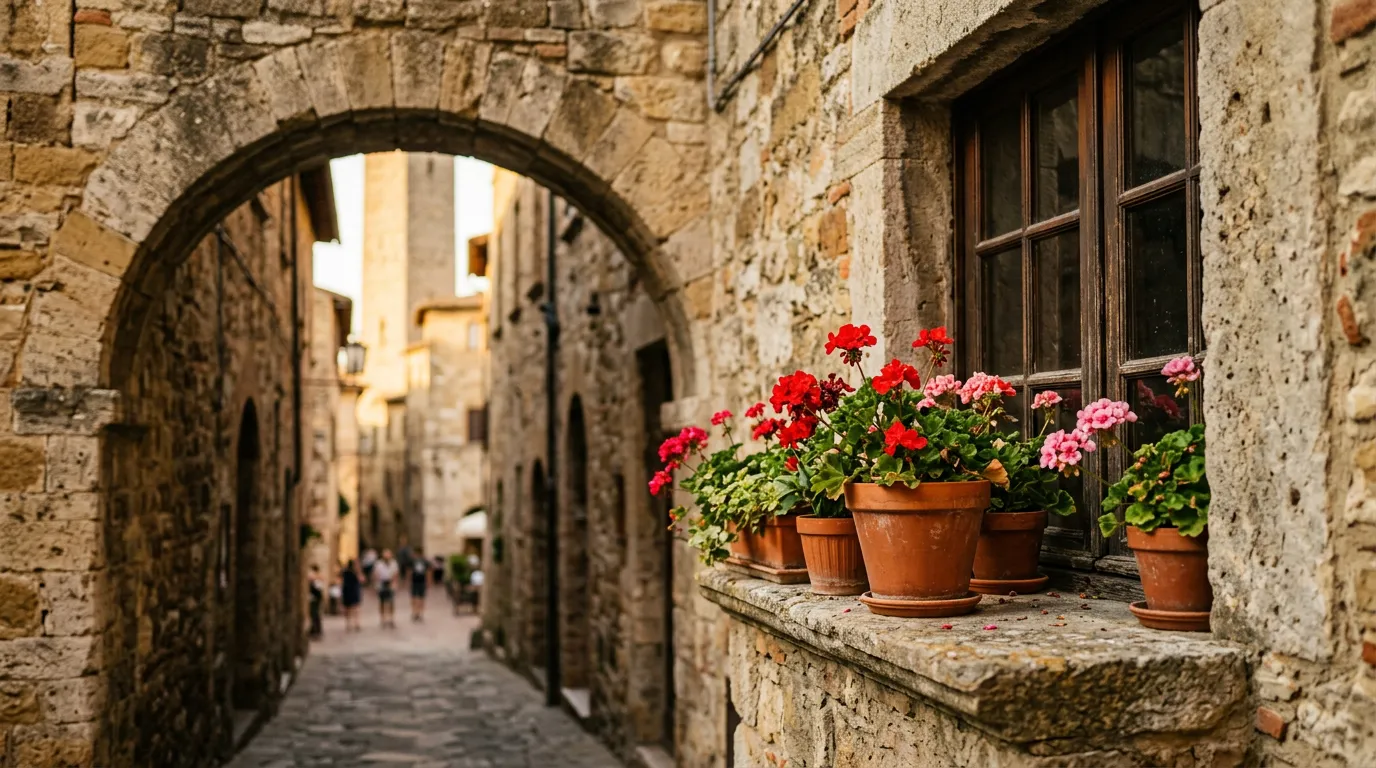
San Gimignano: What to See and How to Beat the Crowds
What to see in San Gimignano in a day: one of the most frequent questions from first-time visitors to Tuscany. The city of medieval towers, a UNESCO World Heritage Site since 1990, is one of the most photographed and admired destinations in Italy, and it manages to surprise even those who have already seen it in hundreds of images. This one-day itinerary covers the essential points, with advice on timing and strategies for enjoying it at its best.
The medieval towers: a skyline unique in the world
San Gimignano has an immediate visual answer: the towers. The 14 surviving medieval towers, built between the twelfth and fourteenth centuries by the noble families of the village in competition to demonstrate power and wealth, form a skyline without equal in the world. Originally there were over 70 towers: most have been demolished over the centuries, but those remaining are enough to create an urban profile recognisable from a distance, from the vineyards and hills that surround the village.
The Torre Grossa, the tallest at 54 metres, is municipally owned and can be climbed. The view from the top is the best way to understand the structure of the village: the two main squares, the web of alleys, the agricultural landscape surrounding it and, on clear days, the silhouettes of Siena and Volterra on the horizon.
The other towers are privately owned and cannot be visited inside, but the play of volumes and heights they create as you walk through the alleys is itself an architectural spectacle.
Piazza della Cisterna and Piazza del Duomo
The heart of San Gimignano is formed by two adjacent squares that together make up one of the finest medieval complexes in Italy. Piazza della Cisterna takes its name from the fourteenth-century well at its centre, still standing in its original form. The square is irregular, surrounded by medieval palaces with their towers, and creates a scenic effect that every photographer wants to capture.
Piazza del Duomo, immediately adjacent, is the civic and religious heart of the village. The Collegiata di Santa Maria Assunta dominates the square with its sober Romanesque facade, which conceals a completely frescoed interior. The Palazzo del Podestà and the Torre della Rognosa (54 metres, the second tallest) face the same square, creating a medieval ensemble of extraordinary coherence.
The Collegiata di Santa Maria Assunta
The interior of the Collegiata of San Gimignano is one of the richest in frescoes in Tuscany. The walls of the left nave are covered with scenes from the Old Testament by Bartolo di Fredi; those of the right nave with New Testament scenes. In the Chapel of Santa Fina, patron saint of San Gimignano, Domenico Ghirlandaio painted in 1475 two of his most elegant compositions.
The visit takes about 30–45 minutes. Entrance is charged.
Vernaccia di San Gimignano: the DOCG white wine
San Gimignano’s story is also a story of wine. Vernaccia di San Gimignano is one of the oldest and most important white wines in Italy: the first documented mention dates to 1276, and it was the first Italian wine to receive the DOC in 1966. The grape variety is native, found only in this area, and produces dry white wines with unique characteristics: floral fragrance, lively acidity, a minerality that recalls the calcareous soil of the hills.
The wine bars of San Gimignano are among the best-stocked in Tuscany for Vernaccia. Most offer tastings by the glass, even standing at the counter. The Museo della Vernaccia, in the medieval Rocca, tells the history of the wine through a collection of historical documents and ancient winemaking instruments.
For those who want to go to the source, several wineries produce Vernaccia in the immediate surroundings of the village and offer tastings by appointment. Panizzi, Montenidoli and Il Palagetto are benchmark names.
San Gimignano’s gelato: world champion
San Gimignano is also famous for its artisan gelato. Gelateria Dondoli on Piazza della Cisterna has won the Gelato World Tour - the artisan gelato world championship - multiple times. Crema di Santa Fina and Vernaccia Sorbetto are the signature flavours. There is almost always a queue, especially in summer, but it moves quickly. It is worth waiting.
Museums and secondary attractions
Beyond the Collegiata and the Torre Grossa, San Gimignano has other museums worthy of attention.
The Museo Civico inside the Palazzo del Popolo tells the history of the village through medieval and Renaissance artworks, including the famous fresco by Memmo di Filippuccio with profane scenes of married life - a unique work in Tuscan medieval art.
The Museo della Tortura, located in the historic centre, is not suitable for everyone but is one of the most complete museums of its kind in Europe, with a collection of historical instruments and documentation on the history of punishment in medieval and modern Europe.
The medieval Rocca is free to visit. Built by the Florentines after their conquest of the village in 1353, the fortress today houses the Museo della Vernaccia and a public park with fig trees and olive trees. The terrace on the walls offers a panoramic view different from that of the towers: lower and closer, it shows the rooftops of the village from a different angle.
Practical tips for visiting San Gimignano
Timing: arriving before 9am or after 5pm means finding the village almost empty. The middle hours of the day, especially in summer, are the most crowded.
Parking: all car parks are outside the walls. The most convenient is the northern one, near Porta San Giovanni. Entry to the village is on foot through the main gate.
Time required: a complete visit to San Gimignano takes about 4–5 hours. Half a day is sufficient to see the main monuments, climb the Torre Grossa, visit the Collegiata and enjoy a food and wine stop.
Best time to visit: spring and autumn are ideal. In summer, arrive early. December is particularly evocative: the Christmas market in Piazza della Cisterna transforms the village into something almost magical.
Where to stay
Homelink Sogno d’Oro is just 15 minutes by car from San Gimignano, and is the ideal base for visiting the village. Staying in Barberino Val d’Elsa rather than in San Gimignano means waking up in a quiet rural property among vineyards and hills, setting off early in the morning towards San Gimignano before the crowds, and returning in the evening to a Tuscan countryside landscape that is itself part of the journey.
Related property: Homelink Sogno d’Oro Link: /sogno-doro/
Where to stay
Dove dormire: Homelink Sogno d'Oro - Val d'Elsa · tra Firenze e Siena
Controlla la disponibilità