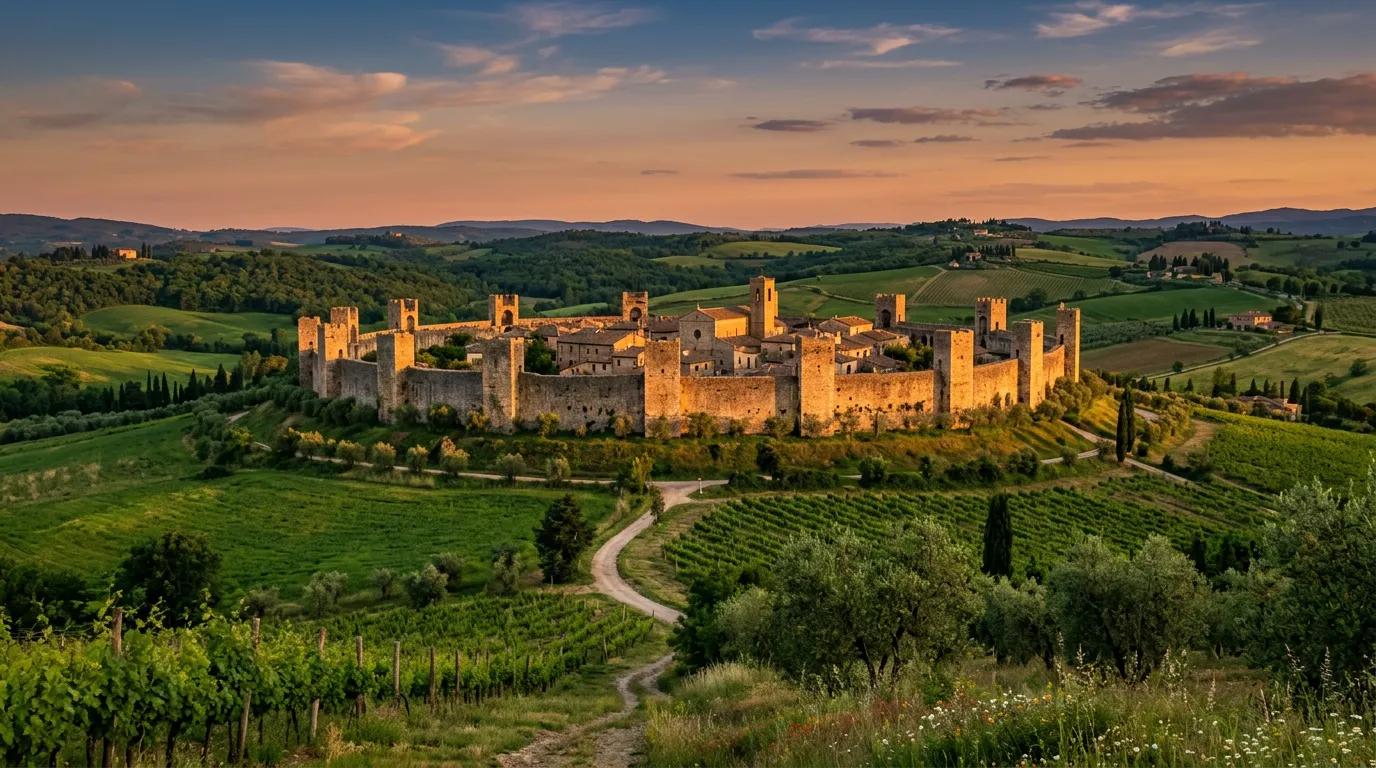
Monteriggioni: What to See in This Perfect Medieval Fortress
Monteriggioni: the answer might seem simple, because the castle is a place of modest dimensions, yet the experience of visiting it goes well beyond the few square metres of the village inside. What makes Monteriggioni extraordinary is the sensation of standing before something rare in the panorama of European medieval heritage: a castle intact, almost unchanged since it was built in the thirteenth century, that emerges from the open landscape of the Sienese countryside like an apparition.
The walls and towers: medieval defensive engineering
The main reason Monteriggioni sits at the top of every list of Sienese destinations is the perfection of its defensive walls. Built by the Sienese Republic between 1213 and 1219 as a strategic outpost against Florence, the walls form a near-circular ring of approximately 570 metres in perimeter, with 14 rectangular towers originally 20 metres high that project outward like the teeth of a crown.
The number 14 is not coincidental: it corresponds to the number of towers that Dante Alighieri cites in the Inferno (Canto XXXI), when he compares the giants of the thirty-first circle to Monteriggioni being “crowned with towers”. Dante’s citation made the castle immortal in medieval literature, transforming it into a symbol recognisable even to those who have never visited in person.
Today the walls are partly walkable: a walkway of about 220 metres is open to visitors, accessed from inside the village via a staircase. The view from the walkway is extraordinary: on one side you see the interior of the castle with its square and Romanesque church; on the other the landscape of the Sienese countryside opens out - wheat fields, cypresses, hills descending towards Siena.
The defensive system
The towers of Monteriggioni were originally even taller than what you see today: over the centuries they were lowered and modified, but the defensive structure remains intact. The walls are up to 2 metres thick at the base and have a main gateway with a round arch - the Porta Franca - opening towards the Via Cassia. A second smaller gate, the Porta di Sienese, opens on the opposite side.
Inside the village: the square and the Romanesque church
The interior of Monteriggioni castle is surprisingly intimate. A rectangular square, a few dozen dwellings and the church of Santa Maria Assunta: that is all. Yet there is no sense of disappointment, because the contrast between the imposing outer walls and the tiny village within creates a fascinating tension.
The church of Santa Maria Assunta is a sober example of Sienese Romanesque architecture, with a stone facade and a single-nave interior. The building preserves several medieval and Renaissance artworks, including a fourteenth-century panel painting. The simplicity of the interior contrasts pleasantly with the grandeur of the outer walls.
The square is the heart of life in the castle: a few shops, a wine bar, a restaurant and a local produce store. It is not a commercial place in the negative sense of the term: the scale of the village is so contained that the tourist presence has not yet altered the character of the place.
The Via Francigena and Monteriggioni
Monteriggioni’s identity as a historic stop on the Via Francigena is another dimension worth exploring. The ancient pilgrimage route from Canterbury to Rome passed directly beneath the castle walls, and medieval pilgrims found shelter and protection here. The structure of the castle, with its defensive plan and strategic position along the road, was also designed to guarantee safety to travellers.
Today the Via Francigena continues to pass through Monteriggioni. Walkers covering the stretch from Siena to San Gimignano pass beneath the walls, and many stop for a rest. The village also offers services for pilgrims, with information about the route and the opportunity to stamp the pilgrim’s credenziale.
The stretch of Via Francigena between Monteriggioni and Siena (about 15 km) is considered one of the most beautiful and best-preserved on the Italian route. It crosses hills of cypresses and olive groves, skirts medieval villages and country churches, and maintains its original unpaved surface for long stretches.
The Museum and the medieval events
Inside the castle there is a museum dedicated to the history of Monteriggioni and its walls. The displays are simple but effective, including reconstructions of medieval life, armour, weapons and historical documents relating to the castle and its story.
The highlight of the year in Monteriggioni is the medieval festival “Monteriggioni di Torri si Corona”, held every year on the first weekends of July. During the event the castle is transformed: the 14 guards on the towers, the medieval market in the square, the archery and crossbow tournaments, the historical dances and battle re-enactments take the village back 800 years. It is one of the most successful medieval events in Tuscany, capable of engaging adults and children equally.
How to visit Monteriggioni: practical tips
Monteriggioni is reached by car via the Via Cassia, about 15 km from Siena. Parking is available outside the walls and access to the village is free. The museum and the wall walkway require a paid entrance ticket.
The best time to visit, if you want to avoid the crowds, is early morning or late afternoon. In July, during the medieval festival, the castle is crowded and restaurant prices rise: a good opportunity for those who seek the atmosphere of re-enactment, less ideal for those who prefer tranquillity.
Monteriggioni is easily visited in half a day: two hours are sufficient for the walls, the museum, the church and a circuit of the square. It is ideal combined with a visit to Siena (20 minutes by car) or San Gimignano (30 minutes by car).
Where to stay
Homelink Sogno d’Oro is 20 minutes by car from Monteriggioni, in Barberino Val d’Elsa. The location allows you to visit the castle in half a day and dedicate the remaining time to the other villages of the Val d’Elsa. The property is also on the Via Francigena route, making it ideal for those who want to combine a visit to Monteriggioni with a stretch of the historic pilgrimage road that passes beneath its walls.
Related property: Homelink Sogno d’Oro Link: /sogno-doro/
Where to stay
Dove dormire: Homelink Sogno d'Oro - Val d'Elsa · tra Firenze e Siena
Controlla la disponibilità