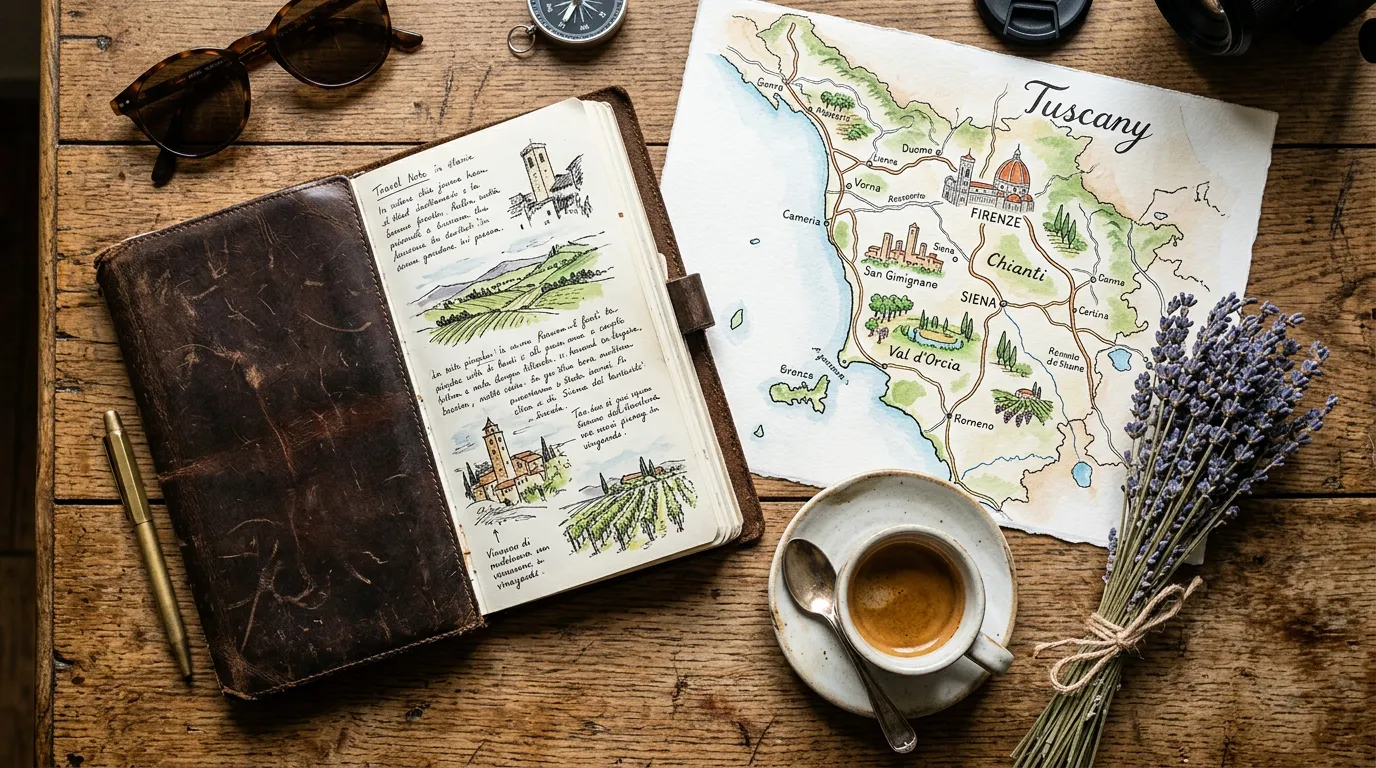
7 Days in Tuscany: The Complete Itinerary
A week in Tuscany is the minimum time needed to begin understanding the depth of this region. With a well-planned 7-day itinerary you can move between art cities and medieval villages, Chianti hills and Maremma beaches, Val d’Orcia vineyards and the towers of San Gimignano. Seven days are not enough to see everything, but they allow you to immerse yourself in authentic Tuscany without having to rush.
This itinerary is designed for travellers with a car - the most flexible option for exploring a region where the distances between its finest places are typically 30 to 60 minutes.
Days 1–2: Florence, the Capital of Art
Florence deserves at least two full days in a 7-day Tuscany itinerary. The city is not exhausted by the Uffizi and the Duomo: every alley in the historic centre hides a frescoed church, a Renaissance palace or an artisan market.
First day in Florence
Begin at the Cathedral of Santa Maria del Fiore and climb Brunelleschi’s dome for an unrivalled view over the city. Book tickets in advance for the Uffizi Gallery: the collection includes works by Botticelli, Caravaggio, Giotto, Leonardo da Vinci and Raphael. In the afternoon visit Palazzo Pitti and the Boboli Gardens, then head up to Piazzale Michelangelo for the sunset.
Second day in Florence
Spend the morning in the Santa Croce neighbourhood, with its Basilica where Michelangelo, Machiavelli and Galileo are buried. In the afternoon explore the San Lorenzo market and the Oltrarno quarter, home to craftsmen, restoration workshops and authentic restaurants. Visit the Brancacci Chapel with Masaccio’s frescoes.
Day 3: Pisa and Lucca
The third day of this 7-day Tuscany itinerary is dedicated to two cities often underestimated by hurried tourists. Pisa is not just the Leaning Tower: the Piazza dei Miracoli holds the Duomo, the Baptistery and the Camposanto Monumentale, an architectural complex of extraordinary beauty. Arrive early in the morning to photograph the square without crowds.
In the afternoon, Lucca is just 30 minutes away. The city is entirely enclosed by perfectly preserved Renaissance walls: hire a bicycle and ride the 4-kilometre circuit along the top of the walls for a unique experience. The centre contains piazze, medieval towers and the Cathedral of San Martino with the statue of Ilaria del Carretto.
Day 4: Siena and the Val d’Orcia
Siena is one of the best-preserved medieval cities in Europe. Piazza del Campo, with its shell-like shape, is the setting for the Palio, the horse race held twice a year. Visit the Palazzo Pubblico, the Torre del Mangia and the Duomo with its marble floor inlaid with 56 biblical scenes.
The Val d’Orcia in the afternoon
In the afternoon, head south towards the Val d’Orcia. This landscape of rolling hills with rows of cypress trees, dirt tracks and medieval villages was painted by the Sienese masters of the fourteenth century and is today a UNESCO World Heritage Site. Stop in Montalcino, home of Brunello, one of the world’s most celebrated red wines, and visit the medieval fortress. If you have time, pass through Pienza as well, the Renaissance city built by Pope Pius II.
Day 5: San Gimignano and the Chianti
San Gimignano, just 15 minutes from the Val d’Elsa, is the city of towers. In the Middle Ages noble families competed in height by building ever taller towers: of the original 72, 14 remain, still imposing. Visit the Museo Civico and taste the Vernaccia di San Gimignano DOCG, the first Italian wine to receive this denomination.
In the afternoon, drive along the Via Chiantigiana (SP222) through the Chianti Classico vineyards. Greve in Chianti, Panzano and Radda in Chianti are perfect villages for a stop, a tasting or lunch. The Gallo Nero wineries welcome visitors for guided tours and wine tastings in historic settings.
Day 6: Maremma and the Argentario Coast
The sixth day takes the itinerary towards the sea. The Maremma is the least-known part of Tuscany: a land of Mediterranean scrubland, lagoons, horseback cowboys and wild beaches. The Parco Regionale della Maremma, also known as the Parco dell’Uccellina, is one of the most unspoilt stretches of coastline in Italy.
The Argentario, a peninsula connected to the mainland by three sandbars, is an elegant destination with the harbours of Porto Santo Stefano and Porto Ercole. The Orbetello Lagoon, with its pink flamingos, is a natural spectacle not to be missed. For those who enjoy thermal baths, Saturnia is just 45 minutes away: the natural waterfall pools at Mulino are free and open all year round.
Day 7: Volterra and the journey home
The final day of the 7-day Tuscany itinerary is dedicated to Volterra, one of the most fascinating Etruscan cities in the region. It stands on a high cliff and dominates the Val di Cecina with its cyclopean Etruscan walls, the largest in Italy. The Guarnacci Etruscan Museum holds thousands of funerary urns and the Shadow of the Evening, a bronze Etruscan sculpture of strikingly modern appearance.
Volterra is famous for its alabaster craftsmanship: throughout the town there are artisan workshops where you can buy unique objects. Piazza dei Priori, one of the most intact medieval squares in Tuscany, is perfect for a final stroll before heading home.
Practical tips for a 7-day Tuscany itinerary
- Car: essential. Public transport in the countryside is sparse and infrequent.
- Museum bookings: above all in Florence. The Uffizi, Accademia and Palazzo Pitti need to be booked weeks in advance during high season.
- Accommodation: consider a central base for the countryside days (Val d’Elsa or Chianti) and at least one night in Florence if you want to experience the city in the evening.
- Budget: medieval villages and the countryside are far more affordable than Florence. A meal at a country trattoria costs half as much as in the Florentine centre.
- Best season: April–May and September–October for the best weather and fewer crowds.
Where to stay
Homelink Sogno d’Oro, in Barberino Val d’Elsa, is the perfect base for this 7-day Tuscany itinerary: it is 40 minutes from Florence, 30 from Siena, 15 from San Gimignano and 20 from the Chianti. A position equidistant from all the main places, allowing you to return each evening to the Tuscan hills without needing to change hotel every night.
Related property: Homelink Sogno d’Oro Link: /sogno-doro/
Where to stay
Dove dormire: Homelink The Key - Porta al Prato / Santa Maria Novella
Controlla la disponibilitàDove dormire: Homelink Sogno d'Oro - Val d'Elsa · tra Firenze e Siena
Controlla la disponibilitàDove dormire: Homelink Argentario · Tramonto Dorato - Maremma Toscana · Grosseto
Controlla la disponibilità