Saturnia Complete Guide: Everything You Need to Know
This complete guide to the Terme di Saturnia was written in the belief that these thermal springs deserve to be known in depth - not merely as a tourist attraction to tick off a list, but as an experience that can transform a holiday in the Maremma into something unforgettable. The Terme di Saturnia are one of the natural wonders of Tuscany: sulphurous water that springs uninterruptedly from the rock at 37.5 degrees, forming white travertine pools where you can bathe for free in one of the most beautiful landscapes in Italy.
Saturnia is a small village in the Grosseto Maremma, about 60 kilometres from Grosseto, in a rolling landscape of hills and valleys that changes colour with the seasons: deep green in spring, golden in summer, copper in autumn. The village is small and quiet, with a few hundred inhabitants and a history stretching back to ancient times.
The history of the Terme di Saturnia
The thermal spring at Saturnia has been known and used since antiquity. The Etruscans, who inhabited this part of southern Tuscany many centuries before the Roman conquest, were familiar with and made use of these waters. According to mythology, the spring was born from the lightning bolt of Saturn, the Roman god of time and agriculture, who hurled it to earth to calm a conflict among men.
The waters of Saturnia are cited in Roman documents from the first century BC. Virgil mentions them in the Aeneid as a sacred place. In the Middle Ages the spring was used by local villages for therapeutic bathing and for the maceration of wool, thanks to the properties of sulphur. The Mill to which the name “Cascate del Mulino” refers was a real water mill that exploited the constant flow of the spring: its remains are still visible beside the waterfalls.
The Cascate del Mulino: free access
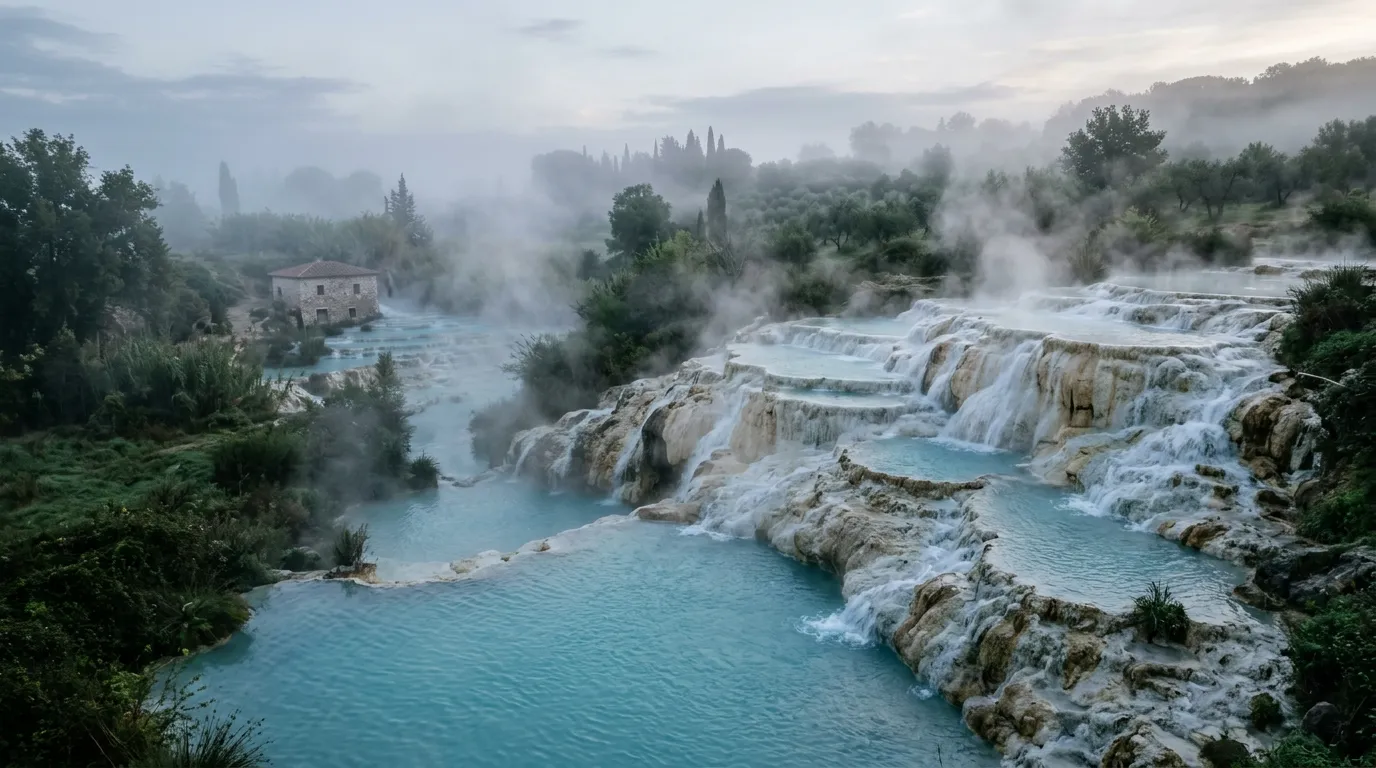
The Cascate del Mulino are the heart of the thermal experience at Saturnia. They consist of a series of natural pools formed over millennia by the deposit of calcium carbonate (travertine) dissolved in the thermal water. Each pool is a different size, with cascading edges that allow water to flow continuously from the upper pool to the lower one.
Water characteristics
The water springs from the main source at a constant temperature of 37.5 degrees Celsius, unchanged throughout all seasons. It is rich in hydrogen sulphide, which explains the characteristic egg smell noticeable nearby. Despite this, the water is transparent and perfectly clean. The recognised therapeutic properties include beneficial effects on the skin, blood circulation and contracted muscles. Many regular visitors report improvements in arthritic and rheumatic conditions.
How to use the pools
You immerse yourself in the pools freely, with no obligations or facilities. There are no instructors, guards or service staff in the free waterfall areas. You enter and leave the water whenever you wish. The unwritten etiquette requires you to respect others’ space, not to occupy entire pools with your group when other visitors are waiting, and not to leave litter.
The depth of the pools varies from just a few centimetres to about one metre in the main pools. The upper pools are hotter (close to the source), the lower ones slightly cooler due to the natural cooling effect of the flowing water.
The Terme di Saturnia Spa & Golf Resort
About one kilometre from the free waterfalls stands the official spa centre. It is an international luxury facility with indoor and outdoor thermal pools, aesthetic and therapeutic treatments, thermal mud baths, massages, sauna, hammam, a gourmet restaurant and a five-star hotel.
What it offers
The spa centre pools are heated with the same source water and maintained at different temperatures depending on the type of pool (from the cooler swimming pools to the hotter jacuzzi pools). The thermal mud treatments are particularly popular for their moisturising and rebalancing properties on the skin.
Prices and access
Daily admission to the spa centre typically ranges between 30 and 70 euros per person depending on the season and services included. Additional treatments are paid separately. It is advisable to book online in advance, especially during the summer months.
When to visit the Terme di Saturnia
The short answer is: any season, but with different preferences depending on what you are looking for.
Winter (November - March): The most evocative period. The cold and often misty air creates a wonderful contrast with the hot water: steam rises into the air and the colours of the white travertine emerge from the haze. The waterfalls are almost deserted on winter weekdays. This is the favourite season for locals and regulars.
Spring (April - May): The waterfalls are very beautiful with the green of the surrounding fields. Temperatures are mild, the water is wonderfully pleasant and the crowds have not yet arrived. Recommended especially for those who want to enjoy the springs in peace and quiet.
Summer (June - August): High season. The waterfalls fill up, especially at weekends and in August. The experience is still lovely, but requires arriving early in the morning to find a place in the best pools. The water at 37.5 degrees in August may seem warm, but the continuous current of fresh flowing water makes it bearable.
Autumn (September - October): Second best season, together with spring. External temperatures are mild, the water is perfect and the summer crowds have diminished. The autumn landscapes of the surrounding Maremma are of great beauty.
Practical tips: what to bring and how to behave
What to bring:
- Large towel (preferably two: one for the pools, one for afterwards)
- Water shoes or rubber-soled sandals (wet travertine is very slippery)
- Complete dry change of clothes
- Waterproof bag for valuables
- Moisturising cream (sulphurous water can dry out the skin)
- Plenty of drinking water
- Snacks or a packed lunch (nearby there is only a bar and a few stalls)
What not to bring:
- Precious jewellery (sulphur blackens metals, especially silver)
- Sun creams or cosmetic products in large quantities (they pollute the water)
- Glass or alcohol
Duration of the visit: Most visitors spend between 2 and 4 hours in the pools. Those who wish to alternate bathing in different pools or simply relax without rushing tend to stay longer.
What to see around Saturnia
The village of Saturnia, 2 km from the waterfalls, is worth a short stroll. The historic centre has a charming square, a small medieval church and a couple of bars for a coffee stop. Nearby you will find Manciano (15 minutes by car), Pitigliano (30 minutes) and Sorano (25 minutes). Combining the springs with a visit to the Etruscan tufa towns is one of the best activity combinations that the Maremma offers.
Where to stay
Tramonto Dorato in Montiano is about 45 minutes by car from the Terme di Saturnia. The location is ideal for organising day trips to the waterfalls, with an early morning departure to make the most of the quieter hours. On return, the panoramic porch overlooking Orbetello and the Argentario offers the perfect setting to close a day of relaxation in the thermal waters of the Maremma.
Related property: Homelink Argentario · Tramonto Dorato Link: /tramonto-dorato/
Where to stay
Dove dormire: Homelink Argentario · Tramonto Dorato - Maremma Toscana · Grosseto
Controlla la disponibilità