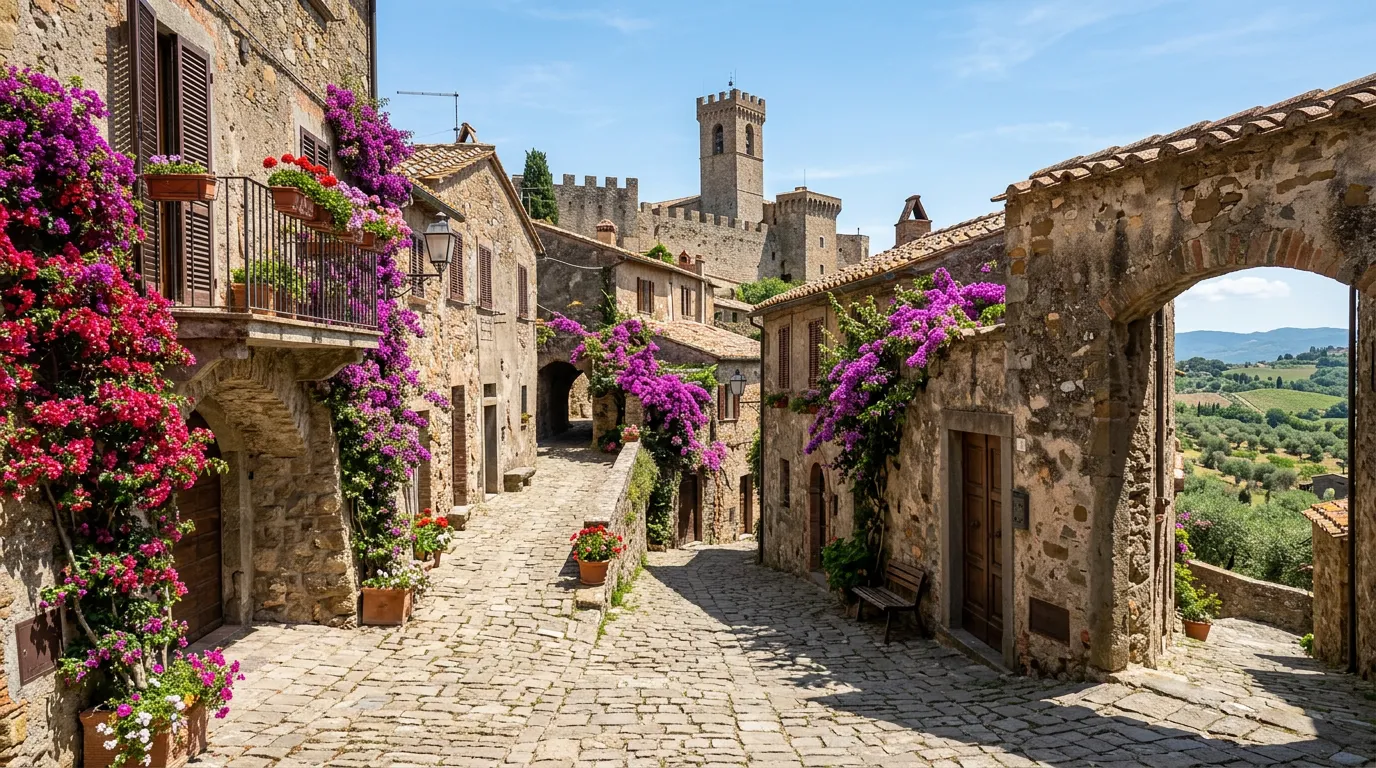
Capalbio: What to See in the Pearl of the Maremma
What to see in Capalbio is one of the most common questions among those visiting the Tuscan Maremma for the first time. This medieval village perched on a hill in the southernmost stretch of Tuscany is one of the best-preserved historic centres in the region. Surrounded by almost-intact fourteenth-century walls and overlooking a landscape of hills, Mediterranean scrub and sea, Capalbio offers far more than its size might suggest.
The village has long been frequented by Italian intellectuals, artists and politicians, earning over the years the nickname “the little Tuscany of the powerful.” Yet its authentic character and the discreet beauty of the landscape make it accessible and enjoyable for any type of traveller.
What to see in Capalbio: the historic centre
The historic centre of Capalbio is enclosed within medieval walls built in the fourteenth century. Entering through the Porta Senese, the main gate of the village, you find yourself in a labyrinth of cobbled alleys, stairways, arches and small squares where silence is almost absolute.
The Aldobrandeschi Tower
The Aldobrandeschi Tower is the symbol of the village. Tall and massive, it dominates the town’s profile from every perspective. It was built by the Aldobrandeschi family, who for a long time ruled much of the Maremma, as a defensive element and symbol of power. Today the tower can be visited during certain periods of the year and offers an extraordinary panoramic view over the hills, the sea and, on clear days, the island of Giglio.
The Collegiate Church of San Nicola
At the centre of the village stands the Collegiate Church of San Nicola, a Romanesque church with fifteenth-century frescoes attributed to the school of Pinturicchio. The interior is sober and evocative, with decorated vaults that tell sacred scenes in colours still vivid despite the centuries. Entry is free and it is absolutely worth the time.
The walls and the walkway
Capalbio’s medieval walls are among the most integrated in the entire Maremma. A walkway allows you to walk along part of them and enjoy the panorama over the surrounding countryside. The contrast between the ancient stones and the green of the cultivated fields, with the sea in the background, creates one of the most beautiful images in the entire area.
The Tarot Garden
About 8 kilometres from Capalbio, in the direction of Pescia Romana, is the Tarot Garden: one of the most original contemporary art parks in Europe. The Franco-American artist Niki de Saint Phalle began its construction in 1979 and worked on it for almost twenty years, creating 22 giant sculptures inspired by the Tarot cards. The figures, covered in coloured ceramics and mirrors, emerge from the Mediterranean scrub like fantastic apparitions.
The garden is open from April to October and is easily reached by car. It is not suitable for those with mobility difficulties, as the paths between the sculptures are uneven. The visit lasts about an hour and a half and leaves a lasting impression on both adults and children.
The beaches of Capalbio
The Capalbio coastline is one of the least built-up coastal stretches in Tuscany. The beaches are mostly free, sometimes wild, surrounded by Mediterranean scrub that reaches almost to the water.
Capalbio Spiaggia and the pine forest
The main beach of Capalbio is reached by driving about 7 kilometres from the hilltop village down to the sea. A shaded pine forest runs alongside the shoreline, offering coolness even on the hottest days. The beach is wide, sandy and with shallow waters, suitable for families with children. In the summer season there are a few beach establishments, but most of the coastline remains free.
The Lago Albano nature reserve
Just north of Capalbio beach lies the Lago Albano nature reserve, a protected area where Mediterranean scrub and pine forest alternate in an environment of great natural value. The beach in the reserve is accessible on foot or by bike and offers crystal-clear sea in a context of total tranquillity.
Capalbio Scalo and the Feniglia
Capalbio Scalo is the modern seafront hamlet, with supermarkets, bars and restaurants. From here you can easily access the Feniglia beach, one of the most beautiful and famous in the Tuscan Maremma: a tongue of very fine sand, up to 200 metres wide, which separates the Orbetello lagoon from the open sea. The Feniglia is a nature reserve: cars are prohibited and the beach is reached on foot or by bicycle through a pine forest that smells intensely of resin. The water quality is excellent.
Practical tips for visiting Capalbio
When to go: Spring and autumn are the best periods for the historic centre. In summer the village is busier, but the beaches compensate with warm water. Winter is ideal for those seeking silence and authenticity.
How to get there: By car, Capalbio is on the Aurelia (SS1), exiting at Capalbio Scalo. The historic centre is 7 km from the coast. Parking outside the walls is free.
Where to eat: The village hosts several trattorias offering traditional Maremma cuisine. Wild boar, pici with hare sauce and grilled meat are the most characteristic dishes. In summer it is advisable to book in advance.
What to buy: The shops in the centre sell local products: extra virgin olive oil, wine, honey and cured meats. The weekly market at Capalbio Scalo is an excellent place to stock up on fresh produce.
Where to stay
Tramonto Dorato is located in Montiano, just 20 minutes by car from Capalbio. The location makes it easy to reach the medieval village and its beaches, either for a morning or a full day. In the evening you return to the silence of the Maremma hills, with the view over the Orbetello lagoon from the panoramic portico.
Related property: Homelink Argentario · Tramonto Dorato Link: /tramonto-dorato/
Where to stay
Dove dormire: Homelink Argentario · Tramonto Dorato - Maremma Toscana · Grosseto
Controlla la disponibilità