Volterra What to See: Complete Travel Guide
Volterra: A Complete Guide to the Etruscan City
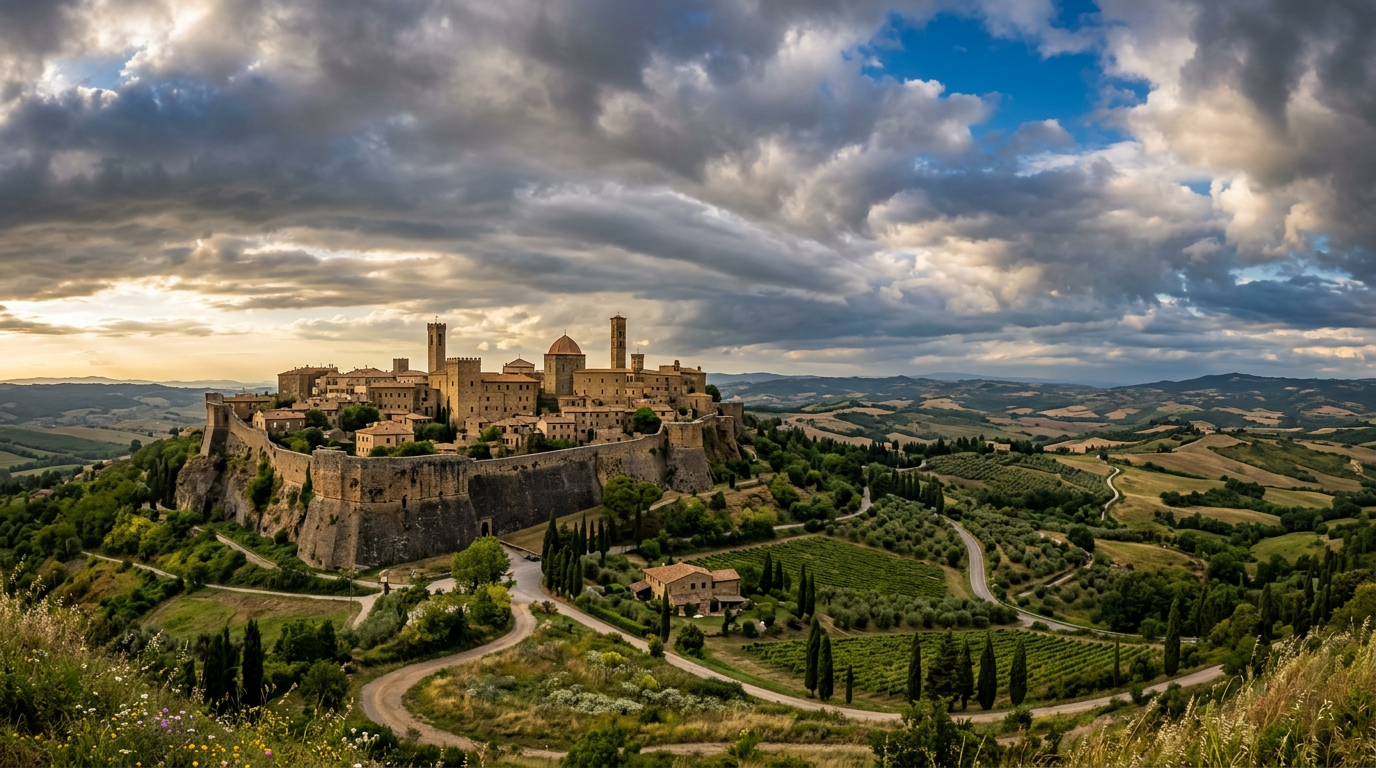
Volterra stands on a high plateau about 550 metres above sea level, surrounded by deeply eroded clay hills known as the balze. It is one of the best-preserved medieval hilltop towns in Tuscany and, before that, one of the most important cities of the Etruscan civilisation.
The combination of Etruscan archaeology, medieval architecture, and living alabaster craftsmanship makes Volterra one of the most rewarding day trips from Florence.
Volterra: the Etruscan city
The Etruscans called the city Velathri. It was one of the twelve cities of the Etruscan League, a loose confederation that controlled much of central Italy between the 8th and 3rd centuries BC. At its height, the Etruscan city covered a much larger area than the current hilltop town, extending down the slopes in directions that are now fields and erosion terrain.
The city walls built by the Etruscans still define the perimeter of the historic centre. The Porta all’Arco, the arched gateway on the south side of the town, was built in the 4th or 3rd century BC. The basalt arch stones are original Etruscan construction, although the walls flanking them were rebuilt in Roman and medieval periods. The arch is one of the finest surviving examples of Etruscan architecture anywhere in Italy.
The Etruscan burial grounds, the necropolis, are located outside the walls on the slopes below the plateau. Several hundred cinerary urns from these burials are displayed in the Museo Etrusco Guarnacci, which is the most important Etruscan museum in the region outside the national collections in Rome.
The medieval historic centre
Volterra’s medieval centre is compact and well-preserved. The main piazza, Piazza dei Priori, is one of the finest medieval squares in Tuscany. It is surrounded on three sides by 13th and 14th-century buildings: the Palazzo dei Priori, the Palazzo Pretorio with its distinctive tower, and the Cathedral.
The Palazzo dei Priori was built between 1208 and 1254, making it one of the oldest communal palaces in Tuscany. It is still used as the town hall. The ground floor is accessible to visitors. The frescoed council chamber on the upper floor is open for guided visits.
The Cathedral of Santa Maria Assunta was built in the 12th century and modified in the 13th. The interior contains several important works, including a Deposition group by Zaccaria di Jacopo from around 1228, one of the earliest examples of polychrome sculpture in Tuscany.
The Pinacoteca e Museo Civico in Palazzo Minucci-Solaini contains a Rosso Fiorentino painting, the Deposition of Christ from 1521, which is considered one of the masterpieces of Florentine Mannerism. The composition is tense and emotionally charged. Entry costs 8 euros.
The Roman theatre, dating from the 1st century BC, stands just below the walls on the north side of the town. It was excavated in the 1950s and is in good condition. The stage building and several rows of seating are intact. It can be viewed from above from a public path along the wall, or entered directly. Entry costs 5 euros.
Museums and alabaster
The Museo Etrusco Guarnacci is the principal reason to visit Volterra for anyone interested in Etruscan civilisation. The museum contains over 600 cinerary urns, mostly from the 3rd and 2nd centuries BC, representing an almost unique concentration of Hellenistic-period Etruscan funerary art.
The urns are carved in alabaster, terracotta, or tufa stone. They typically show a reclining figure on the lid and a narrative scene on the front panel. The scenes depict myths, journeys to the underworld, and symbolic subjects drawn from both Etruscan and Greek traditions.
The most famous object in the collection is the “Ombra della Sera” (Evening Shadow), a slender bronze figurine of extraordinary modernity. The elongated form, dating from the 3rd or 2nd century BC, looks to modern eyes like a work of early 20th-century sculpture. Entry to the museum costs 8 euros.
The Ecomuseo dell’Alabastro, the alabaster ecomuseum, traces the history of Volterra’s alabaster industry from antiquity to the present. Entry costs 5 euros. The museum is housed in the former Baldinucci palace and includes historic workshops, tools, and a comprehensive collection of alabaster objects from different periods.
Living alabaster workshops are open to visitors throughout the town. The Cooperativa Artieri Alabastro on Piazza dei Priori has been operating for decades. You can watch craftspeople at work and buy directly at production prices. Prices range from a few euros for small objects to several hundred for larger sculptural pieces.
How to get there from Florence
Volterra is approximately 80 kilometres southwest of Florence. There is no direct train service. The journey by public transport requires a combination of train and bus.
From Florence Santa Maria Novella, take the regional train toward Pisa or Livorno. Change at Saline di Volterra or at Cecina depending on the service. From either of these stations, a bus run by CTT Nord connects to Volterra in about an hour. Total journey time is approximately 2.5 to 3 hours.
The most practical option for a day trip is to travel by car. The drive from Florence to Volterra takes about 75 to 90 minutes depending on traffic and the route. Take the A1 south toward Siena, exit at Colle Val d’Elsa, and follow the provincial roads west to Volterra.
Alternatively, join an organised day tour from Florence. Several tour operators run day trips that include Volterra and San Gimignano in a single itinerary. These tours typically depart at 8 am and return by 7 pm.
Parking in Volterra is available in the car parks immediately outside the historic walls. Do not attempt to drive into the historic centre. The streets are too narrow for most vehicles and access is restricted.
Where to eat in Volterra
Osteria dei Poeti on Via Matteotti is a classic Volterran restaurant serving traditional dishes: pappardelle with wild boar ragu, roast pigeon, and the local pasta called “acquacotta” (cooked water), a simple peasant soup elevated by the quality of the local olive oil and vegetables.
La Vecchia Lira on Via Matteotti is a cheaper option in the same street. It functions as a cafeteria at lunch with daily changing dishes. A full meal costs around 12-15 euros. Quality is reliable.
Trattoria del Sacco Fiorentino on Piazza XX Settembre is named after the Sack of Florence, a local memory that tells you something about the civic pride of Volterra. The kitchen produces good Tuscan standards at mid-range prices.
For a quick lunch before leaving, the bakeries and alimentari in the streets around Piazza dei Priori sell panini and local products. The Volterran salami and the pecorino di Volterra are particularly good.
Where to stay
De’ Medici is a guesthouse in Oltrarno, Florence, ideal as a base for a day trip to Volterra. You can leave Florence in the morning and return in the evening to the neighbourhood’s restaurants and bars.