Volterra Alabaster Crafts: A Complete Guide
Volterra Alabaster: History, Craft, and What to Buy
Volterra has been working alabaster for at least 2,500 years. The Etruscans carved the stone into cinerary urns. The Romans made decorative objects. Medieval craftsmen used it for religious sculpture. Today, the tradition continues in about thirty active workshops in and around the town.
Alabaster from Volterra is a translucent, cream-coloured stone that allows light to pass through its surface. This optical quality, combined with the relative softness of the material, makes it ideal for sculpture and decorative objects.
Volterra alabaster
Alabaster is a form of gypsum, chemically calcium sulphate. The variety quarried around Volterra is known as “alabastro diafano” (translucent alabaster) and is valued above other varieties for its near-transparency and even colour.
The deposits around Volterra have been quarried for millennia. The most productive quarries are in the hills south and east of the town, at locations including Iano and the Balze area. The stone occurs in layers within the clay sediments and must be extracted carefully to avoid fractures.
The quarrying is now done by a small number of specialist firms. The quantity extracted each year is much smaller than in the 19th and early 20th centuries, when the Volterran alabaster industry employed thousands of people and exported products worldwide.
At the height of the industry in the late 19th century, Volterra was producing decorative objects that were sold in Paris, London, New York, and Buenos Aires. The elaborate vases, columns, and decorative panels of the period reflect the aesthetic of Victorian and Edwardian interiors.
The history of a thousand-year-old craft
The earliest Volterran alabaster objects are the cinerary urns of the Etruscan period, dating from roughly the 4th to the 1st century BC. Over 600 of these urns survive in the Museo Etrusco Guarnacci. The carving technique visible on these objects is sophisticated: the narrative relief panels on the fronts of the urns show a mastery of the material that implies a long prior tradition.
In the Roman period, Volterra continued to produce alabaster objects but on a smaller scale, partly because Roman tastes favoured marble and bronze. The industry contracted and revived several times during the medieval and early modern periods, depending on demand.
The modern industry takes its form from the 18th century, when Grand Ducal patronage and growing export markets created a sustained demand for Volterran work. The Grand Dukes of Tuscany encouraged the craft by purchasing objects for their collections and by granting privileges to Volterran craftsmen.
In 1895, the Cooperativa Artieri Alabastro was founded. This cooperative, which still operates today on Piazza dei Priori, allowed small workshops to pool resources for marketing and export while maintaining independent production.
Still-active workshops
The Cooperativa Artieri Alabastro on Piazza dei Priori is the most accessible entry point for visitors. The cooperative’s shop displays work from member craftspeople across the full range of styles and price points. Watching the demonstration of working techniques, offered at certain times during the day, is worth the brief time it takes.
Bottega d’Arte Brizzi on Via dei Sarti is a family workshop that has been making traditional Volterran alabaster objects for three generations. The workshop is open to visitors. The range includes small decorative objects, lamps, and custom work. Prices are competitive.
Alab’Arte on Via Orti San Agostino combines traditional and contemporary design in its alabaster work. The workshop produces a range of objects from the traditional egg and bowl shapes to more experimental pieces. It also runs workshops where visitors can try working the stone under supervision. Workshops cost approximately 30 euros per person for a two-hour session.
Lombardi Alabastri on Via Porta Marcoli represents the higher end of the market. The workshop specialises in custom commissions and large decorative pieces. The quality of the carving is exceptional.
How alabaster is worked
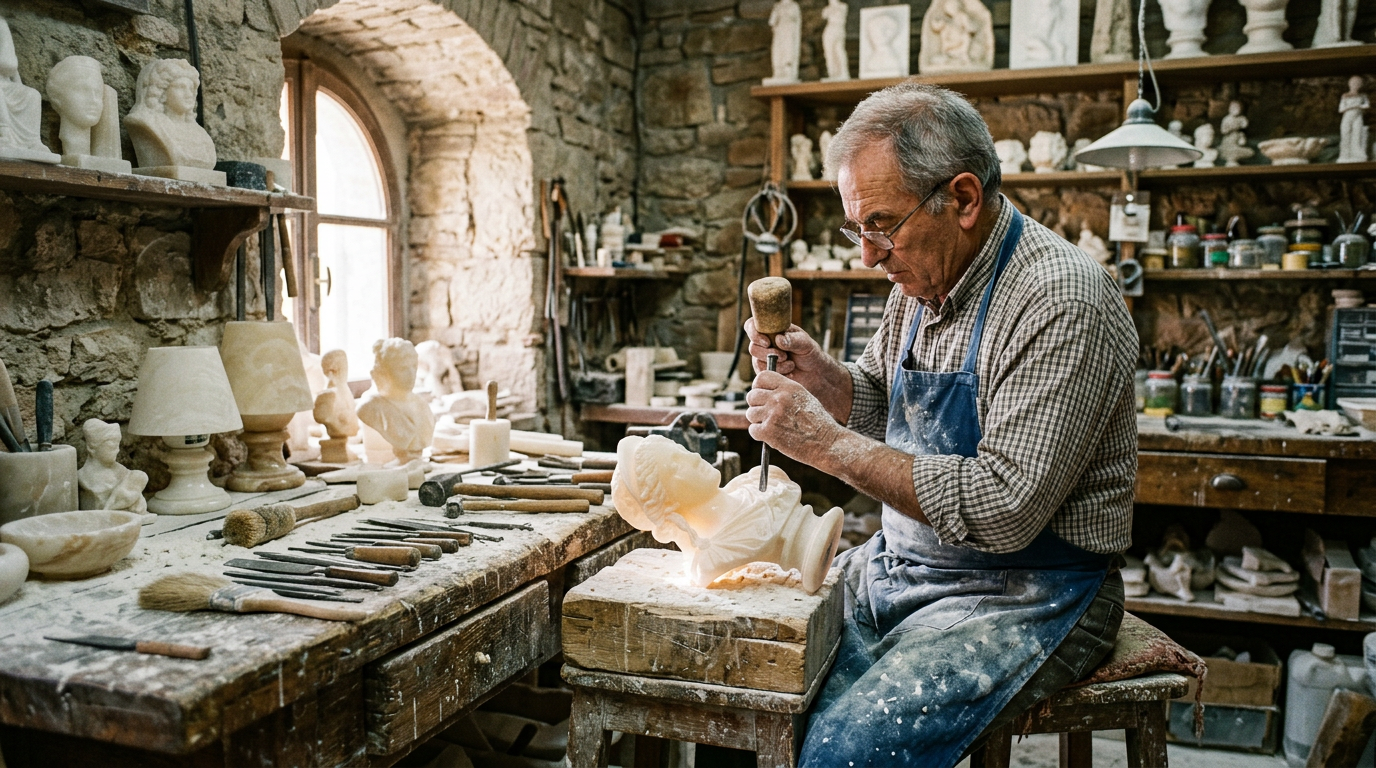
Raw alabaster arrives at the workshop in blocks or rough-cut slabs. The first step is to assess the block for internal fractures, which would cause the stone to split during carving. This is done by holding the block up to a strong light source. Fractures appear as dark lines within the translucent material.
Sound blocks are cut to approximate size using diamond-blade saws. The rough form is then shaped using grinding discs and hand tools. The final surface is worked with progressively finer abrasives, finishing with very fine wet-and-dry paper.
The polishing stage is crucial. Alabaster takes a high natural polish without requiring wax or varnish. The final surface is produced by buffing with progressively finer compounds until the stone develops its characteristic translucent sheen.
Carving for relief work and figurative pieces requires sharp chisels and considerable skill. The softness of alabaster compared to marble makes it easier to carve but also more prone to scratching and surface damage during the process.
Colour can be introduced through staining with pigments or through the application of patinas. The traditional “nero antico” finish uses a black stain to simulate ancient stone. Some workshops also produce onyx-style effects by staining with brown and amber tones.
What to buy and at what prices
Small alabaster objects are the most practical purchases for visitors: eggs, paperweights, small bowls, and decorative spheres. These are easy to transport and represent the craft in its simplest form. Prices start at around 5-8 euros for the smallest objects.
Lamps made from alabaster are the traditional Volterra souvenir. A simple desk lamp with an alabaster shade, carved thin enough to allow light to pass through, costs between 30 and 80 euros depending on size and quality of carving. A good lamp from a cooperative workshop will last indefinitely.
Carved figural objects and vases range from about 30 euros for small pieces to several hundred for larger works or custom commissions.
When buying, ask the seller whether the piece was produced in Volterra. A significant amount of alabaster sold in tourist shops in Tuscany is produced in China or elsewhere and imported. The difference in quality is visible to the practised eye: local alabaster has a distinctive warmth and transparency that machine-produced imports lack.
A certificate of authenticity, available from the Cooperativa Artieri and some independent workshops, confirms that the piece was produced locally.
Where to stay
De’ Medici is a guesthouse in Oltrarno Florence, the ideal base for a day trip to Volterra. The two-hour drive gives you a full day to explore the workshops, museums, and medieval streets before returning to Florence in the evening.