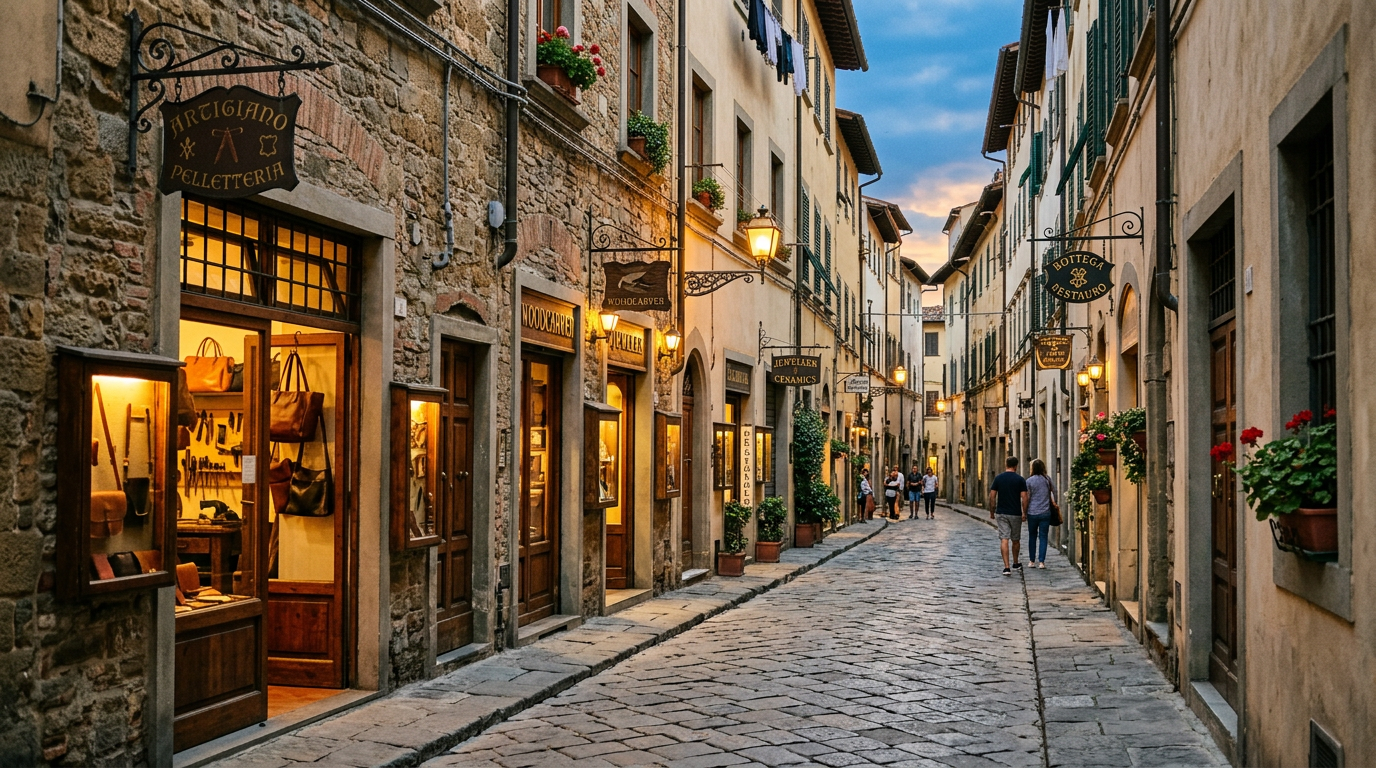
Oltrarno Florence neighbourhood guide
Oltrarno: history and character
Oltrarno is the oldest continuously inhabited neighbourhood on the south bank of the Arno. Its name is simple and direct: it means the part of the city that lies beyond the river. Florence grew outward from the north bank, and for centuries the south side was considered a separate town, slightly apart from the main civic life.
The Romans built their city north of the Arno. The south bank developed more slowly and was enclosed within the city walls only in the 13th century. By that point, it already had its own character: artisan guilds, working-class families, and fewer of the grand civic institutions that defined the north bank.
The Medici changed things significantly. When Cosimo I moved his court to Palazzo Pitti in 1560, the south bank gained prestige. The Uffizi and the Palazzo Vecchio remained on the north side, but Oltrarno became the residence of the ruling family and attracted merchants and nobles who wanted to live nearby.
That double identity, part working-class quarter, part noble enclave, shaped the neighbourhood for the next five centuries. It survives today in the mix you see on the streets: gilded antique shops next to mechanics, high-end restaurants a few doors from basic lunch counters.
The boundaries of the neighbourhood
Oltrarno is bounded to the north by the Arno. To the east, the boundary runs roughly along Via dei Renai and the area around Piazza Poggi. To the west, it ends around Porta San Frediano, one of the surviving medieval city gates on Via Pisana.
The southern boundary is the hill. The land rises quickly once you move away from the flat strip along the river. Streets like Costa San Giorgio and Via de’ Bardi climb steeply. Above the neighbourhood sit the gardens of Forte Belvedere and the residential area of Poggio Imperiale.
Within those boundaries, the neighbourhood is divided informally into distinct sub-areas. The zone immediately south of Ponte Vecchio, around Via de’ Bardi and Borgo San Jacopo, is the most tourist-heavy part. The area around Piazza Santo Spirito is more mixed. The western end, around Piazza del Carmine and beyond Porta San Frediano, is the most residential.
The total area of the historic Oltrarno is about 1.5 square kilometres. The resident population in the historic core is around 7,000 people, though that number has been declining steadily as short-term rentals replace long-term housing. The tension between residents and tourism is real and ongoing.
What made Oltrarno different
The neighbourhood’s artisan identity is not a marketing invention. Guilds of leather workers, goldsmiths, wood carvers, and textile traders were established here in the medieval period. The proximity to the Medici court created a permanent market for skilled craft work.
After the court dissolved, the workshops remained. Through the 19th and 20th centuries, Oltrarno continued to function as a craft production district. Furniture restorers, bookbinders, picture framers, and tailors worked in ground-floor spaces on streets that today still look much as they did in 1900.
The neighbourhood also had a strong tradition of intellectual and artistic life. The Cafe Ricchi on Piazza Santo Spirito was a meeting point for writers and artists in the mid-20th century. Several important Florentine painters and sculptors lived and worked in Oltrarno throughout the Renaissance and into the modern period.
Working-class culture shaped the neighbourhood’s food as well. The cheap cuts, the bean soups, the offal dishes that define Florentine cooking all have their roots in the south bank. Places like the historic trippaio, the wine-shop selling by the glass, and the no-menu trattoria were all Oltrarno inventions that spread to the rest of the city.
The main squares
Piazza Santo Spirito is the neighbourhood’s living room. The square is rectangular, shaded by trees on the north side, and anchored by the facade of the Basilica di Santo Spirito. The church itself was designed by Brunelleschi in the 15th century. It is less visited than the Duomo but architecturally more refined in its proportions.
The market operates Monday through Saturday from around 7:30 to 13:30. You will find vegetables, fruit, bread, cheese, and a few stalls selling clothing and household goods. Coffee at the bars on the square costs 1.20 euros. In the evening the square changes character entirely and becomes a social meeting point.
Piazza del Carmine anchors the western end of Oltrarno. The Brancacci Chapel inside the church of Santa Maria del Carmine contains frescoes by Masaccio and Masolino dating from the 1420s. These are considered among the most important works of early Renaissance painting. Entry costs 8 euros. Booking in advance is recommended.
Piazza della Passera is the smallest of the neighbourhood’s squares but among the most pleasant to sit in. There are no major monuments here. The square exists as a junction point between residential streets. Two or three small bars and a restaurant occupy the surrounding buildings. It is the kind of place that does not appear in most guidebooks.
Oltrarno today: between tourism and authenticity
Oltrarno has changed significantly over the past fifteen years. The number of short-term rental apartments has increased sharply. Several long-standing artisan workshops have closed as rents rose and the founding generation aged. The neighbourhood is not what it was in 2005.
At the same time, much remains. The market at Santo Spirito still functions. Several dozen workshops continue to operate. A new generation of food and wine businesses has opened in the past decade, many of them focused on quality rather than volume.
The key to experiencing Oltrarno well is timing and intention. Come in the morning. Shop at the market. Eat lunch at a place with no English menu. Walk streets that are not on the main tourist routes. The neighbourhood rewards this approach.
The western section of Oltrarno, beyond Via dei Serragli, is the least visited part. It has fewer tourist businesses and more daily life. The streets around Borgo San Frediano are particularly worth exploring. You will find a good mix of small food shops, wine bars, and the kind of hardware store that sells door hinges next to olive oil.
If you visit in spring or autumn, the neighbourhood is at its best. Summer brings crowds, even to Oltrarno. Winter is quieter but many restaurants reduce their hours. March and November are perhaps the ideal months to understand what the neighbourhood actually is.
Where to stay
De’ Medici is a guesthouse located in Oltrarno, close to the neighbourhood’s main squares and within walking distance of every workshop, market, and trattoria mentioned in this guide.
Staying in Oltrarno rather than the north bank changes the quality of your visit. You wake up inside the neighbourhood, not outside it.