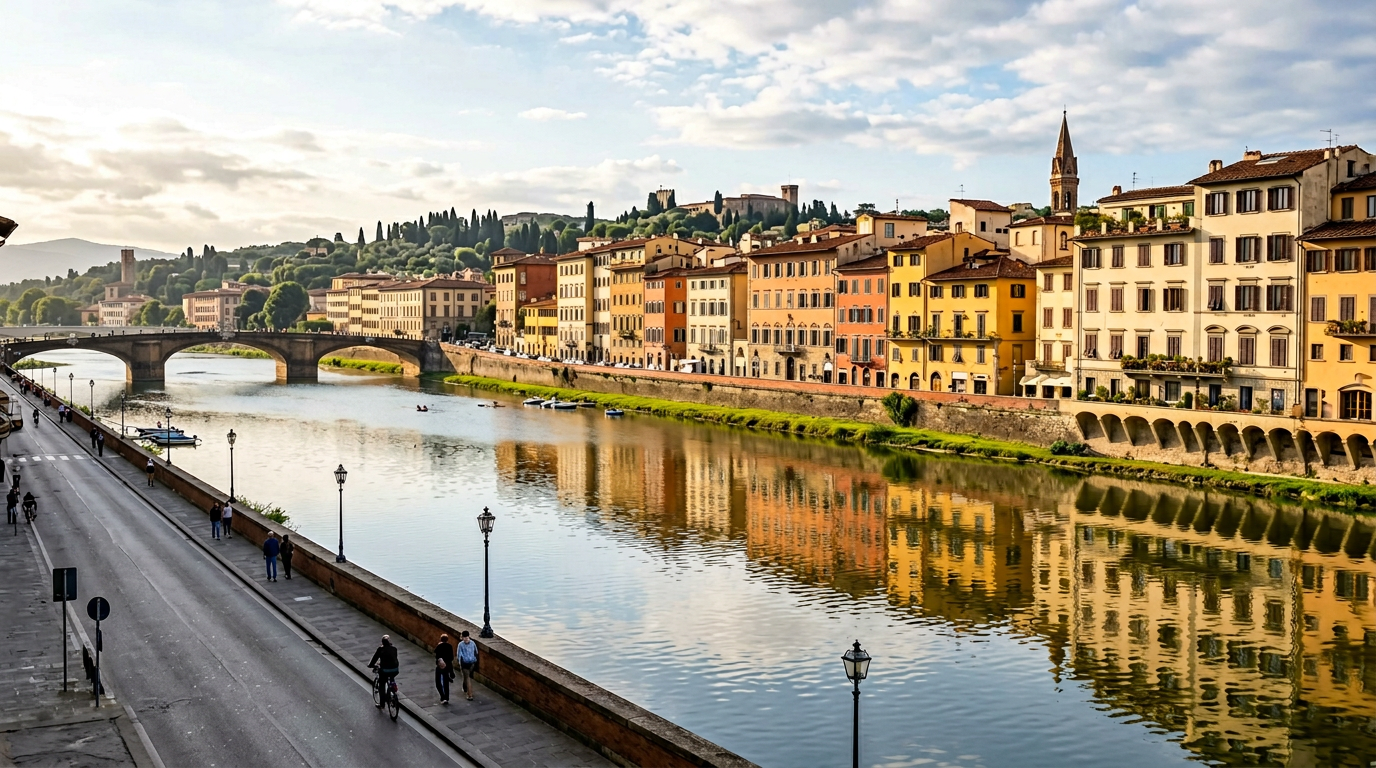
Oltrarno Florence: what to see
Oltrarno as it really is
Oltrarno means “beyond the Arno.” Cross one of the bridges heading south and the city changes almost immediately. The streets narrow, the noise drops, and the people you see are mostly residents going about their day.
This is not a museum district. It is a living neighbourhood with morning markets, workshops open since the 1950s, and trattorias where the menu has not changed in decades. That consistency is exactly what makes it worth your time.
Most visitors spend one afternoon on the south bank. They visit Palazzo Pitti and head back across the river. If you slow down and stay for a few days, you start to understand what Florence looked like before mass tourism reshaped the historic centre.
Oltrarno covers roughly 1.5 square kilometres. You can walk from one end to the other in about 20 minutes. The density of things worth seeing, eating, and buying within that space is unusually high.
Palaces and squares in the neighbourhood
Palazzo Pitti is the obvious starting point. Built in the 15th century for banker Luca Pitti, it passed to the Medici in 1549. Today it houses several museums, including the Palatine Gallery, the Royal Apartments, and the Gallery of Modern Art. A combined ticket costs around 16 euros. Arrive before 9:30 to avoid the main queues.
Behind the palace, the Boboli Gardens stretch up the hillside toward Forte Belvedere. The gardens cover 4.5 hectares and were first opened to the public in 1766. Entry costs about 10 euros. On a weekday morning, you can walk for an hour without feeling crowded.
Piazza Santo Spirito is the neighbourhood’s main square. It does not look like a postcard. There is a produce market most weekday mornings. Neighbourhood cafes open at 7:00. In the evenings, people bring bottles of wine and sit on the steps of the church. It is about 600 metres from Ponte Vecchio on foot.
Piazza della Passera is smaller and much less known. It sits at the intersection of several narrow residential streets. A few tables appear outside in warmer months. People pass through it on their way to buy bread or coffee. It takes about 10 minutes to walk there from Ponte Vecchio.
Streets to walk on foot
Via Maggio is one of the most atmospheric streets in Oltrarno. It runs roughly parallel to the Arno, starting at Ponte Santa Trinita. Antique dealers and art galleries occupy most of the ground-floor spaces. You can browse freely without pressure. The quality of goods varies, but the density of genuine antique trade is real.
Via dei Serragli runs south from the Arno. It is a residential street with a mix of small food shops, a hardware store, two or three tabacchi, and several trattorias where locals actually eat lunch. Walk it slowly. You learn more from this street than from most museums.
Via dello Sprone and Via Toscanella are shorter but worth connecting. They sit in the middle of the artisan quarter. Leather workers, bookbinders, and furniture restorers work in ground-floor workshops here. Many leave their doors open during working hours. That is an informal invitation to look inside.
Costa San Giorgio climbs steeply from the neighbourhood toward Forte Belvedere. The walk covers about 1.2 kilometres. The view from the fort over the city is among the best you will find in Florence. Entry is free when exhibitions are running. Check the city council website before you go.
Borgo San Jacopo follows the Arno along the south bank. It is one of the oldest streets in Oltrarno. Several historic towers survive here, remnants of the medieval city. The street connects Ponte Vecchio to Ponte alla Carraia and takes about 7 minutes to walk end to end.
Artisans and workshops
Oltrarno has been Florence’s artisan quarter for centuries. Many workshops here have been operating continuously since the 1940s and 1950s. Some businesses have remained in the same family across three or four generations.
You will find leather craftspeople, picture framers who apply gold leaf by hand, furniture restorers who work on pieces destined for major museums, and bookbinders who produce notebooks covered in traditional Florentine marbled paper. These are working businesses, not tourist attractions. Most of them sell directly from the workshop.
If you want to visit a workshop, walk along Via Maggio, Borgo San Jacopo, or the small streets east of Piazza Santo Spirito. Look for doors with sawdust on the step, paint-stained walls, or the smell of linseed oil. Those are reliable signs you have found the real thing.
Some workshops now offer short guided visits or demonstrations. Prices range between 15 and 40 euros per person depending on the craft and the duration. Ask at your accommodation for current contacts and availability.
The artisan tradition here is not a recreation for visitors. These people earn their income making things by hand. If you visit, treat the space with respect. Buy something if you can afford it. The survival of these workshops depends in part on people choosing to spend money there.
How to find your way around
Oltrarno is compact enough to navigate without a phone app once you have oriented yourself. From Ponte Vecchio to Piazza Santo Spirito is an 8-minute walk. From Santo Spirito to the Boboli entrance takes about 6 minutes. From Santo Spirito to Piazza della Passera is about 4 minutes.
Use the dome of Santo Spirito church as your reference point. It is visible from most of the neighbourhood and sits almost at the geographical centre of the artisan district.
The busiest tourist hours are between 10:00 and 15:00. If you want to experience the neighbourhood without crowds, walk before 9:00 or after 19:00. Early mornings in Oltrarno are a different experience. The market at Santo Spirito sets up around 7:30. Coffee bars fill with regulars.
Public buses from the city centre cross at Ponte alla Carraia and Ponte San Nicolo. Line C3 serves Via dei Serragli. Line D runs along the south bank of the Arno. Single tickets cost 1.70 euros and are valid for 90 minutes. Buy them at tabacchi before boarding.
If you are arriving by car, use the parking area on Via Romana near the Boboli entrance. It costs around 2 euros per hour. Parking within the neighbourhood itself is restricted. Most visitors do better to park outside the historic centre and walk or use public transport.
The Arno bridges each have a slightly different character. Ponte Vecchio is the most famous and the most crowded. Ponte Santa Trinita is more elegant and often quieter. Ponte alla Carraia is the most local of the three main central bridges. Cross different ones on different days.
Where to stay
De’ Medici is a guesthouse in the heart of Oltrarno. You sleep in the neighbourhood itself, not outside it. The morning market, the artisan workshops, and the best trattorias are within a few minutes on foot.
Staying here means you experience the neighbourhood at its real pace: early mornings, quiet evenings, and the weekday rhythms that visitors on day trips never see.