Lampredotto Florence: history of a working-class food
Lampredotto: history of a working-class food
Florence has a long tradition of eating the parts of the animal that wealthier tables ignored. Tripe, liver, kidneys, and intestines have been part of the city’s food culture for centuries. Lampredotto is the most distinctive of all these preparations and arguably the most Florentine.
The dish traces its origins to the medieval period, when butchers sold offal cheaply to workers who could not afford the prime cuts. The south bank, Oltrarno, was the centre of this working-class food culture. The people who built the palaces and worked in the workshops ate from street stalls because they had neither time nor money for a sit-down meal.
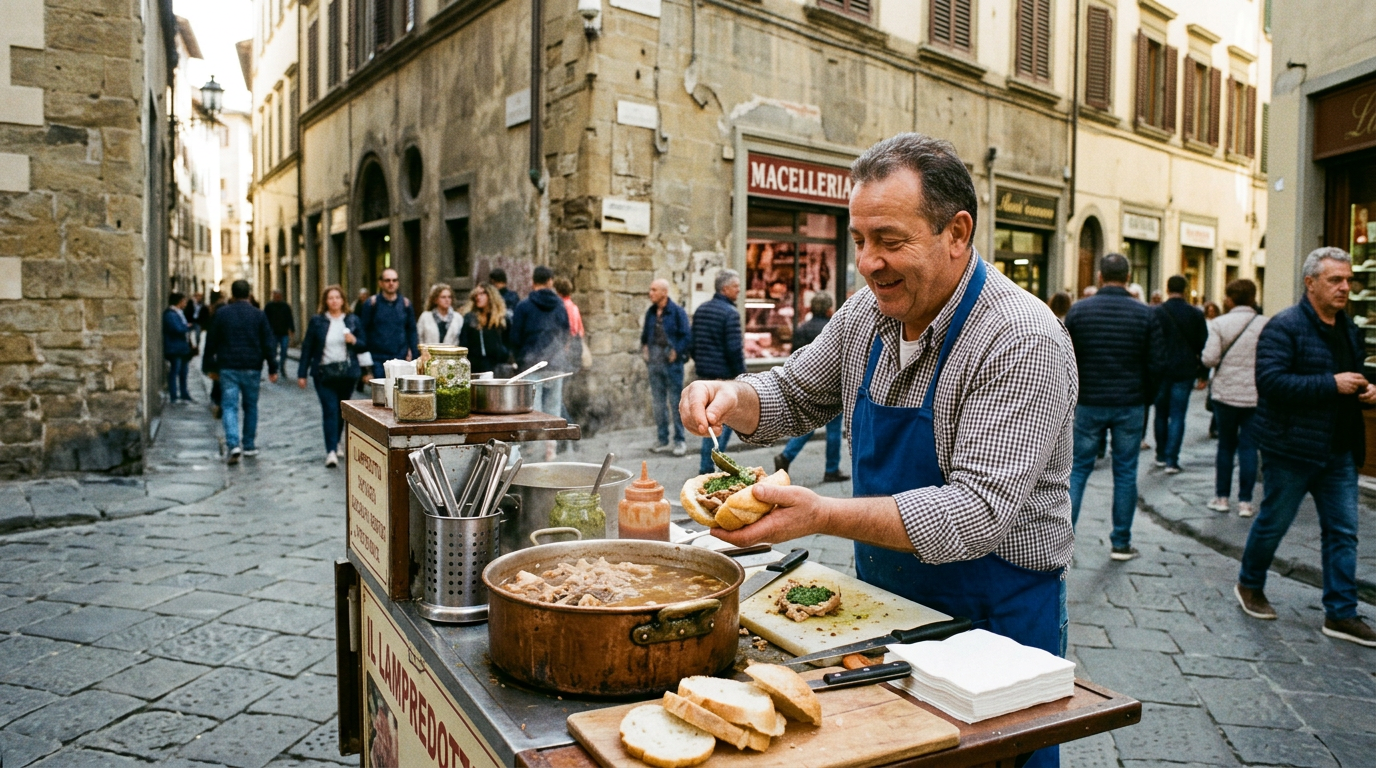
The lampredottaio, the vendor who sells lampredotto from a specially fitted cart or kiosk, is a figure that has been present in Florence for at least five hundred years. Some families have been running the same stall for three or four generations. The cart is still made to a traditional format: a large pot of simmering broth, a cutting board, and a simple setup for constructing sandwiches.
Today, lampredotto has moved beyond its working-class roots without losing its identity. It is now considered a point of civic pride and a marker of authentic Florentine culture. You will see students, workers, tourists, and elderly Florentines all eating at the same stall.
What lampredotto is
Lampredotto is the fourth and final stomach of the cow, specifically the abomasum, the true stomach that processes digested food. It is the darkest and most intensely flavoured of the four bovine stomachs. The other three, the rumen, the reticulum, and the omasum, are used for the lighter tripe dish, trippa.
The lampredotto is cleaned thoroughly, then slow-cooked for several hours in a broth of tomatoes, onion, celery, parsley, and salt. The cooking process transforms a tough, dense piece of offal into something soft, rich, and deeply flavoured. The broth becomes part of the dish.
The classic preparation is the schiacciata, a Florentine flatbread roll called a semelle, soaked briefly in the cooking broth and then filled with sliced lampredotto, green salsa, and sometimes a red chilli sauce. You eat it standing up, quickly, because it is hot and tends to drip.
The flavour is strong, earthy, and bovine. It is not subtle. If you are not accustomed to offal, it may be challenging. If you are open to it, it is one of the most memorable things you will eat in Florence. There is nothing else quite like it.
The historic lampredotto stalls in Florence
The Nerbone stall inside the Mercato Centrale is one of the most famous. It has been operating inside the market for over a century. You queue, order, and eat at one of the few standing tables. Prices are around 4.50 to 6 euros for a lampredotto sandwich in 2026.
Lampredotto all’Antico Vinaio is associated with the famous sandwich shop on Via dei Neri, which has become extremely popular with tourists. The quality is consistent but the queues can be long. There are now multiple branches of Antico Vinaio. Only the original location on Via dei Neri has the old character.
On the south bank, several stalls operate in or near the Oltrarno markets. The area around Piazza dei Nerli and Borgo San Frediano has traditional stalls that have served the neighbourhood for decades. These are the least known outside Florence and the most embedded in daily life.
The Mercato di Sant’Ambrogio, east of the centre, has a good selection of traditional food stalls including lampredotto. It is less crowded than the Mercato Centrale and worth visiting for the broader market experience.
How it is eaten
Eating lampredotto is a physical experience. You hold the sandwich with both hands. The bread, soaked in broth, is soft and likely to fall apart if you are not careful. The contents are hot and slippery.
You eat standing up. You lean forward slightly to avoid dripping on your clothes. You take large bites because small bites are more difficult to manage. The whole thing should take about five minutes from ordering to finishing.
The classic accompaniment is a glass of red wine, served in a small tumbler. Many lampredotto stalls in Florence have a simple arrangement for serving basic red wine alongside the food. A glass costs 1.50 to 2.50 euros. It cuts through the richness of the lampredotto perfectly.
Some people order bagnato, which means they ask for the bread to be fully soaked in broth before filling. This produces a wetter, more intensely flavoured sandwich that disintegrates more quickly. It is the traditional working-man’s version. Others prefer the bread only lightly dipped. You decide.
Where to find it in Oltrarno
Oltrarno is historically the heartland of Florentine street food culture. The neighbourhood’s working-class identity meant that fast, cheap, filling food sold from carts was essential to daily life.
Today the tradition continues, though the number of stalls has decreased. Look around the Mercato di Santo Spirito, which operates Monday through Saturday mornings. Several vendors in and around the market sell lampredotto and other traditional street foods.
Borgo San Frediano, running through the western section of Oltrarno, has a few traditional food points. These are not tourist destinations. They are working stalls for the neighbourhood. Finding them requires walking slowly and looking for the steam rising from a simmering pot.
Piazza dei Nerli, just inside the old medieval gate, is a reliable area. The stalls here are few but consistent. They operate from early morning through midday. The best time to eat lampredotto is between 11:00 and 13:00, when the broth is at its best and the bread is freshly restocked.
If you are staying in Oltrarno, ask your guesthouse for the nearest current stall. The lampredotto landscape changes. Stalls open and close. The best local recommendation will be more accurate than any published list.
Where to stay
De’ Medici is a guesthouse in Oltrarno, the neighbourhood where the lampredotto tradition was born. From here you can walk to a traditional stall in under ten minutes and eat one of Florence’s most genuine and most ancient street foods.