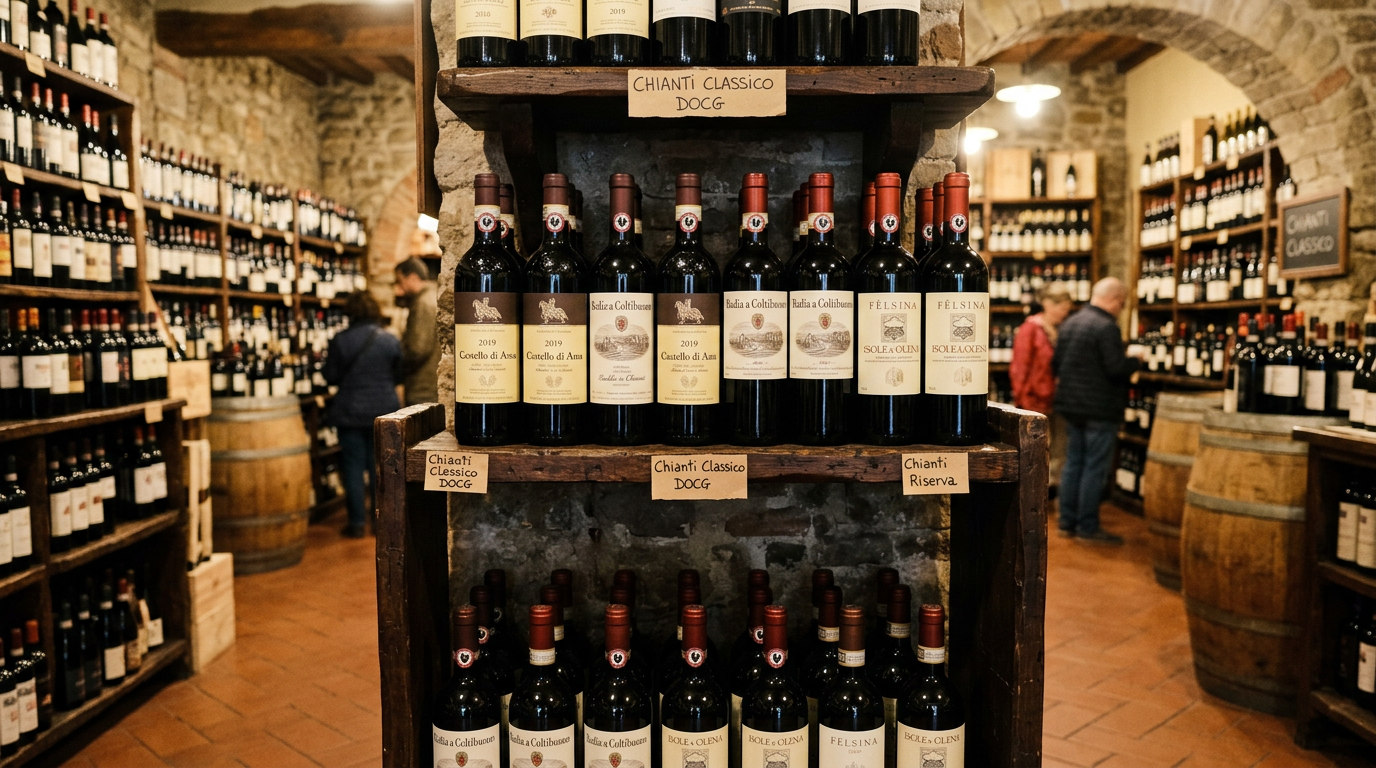
Florence Chianti wine: how to buy well
Chianti to buy in Florence
Chianti is the most exported and most misunderstood Italian wine. For decades, the name was associated with cheap, acidic red wine sold in straw-covered fiaschi. That image persists in parts of the world despite being forty years out of date.
Contemporary Chianti, particularly Chianti Classico, is among the most serious red wine in Italy. It is made primarily from Sangiovese grapes grown in the hills between Florence and Siena, an area of about 7,200 hectares. The best producers make wines that age for fifteen to twenty years and compete in quality with the best wines of France or Spain.
Understanding the classification system helps you buy better. The basic Chianti denomination covers a large geographic area. Chianti Classico is more specific, covering the historic heartland. Within Classico, Gran Selezione is the top classification, requiring at least 30 months of ageing including three months in bottle. These distinctions matter when you are choosing what to buy.
Florence is the natural starting point for buying Chianti because the wine’s homeland begins just south of the city. Producers whose vineyards are in Greve, Panzano, Radda, or Gaiole are less than an hour’s drive away. Buying directly from the producer is possible and often the best value.
Shops and wine bars
The Enoteca Italiana does not have a Florence branch, but several independent wine shops in the city carry excellent selections of Chianti and other Tuscan wines. The best ones are in Oltrarno and in the Sant’Ambrogio area.
Wine shops in Oltrarno that focus on Tuscan producers tend to be small, personal, and knowledgeable. They carry wines from producers they have visited. The selection is curated rather than comprehensive. You will not find everything, but what you find will be well-chosen.
Ask specifically for Chianti Classico rather than basic Chianti. The price difference is significant, around 12 to 18 euros for a basic Chianti versus 18 to 45 euros for a Chianti Classico, but the quality difference justifies it. For a Gran Selezione, budget between 35 and 80 euros per bottle.
The Mercato delle Cascine, Florence’s largest market on the west side of the city, has a few food and wine vendors on its outer edges. These tend to sell basic table wine rather than the good stuff. It is a useful place to buy cheap everyday wine for cooking or casual drinking.
How to choose a good Chianti
Reading the label carefully is your first tool. Look for Chianti Classico DOCG rather than just Chianti DOC. Look for the Gallo Nero, the black rooster that is the symbol of the Chianti Classico consortium, on the capsule of the bottle. Its presence confirms the wine has passed the consortium’s testing.
The producer matters more than the year in Chianti. A great producer in a mediocre year will outperform a mediocre producer in a great year. Learning a few reliable producer names is worth more than memorising vintage charts.
Producers with strong reputations for quality and value include Isole e Olena, Fontodi, Montevertine, Querciabella, and Fèlsina among the more traditional. Younger producers taking more natural approaches include Podere Forte and several emerging growers around Radda and Gaiole.
Smell the wine before you drink it if you have the opportunity to taste. Chianti Classico should smell of sour cherry, dried herbs, a hint of leather, and earth. If it smells of heavy oak, vanilla, and concentrated fruit, it has been made in a style that obscures the grape variety and the place. This is not better. It is different.
Look at the colour. Young Chianti is a medium ruby red. With age it moves toward garnet and then brick. The lighter colour of aged Chianti is not a sign of weakness. It is a sign of development.
Vintages to know
Vintage quality in Chianti varies significantly. Tuscany has hot summers and cold winters, and the rain distribution across the growing season shapes the wine character each year.
2015 was an exceptional year across Tuscany. The wines are powerful and long-lived. A 2015 Chianti Classico that was properly cellared is drinking well now and will continue to develop for another decade.
2016 was equally fine. Some producers consider it better than 2015 for its greater elegance. Both years represent the top tier of the last decade and prices reflect this.
2019 and 2020 were both strong years and are currently on the market at more accessible prices than the older vintages. A 2019 Chianti Classico from a good producer is an excellent choice for current drinking in 2026.
2017 was a very hot year. The wines are full-bodied but can lack the freshness and acidity that makes Sangiovese interesting. Some producers managed the heat well. Others did not. Selective buying applies here.
For basic Chianti intended for drinking within a year of purchase, year does not matter much. Buy the most recent available vintage.
How to take it home safely
Flying with wine is possible but requires planning. Checked baggage is the only option. You need a dedicated wine carrier that provides sufficient padding, or you can wrap bottles carefully in clothing and place them in the centre of a checked bag.
Several specialist wine packaging shops in Florence sell foam wine carriers designed for airline travel. These cost between 5 and 15 euros per unit and hold one to three bottles. They can be placed inside a larger bag. This is the most reliable method.
Declare the wine in your checked luggage if asked, but typically wine bought for personal consumption does not require special declaration within the EU. Importing wine into countries outside the EU, including the UK and the US, may be subject to customs duties and limits on quantity. Check your home country’s rules before purchasing large quantities.
An alternative is to buy wine and ask the shop to ship it. Several wine shops in Florence offer international shipping. This is more expensive than carrying it yourself but avoids airline restrictions. Expect to pay 30 to 60 euros for shipping a 6-bottle case to northern Europe.
Where to stay
De’ Medici is a guesthouse in Oltrarno, within a short walk of the neighbourhood’s best wine shops. The south bank is your base for buying Chianti and understanding the wine culture that produced it, without tourist markup and without travelling far.