Florence Historic Streets Walks: Insider Guide
Florence Historic Streets Walks: A Practical Guide
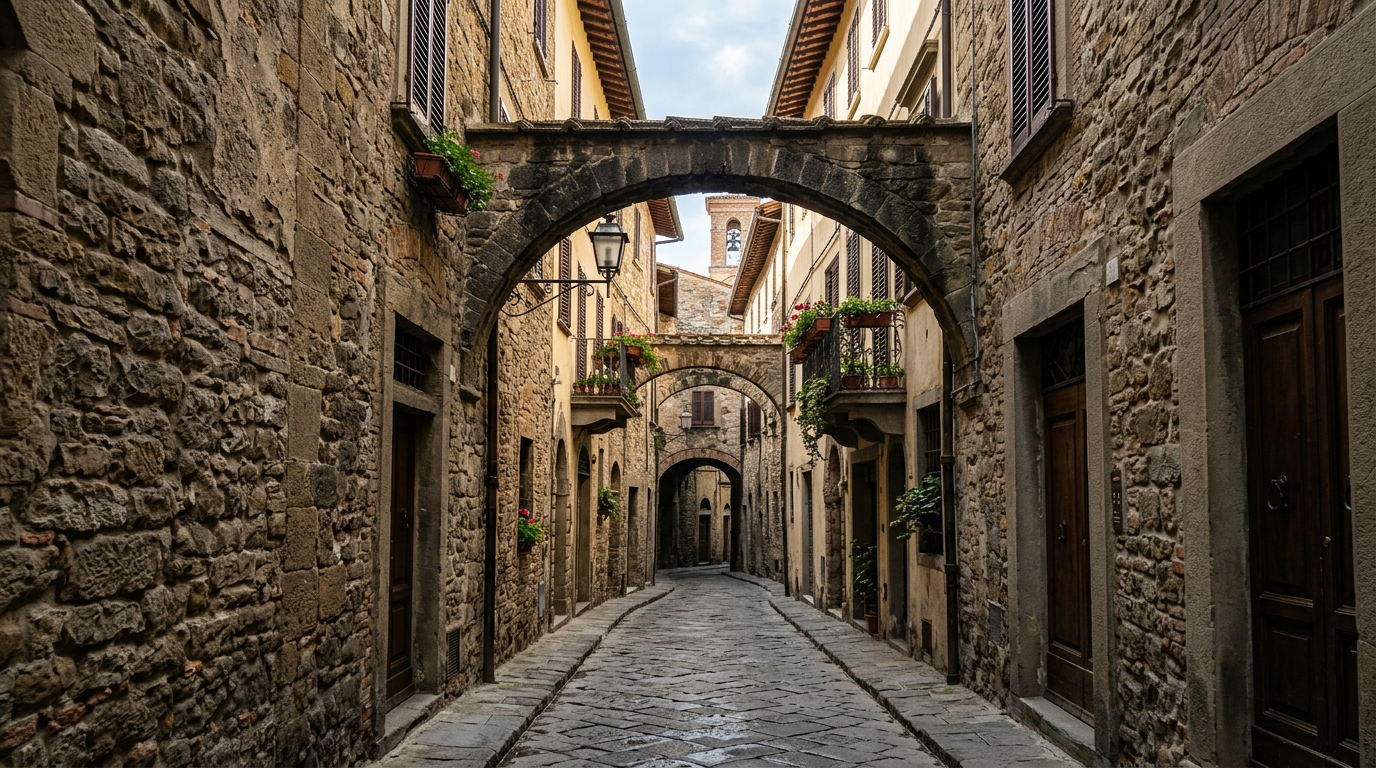
Florence is not just a city of museums and piazzas. The streets themselves are the exhibit. The medieval street plan, the Gothic facades, the Renaissance doorways and the carved stone coats of arms on the buildings form a continuous open-air museum.
You can walk through much of it without entering a single building. All you need is a good pair of shoes and the willingness to look up.
Florence’s historic streets
The historic centre of Florence was largely built between the 12th and 16th centuries. Much of the original street grid has survived. Streets that were laid out in the medieval period are still in use today, following the same alignments as they did 700 years ago.
The historic centre covers roughly 500 hectares. The distance from the Duomo to Ponte Vecchio is less than one kilometre on foot. Yet almost every block along that route contains something worth stopping for.
Florence has around 700 historic streets within the city walls. Most tourists see perhaps fifteen of them. The rest are accessible to anyone willing to step off the main routes.
The stone used for the buildings is pietra forte, a sandy-brown sandstone quarried from the hills around the city. Over centuries, the walls have darkened and streaked with age. The colour changes with the light and the weather in ways that no other city quite replicates.
Streets that tell history
Via dei Calzaiuoli connects the Duomo to Piazza della Signoria. It was widened and straightened in the 19th century, so it lacks the authentic medieval scale. Walk it once to orient yourself, then leave it behind.
Via Por Santa Maria, leading south from Mercato Nuovo toward Ponte Vecchio, is narrower and older. The street name records the old gate of the city wall. At the southern end, Via Guicciardini continues across the bridge into Oltrarno.
Via delle Terme, running parallel to the Arno just north of Ponte Santa Trinita, is one of the better-preserved medieval streets in the centre. The buildings on both sides retain their original heights and proportions. Few tourists turn into it.
Via Dante Alighieri leads east from Piazza della Repubblica toward the supposed birthplace of Dante. The street is short but dense with medieval fabric. The Badia Fiorentina, a 10th-century abbey, stands on the corner.
Via dei Servi runs north from the Duomo toward Santissima Annunziata. The street is wide for a medieval route, which reflects its importance as a processional route. The Renaissance buildings along it include several that are rarely photographed.
The less-walked routes
Borgo Santi Apostoli, running parallel to Lungarno Acciaiuoli between Piazza Santa Trinita and the river, is one of the oldest streets in Florence. The church of Santi Apostoli, founded according to tradition in the early medieval period, stands partway along it.
Via Sant’Agostino in Oltrarno runs southwest from Piazza Santo Spirito. It is a quiet, residential street with a pharmacy, a small tabacchi, and a hardware shop that has been in the same location for decades. This is what Florence looks like without the tourists.
Via dei Michelozzi, connecting Piazza Santo Spirito to Via Maggio, is barely fifty metres long but passes one of the best-preserved Renaissance doorways in Oltrarno. The carved stone frame dates from the mid-15th century.
Via dello Sprone runs from Piazza di Frescobaldi toward Ponte Vecchio. The street is named after the spur, a medieval weapon, and records the presence of an armourer’s workshop here in the 14th century. Today it is mostly residential, with a few small shops.
Vicolo dei Velluti is a narrow lane off Via Maggio that most people walk past without noticing. The lane is barely wide enough for two people to pass. On one side, an old palace wall rises three storeys with no windows at street level.
Palaces to look at in passing
Palazzo Antinori stands on Piazza Antinori, just off Via Tornabuoni. The facade, built between 1461 and 1469, is considered one of the best examples of Florentine Renaissance domestic architecture. The family still owns it. The ground floor hosts a wine bar open to the public.
Palazzo Strozzi, the largest private palace in Florence, occupies a full block between Via Tornabuoni and Via degli Strozzi. Construction began in 1489. The building was never finished to the original plan, but what was completed is extraordinary. The courtyard is open daily and free to enter.
Palazzo Davanzati on Via Porta Rossa is the best-preserved medieval merchant’s palace in the city. The exterior gives a clear idea of how Florence’s elite lived in the 14th century. Entry to the museum costs 6 euros.
Palazzo Gondi on Piazza San Firenze is often overlooked. Giuliano da Sangallo designed it in 1490. The rusticated stone facade and the carved door surrounds are typical of the period. The building is still privately owned and used as offices.
In Oltrarno, Palazzo Guadagni on Piazza Santo Spirito has a distinctive loggia on the top floor, open to the sky. Built around 1505, it was one of the first palaces in Florence to incorporate a loggia of this kind. The building now operates as a small hotel.
How to plan a historic walk
Start from Oltrarno if you are staying in the neighbourhood. Cross Ponte Vecchio early in the morning, before 9 am, when the bridge is quieter and the light from the east is still low.
Work your way through the streets north of the Arno in a loose grid. Do not follow a fixed itinerary. Turn into any street that looks interesting. The historic centre is small enough that you cannot get seriously lost.
Carry a small notebook or use your phone to note the addresses of things you want to return to. Florence rewards revisiting. A palace you see in the morning looks completely different in the late afternoon.
Visit the interiors of at least two churches that are not on the main tourist circuit. Santa Margherita de’ Cerchi, near the Bargello, is often empty. Orsanmichele, the former grain market converted into a church, is free to enter and contains remarkable sculpture.
Plan a walk of two to three hours in the morning and another in the late afternoon. The midday heat in summer makes walking in the historic centre uncomfortable. Use that time for museums or for resting.
The best way to end a historic walk in Florence is to cross back to Oltrarno. The streets on the south bank of the Arno are quieter, the cafes are less expensive, and the light on the Lungarno in the late afternoon is a reward in itself.
Where to stay
De’ Medici is a guesthouse in Oltrarno, a five-minute walk from Ponte Vecchio and the beginning of the historic centre. You can start and end every walk from the neighbourhood that many Florentines consider the city’s most authentic.