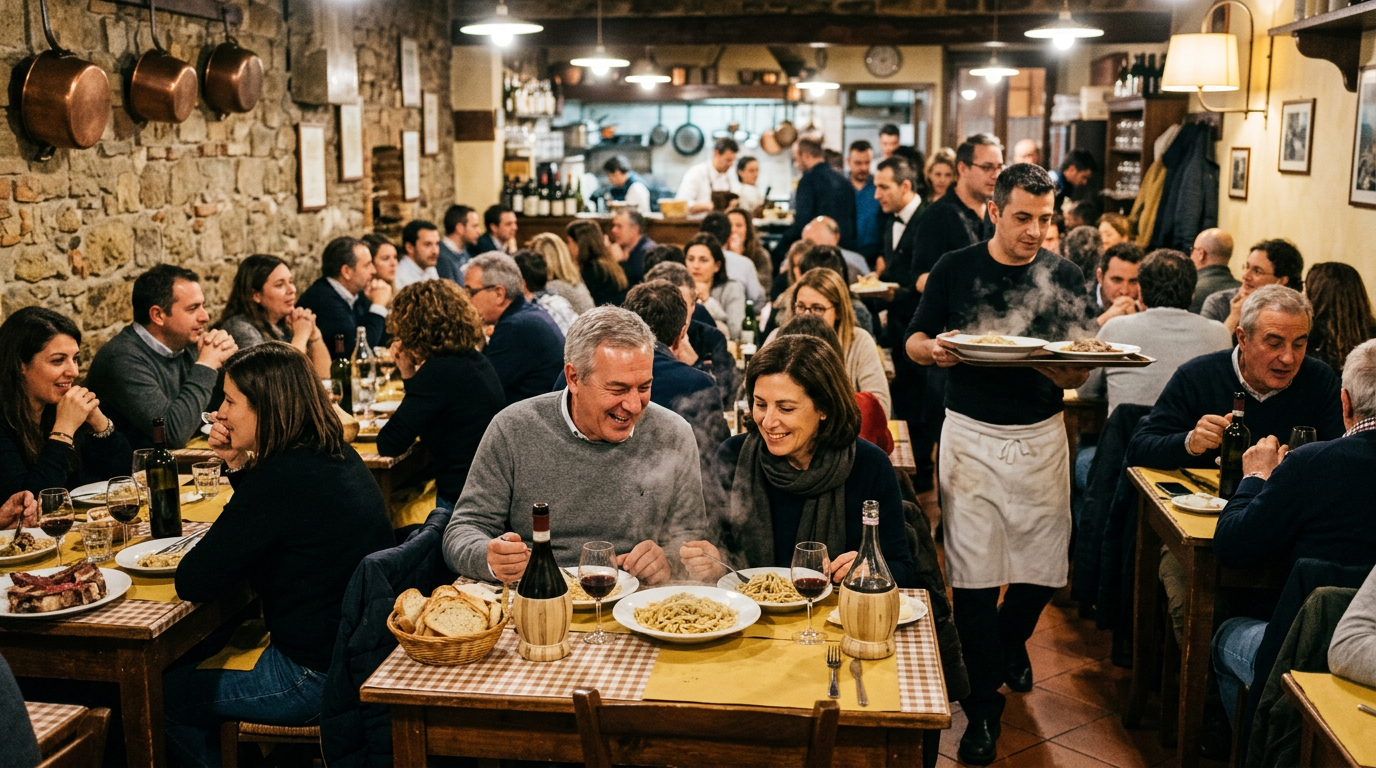
Florence trattorias where locals eat in 2026
Trattorias where Florentines eat
The question of where locals eat in Florence is more complicated than it sounds. Florentines eat at home most of the time. When they go out, they go to places that offer value, quality, and familiarity. They do not go to the restaurants with the best TripAdvisor scores near the Uffizi.
The places where Florentines actually eat lunch on a working day are different from the places marketed as “local gems” in travel articles. They tend to be further from the main monuments. They tend to have no website and no Instagram presence. They fill up by 12:45 and are empty by 14:30.
Finding them requires either local knowledge or a willingness to walk away from the tourist circuit and pay attention to what you see. A full room of Italian speakers is the most reliable signal. The next most reliable signal is a handwritten daily menu.
This guide focuses on practical methods for finding these places rather than listing specific names, because restaurant quality changes and the best places are often not the ones that appear in published lists.
How to recognise an authentic trattoria
The first and most important indicator is the clientele. If you look through the window at 13:00 and the room is full of people in work clothes eating quickly and talking loudly, you have found the right place. If you see a room of tourists with guidebooks, keep walking.
The menu is the second indicator. A traditional Florentine trattoria offers a daily menu, either written on a board or described verbally. It changes based on what is fresh and available. A laminated menu with photographs that includes pasta, pizza, grilled fish, and dessert is not a traditional trattoria.
The third indicator is price. A genuine working lunch, pasta, a second course, bread, and a quarter litre of house wine, should cost between 12 and 20 euros per person in 2026. If the prices are significantly higher than this, you are paying a tourist premium.
The physical space often tells you something. Traditional trattorias in Florence tend to occupy ground-floor rooms in old buildings. The furniture is functional. The tablecloths, if there are any, are paper. The lighting is adequate but not designed. These are places built for eating, not for photography.
Neighbourhoods to look in
Oltrarno is the best starting point. The western end, around Borgo San Frediano and Piazza del Carmine, has the highest concentration of working local restaurants. These places serve neighbourhood residents and employees. They have no incentive to attract tourists and no marketing budget.
The area around Via dei Serragli, running south from the Arno, has several options on the street itself and on the side streets branching off it. Walk slowly and look at who is inside each place. Trust the evidence of your eyes over any list.
The Mercato di Sant’Ambrogio on the east side of the city is surrounded by small lunch spots that cater to market workers, local employees, and neighbourhood residents. The area is about 15 minutes on foot from the Duomo. The quality of the food tends to be high because the competition for regular customers is real.
Rifredi and Campo di Marte, further from the centre, are almost entirely outside the tourist circuit. Getting there requires a 20 to 30 minute bus ride. The experience of eating in a place that has genuinely never adjusted for outsiders is valuable if you want to understand how the city actually feeds itself.
The daily menu: what to expect
Most traditional Florentine trattorias offer a fixed structure even when they do not publish a fixed-price menu. There is always pasta or a soup as a first course. There is always a meat dish as a second course. Vegetables are served as a side, not included with the main course.
Typical first courses in autumn and winter include ribollita, pappardelle with ragu, pasta e fagioli, and tortellini in broth. In spring, you begin to see lighter dishes: pici with various sauces, pasta with fresh vegetables, risotto made when the cook feels like it.
Second courses lean toward braised and slow-cooked meats. Beef stew, rabbit in sauce, roasted chicken, veal with lemon, and tripe are all common. Fish appears less often and is more expensive. Expect to pay 10 to 18 euros for a meat main course in a genuine local trattoria.
Dessert is often simple: a slice of crostata with jam, a piece of tart, or cantucci with vin santo. Some places skip dessert entirely and end the meal with a digestivo, a small glass of grappa or amaro.
Coffee arrives at the end. It is espresso. It costs 1.20 to 1.50 euros. Drinking it standing at the bar rather than at the table is slightly cheaper and more traditional.
Real prices in 2026
A full traditional lunch, starter, pasta, main course, side vegetable, bread, house wine, and water, costs between 22 and 35 euros per person in a genuine Florentine trattoria in 2026.
A simpler lunch, a single pasta dish and a glass of wine, comes to between 13 and 19 euros. This is entirely acceptable. You are not obliged to order multiple courses.
Cover charges, pane e coperto, add 1.50 to 3 euros per person to your bill. This is standard and not negotiable. It covers the bread and the setup of your table.
House wine in a carafe is always the most economical choice. A quarter litre, the smallest size, costs 3 to 5 euros. A half litre costs 5 to 8 euros. A full litre costs 8 to 14 euros. Bottled wine from the list costs more but is often worth it if the selection is good.
The most expensive part of eating in a tourist-facing restaurant in Florence is not the food but the location and the markup on wine. A bottle of Chianti that costs 8 euros at a local wine shop may appear on a tourist restaurant wine list at 35 euros.
Where to stay
De’ Medici is a guesthouse in Oltrarno, the neighbourhood where the best local trattorias in Florence are concentrated. Staying here gives you immediate access to the kind of restaurants described in this guide, places that exist for the neighbourhood, not for visitors.