Florence Medici History Oltrarno: Full Guide
The Medici in Oltrarno: History and Legacy
The Medici family shaped Florence more than any other single force in its history. For over three centuries, from their rise to prominence in the early 15th century to the extinction of the main branch in 1737, they determined the appearance of the city, the direction of its culture, and the lives of its inhabitants.
In Oltrarno, their influence was direct and physical. The largest palace in the neighbourhood, the most important garden, and the corridor that connected their private world to the public one all bear their mark.
The Medici and Oltrarno
The Medici did not originate in Oltrarno. Their early base was the parish of San Lorenzo, north of the Arno. But when Cosimo I de’ Medici became the first Grand Duke of Tuscany in 1569, he moved the centre of power to the south bank.
The decision to acquire and expand Palazzo Pitti transformed Oltrarno. What had been a prosperous but relatively modest neighbourhood became the centre of a grand duchy. The palace expanded. The garden behind it was designed as a statement of political power. The elevated corridor connecting the palace to Palazzo Vecchio across the river reordered the urban fabric.
Nobles, courtiers, and wealthy merchants who wanted to be close to power followed the Grand Duke south. The great palaces on Via Maggio, Via dei Bardi, and Via Guicciardini were built or enlarged during this period. The neighbourhood’s current character, dense with Renaissance and Baroque palaces, reflects that 16th-century concentration of wealth.
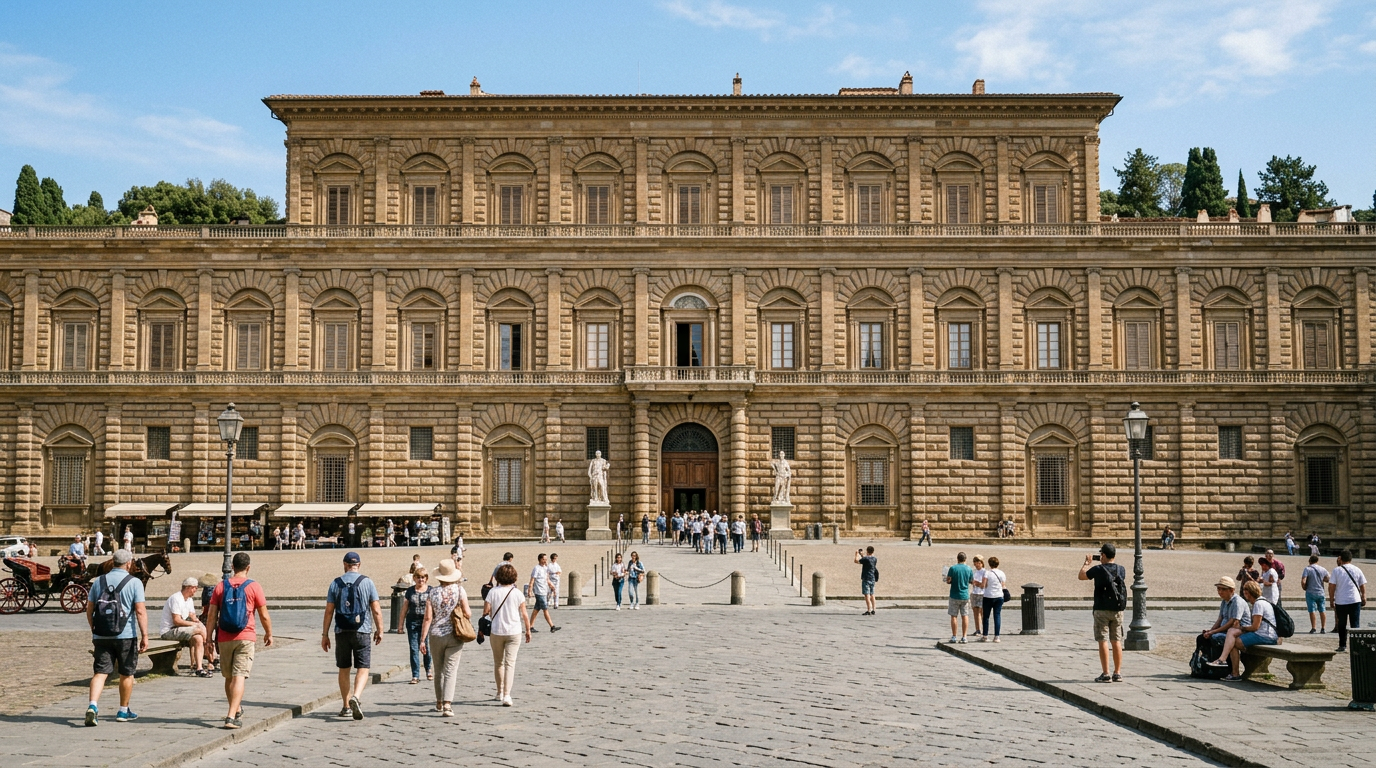
Palazzo Pitti: the grand ducal residence
Palazzo Pitti was built by the Pitti family, rivals of the Medici, beginning in 1457. The original building was already substantial, but Eleonora di Toledo, wife of Cosimo I, purchased it in 1549 and immediately began the expansion that would transform it into one of the largest palaces in Europe.
The architect Bartolomeo Ammannati designed the current courtyard, completed around 1560. The courtyard is three storeys high on all four sides, with rusticated stone articulated by superimposed classical orders. It is one of the finest architectural spaces of the Italian High Renaissance.
The palace grew continuously through the 17th and 18th centuries. Each addition expanded the building along the hillside. By the time of the last Medici Grand Duke, Gian Gastone, who died in 1737, the building was roughly the size it is today.
The palace now contains five museums: the Palatine Gallery, the Royal Apartments, the Gallery of Modern Art, the Museum of Silverware, and the Costume Gallery. The combined collection includes works by Raphael, Titian, Caravaggio, Rubens, and Van Dyck, among many others.
A single combined ticket covers the palace museums and the Boboli Garden. The price is 16 euros for adults. The museums are open Tuesday to Sunday, from 8:15 am to 6:30 pm.
Boboli Garden: power and nature
The Boboli Garden behind Palazzo Pitti was begun in 1549 at Eleonora di Toledo’s commission. Niccolò Tribolo designed the original layout, and the garden was expanded and modified by subsequent generations of the Medici through the 17th century.
The garden covers approximately 45,000 square metres. It rises up the hillside in a series of terraces, avenues, fountains, and grottos. The design is neither naturalistic nor purely formal, but a combination of both, with geometric avenues giving way to wilder planted areas on the upper slopes.
The Amphitheatre at the heart of the garden, cut into the hillside directly behind the palace, was the setting for court entertainments, theatrical performances, and celebrations. The first performances of opera in history took place in spaces connected to the Medici court. Jacopo Peri’s “Euridice”, considered the first opera to survive complete, was performed in 1600 for the wedding of Maria de’ Medici to Henri IV of France.
The Grotta del Buontalento, designed by Bernardo Buontalento between 1583 and 1593, is one of the most extraordinary spaces in the garden. The artificial cave is decorated with stalactites, shells, sponge rock, and frescoes depicting sheep and shepherds. Inside, positioned in three alcoves, are casts of Michelangelo’s Prisoners, placed here in the 16th century. The originals are now in the Accademia.
The Kaffeehaus, an 18th-century pavilion at the top of the garden, offers coffee and cold drinks in summer. The view from the terrace looks north over the rooftops of Florence to the Duomo.
Patrons who changed the neighbourhood
The Medici were not the only patrons in Oltrarno, but they were the most powerful. Their patronage of churches, artists, and institutions set the tone for the entire neighbourhood.
Cosimo il Vecchio, the first Medici to consolidate political power, was a patron of the Observant Franciscan convent at Santa Croce (north of the Arno) and supported numerous building projects across the city. In Oltrarno, his most important commission was the enlargement of the Dominican convent at Santa Maria Novella.
Lorenzo de’ Medici, known as il Magnifico, was the greatest patron of the family’s first generation. He supported Botticelli, Leonardo da Vinci, Filippino Lippi, and the young Michelangelo, who lived for a time in the Medici household. His influence on the arts extended across Florence and reached artists working across Italy and beyond.
Pope Leo X (Giovanni de’ Medici), son of Lorenzo, used his position to commission major works for Roman and Florentine churches. Pope Clement VII (Giulio de’ Medici) commissioned Michelangelo’s design for the Biblioteca Laurenziana in San Lorenzo.
The Medici legacy today
The Medici name is visible throughout Oltrarno. The Corridoio Vasariano, the elevated walkway commissioned by Cosimo I and designed by Giorgio Vasari in 1565, still passes above Via Guicciardini and Lungarno Archibusieri. It is occasionally opened for guided visits.
The Medici coats of arms, a shield with six balls or palle, appear carved in stone on many buildings in the neighbourhood. The six balls refer to the medicinal pills or coins that gave the family its surname; Medici means doctors.
Palazzo Pitti and Boboli Garden together remain the most significant concentration of Medici legacy anywhere in Florence. Spending a full day in the palace and garden gives you a genuine sense of the scale of their ambition and achievement.
The Medici Grand Duchy came to an end with Gian Gastone de’ Medici in 1737. He left no heirs. The last surviving Medici, his sister Anna Maria Luisa, bequeathed the entire family collection to the city of Florence on the condition that it could never be removed. This act preserved what is now one of the great art collections in the world.
Where to stay
De’ Medici is a guesthouse in Oltrarno, within a ten-minute walk of Palazzo Pitti and Boboli Garden. The neighbourhood you stay in is the one that the Medici Grand Dukes chose as the centre of their world.