San Miniato al Monte Florence: Complete Guide
San Miniato al Monte: From Oltrarno to the Hill
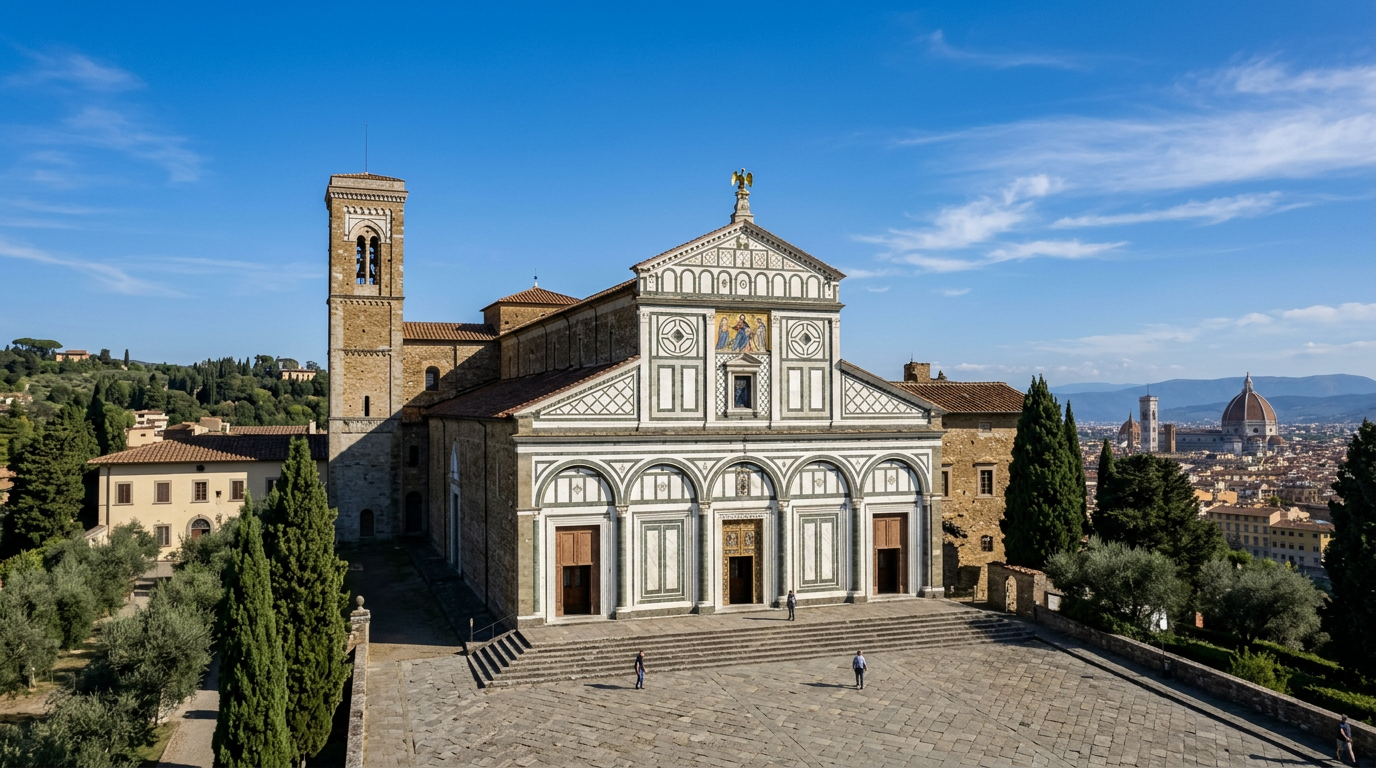
San Miniato al Monte stands on the hill above Oltrarno. It is one of the finest Romanesque churches in Italy and one of the best-preserved buildings from the 11th century in Florence.
Most visitors who make the effort to reach it are surprised by what they find. Not a ruined monument, not a heavily restored tourist attraction, but a living monastery with monks, a working shop, and a church that has been in continuous use for nearly a thousand years.
San Miniato al Monte from Oltrarno
The basilica stands on the Colle di San Miniato, about 90 metres above the level of the Arno. From the Oltrarno neighbourhood, it is clearly visible: the white and green marble facade catches the sun from mid-morning onwards and can be seen from many streets in the neighbourhood.
The walk from Oltrarno to San Miniato takes approximately twenty-five minutes on foot. The route passes through two very different sections of the hillside: the first through the park and steps below Piazzale Michelangelo, the second through the old city fortifications above it.
The approach from Oltrarno begins on Lungarno Serristori, just east of Ponte alle Grazie. You climb the broad flight of stairs known as the Rampe del Poggi, designed by Giuseppe Poggi in the 1860s as part of Florence’s urban expansion programme. The stairs pass through a series of terraced gardens with fountains. The climbing is gradual but continuous.
Alternatively, bus line 12 connects Porta Romana with the stop at Piazzale Michelangelo, from which the basilica is a further ten minutes uphill on foot. The bus runs regularly during the day.
The uphill walk from the neighbourhood
Leaving from Piazza Poggi at the base of the Rampe, the walk takes you first to Piazzale Michelangelo, one of the most photographed viewpoints in Florence. If you come in the early morning, before 8:30 am, the square is quiet. Later in the day, particularly in summer, it fills with tour groups and souvenir stalls.
Above Piazzale Michelangelo, a second flight of stairs climbs through a cypress avenue toward the church of San Salvatore al Monte. This building, designed by Cronaca around 1500 and described by Michelangelo as his “bella villanella” (pretty country girl), is often overlooked by visitors heading straight for San Miniato.
From San Salvatore, a gravel path continues uphill for about three minutes to the main entrance of San Miniato. The path runs alongside an old cemetery wall. The Cimitero Monumentale delle Porte Sante, the historic cemetery adjacent to the basilica, contains the graves of many notable Florentines, including Carlo Collodi, the author of Pinocchio.
The basilica and its history
San Miniato al Monte was built between 1013 and 1062 on the site of a shrine marking the spot where the martyr Miniato was supposedly buried. Miniato was a Christian killed during the Roman persecutions, probably in the 3rd century.
The facade is covered in geometric patterns of white marble from Carrara and green marble from Prato. These two colours, which you also see in the Baptistery and the campanile of Santa Maria Novella, are characteristic of the Florentine Romanesque style.
The interior is divided into three naves. The floor is covered in extraordinary marble intarsia panels dating from 1207, depicting the signs of the zodiac, eagles, and lions. These are among the finest Cosmatesque marble floors in Tuscany.
The raised choir contains carved marble choir stalls and a pulpit of 1207. The mid-nave chapel of the Cardinal of Portugal, added in 1461 by Antonio Rossellino, is one of the great Renaissance funerary monuments of the 15th century. The ceiling is covered in glazed terracotta roundels by Luca della Robbia.
The crypt beneath the raised floor dates from the 11th century and contains the tomb of San Miniato himself. The space is low, narrow, and lit by oil lamps. Monks chant vespers here every day at 5:30 pm. Attending the service is free and open to all visitors.
The sacristy contains a fresco cycle by Spinello Aretino depicting the life of Saint Benedict, painted in 1387. These are among the best-preserved 14th-century frescoes in the city.
The view from the terrace
The terrace in front of the basilica offers one of the most complete views of Florence. Unlike Piazzale Michelangelo below, which looks across the whole city, the terrace of San Miniato is positioned slightly higher and further back, giving a broader panorama.
From here you can identify the Duomo, Giotto’s campanile, the Palazzo Vecchio tower, the dome of San Lorenzo, the tower of the Badia Fiorentina, and the distant profile of Fiesole on the hills to the north. In clear weather, the Apennines are visible further north.
The view at sunset is exceptional. The sun sets to the west, behind the hills toward San Casciano and Tavarnelle. The city below turns gold. The quality of the light between 7 and 8 pm in September and October is outstanding.
The terrace also looks east, toward the hills above San Niccolò and the Arno valley. You can trace the line of the river from Ponte San Niccolò to Ponte alle Grazie and beyond.
When to go and how to behave
The basilica is open every day. Morning hours are from 9:30 am to 1:00 pm. Afternoon hours are from 3:00 pm to 7:00 pm in summer and from 2:30 pm to 6:00 pm in winter.
The Benedictine monks who run San Miniato chant the office at regular hours throughout the day. Vespers at 5:30 pm is the service most accessible to visitors. The chanting lasts approximately thirty minutes and takes place in the crypt or the upper church depending on the season.
Entry to the basilica is free. Donations are welcome and are used for the building’s upkeep.
Dress codes apply. Bare shoulders, sleeveless tops, and shorts above the knee are not permitted. A light layer is sufficient for covering bare shoulders in summer.
Avoid visiting on summer Sunday afternoons when crowds from Piazzale Michelangelo tend to continue uphill. Weekday mornings between Tuesday and Friday are the quietest times.
The monastery shop sells honey, herbal teas, liqueurs, and cosmetics produced by the monks. These make practical and authentic souvenirs. The shop is open during the same hours as the basilica.
Where to stay
De’ Medici is a guesthouse in Oltrarno, at the base of the hill that leads up to San Miniato al Monte. The walk to the basilica begins steps from your door and takes twenty-five minutes at a relaxed pace.