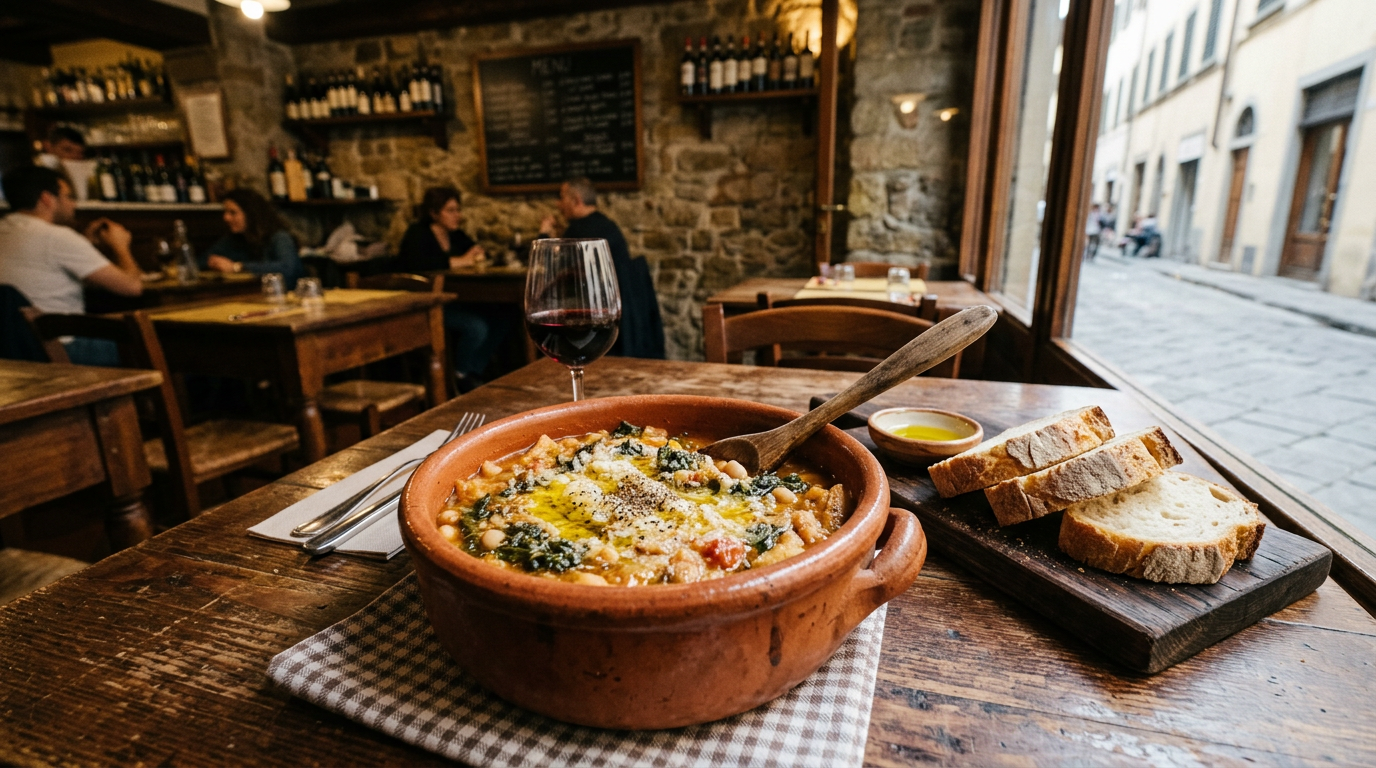
Authentic ribollita in Florence and Oltrarno
Authentic ribollita from Oltrarno
Ribollita is one of the most honest dishes in Italian cooking. It was invented from necessity, from a need to make something nourishing out of ingredients that cost very little and that were available through the long Tuscan winter. Its name, reboiled, says everything about its origin.
You make a vegetable and bean soup on one day. The next day, you reheat it, adding stale bread to thicken it further. The result is denser, more flavourful, and more filling than the original soup. The reheating transforms the dish. This is not a shortcut. It is the actual method.
In Florence, ribollita is not a restaurant invention. It began in farmhouses and working-class kitchens throughout Tuscany. It came to the city through the families who moved from the countryside to work in the workshops and factories. Oltrarno, as the neighbourhood of artisans and workers, was the part of Florence where this dish became most embedded in daily cooking.
A properly made ribollita is a winter and autumn dish. It requires ingredients that are at their peak between October and March, particularly cavolo nero, the dark leafy kale that grows through the cold months, and dried borlotti or cannellini beans. Making ribollita in July with out-of-season ingredients is possible but produces an inferior result.
The history of this poor dish
The origins of ribollita predate any written recipe. Medieval Tuscan cooking was based on pulses, bread, olive oil, and wild vegetables. The wealthy used these ingredients too, but with additions of meat, expensive spices, and wine. The poor used them alone.
The bread element is fundamental and specifically Tuscan. Tuscan bread is made without salt, and it goes stale quickly. Stale bread was not discarded. It was soaked in broth, layered into soups, or dried completely and used for crostini. Ribollita is part of this systematic refusal to waste.
The first written recipe for something resembling ribollita appears in 18th century Tuscan cookbooks under the name acquacotta or zuppa di pane. The name ribollita became common in the 20th century as the dish moved from farmhouse to trattoria. Pellegrino Artusi, the great 19th century Italian cookbook author, wrote about several related dishes from Tuscany.
The peasant origins are not something Florentines are apologetic about. They are a source of pride. The fact that a dish made from leftover bread and cheap vegetables has become an emblem of Florentine cooking says something important about the culture. Quality does not require expense.
Trattorias where you eat the real thing
A genuine ribollita must be made with cavolo nero, Tuscan white beans, stale unsalted Tuscan bread, carrot, celery, onion, potato, and a good quantity of olive oil. The texture must be thick, almost solid. You should be able to eat it with a fork.
Any version served in a bowl with a light broth is not ribollita. Any version that uses spinach instead of cavolo nero is not ribollita. Any version made to order in fifteen minutes has not been reboiled and is therefore, by definition, not ribollita.
The best versions in Oltrarno come from the traditional trattorias that make a large pot on Monday and serve it through the week, reheating it each morning. The soup gets better as the week progresses. Thursday’s ribollita in a good trattoria is often better than Monday’s.
Look for places in Oltrarno with handwritten menus and no English signage on the outside. Ask directly whether the ribollita is made with cavolo nero and old bread. In a good kitchen, this question will be understood and respected. In a bad kitchen, it will cause confusion.
Prices for ribollita as a first course in a genuine trattoria run from 7 to 12 euros in 2026. If it costs more than this, you are likely paying a tourist premium. If it costs less than 6 euros, be cautious about the quality of the ingredients.
The right season
Ribollita is best from October through March. This is the period when cavolo nero is at its best, when the cold air of Tuscany has sweetened the leaves and made them denser. March cavolo nero is still good. April is marginal. By May the plant is bolting and the quality drops.
Summer ribollita exists in some restaurants that have it on the menu year-round. It is typically made with different greens and lacks the depth and body of the winter version. If you want the authentic experience, visit Florence in the colder months.
November is perhaps the ideal month for ribollita tourism. The new olive oil has just been pressed and you can ask for it drizzled over your soup. The cavolo nero is fresh. The dried beans from the summer harvest are still relatively young. Everything is at its seasonal best.
A late November meal in a Florence trattoria might include crostini neri, ribollita, a piece of Chianina beef, and a bottle of Chianti Classico. This is Florentine cooking at its most complete and most seasonal.
The difference from tourist versions
The tourist version of ribollita is watery, slightly greasy, and uniform in colour. It is often greenish rather than the deep dark brown-black of the real thing. It arrives quickly. The texture is soupy. It tastes of little except generic herbs.
The real version arrives thick enough to hold its shape in the bowl. It is dark, almost black from the cavolo nero. The bread has completely dissolved into the body of the soup. You can see olive oil pooling on the surface. It smells of the countryside, of beans and earth and herbs.
The real version is almost never available in restaurants in the main tourist areas north of the Arno. It requires a kitchen that has made a deliberate choice to do things properly. That choice is expensive in terms of time and effort. It is not compatible with the high-volume, rapid-turnover model of tourist restaurant economics.
Eating the real ribollita means going to Oltrarno, finding the right trattoria, and visiting in the right season. These conditions are not difficult to meet. They simply require intention.
Where to stay
De’ Medici is a guesthouse in Oltrarno. In winter and autumn, when ribollita is at its best, you can eat a genuine version within a few minutes’ walk. The neighbourhood’s working-class food tradition, which produced this dish, is still alive here.