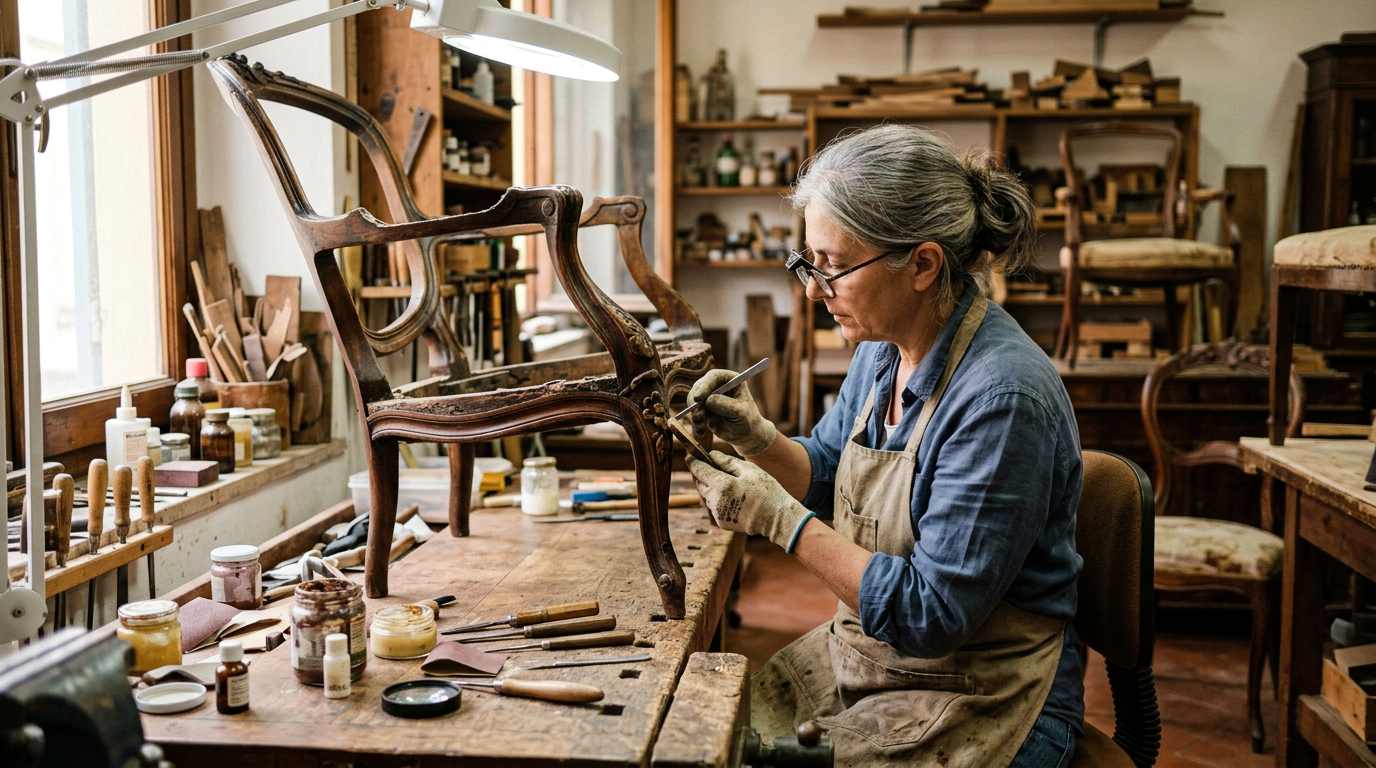
Florence restorers: antique objects in Oltrarno
Florentine restorers
Florence is one of the great restoration centres of the world. This is not a recent development. It is a direct consequence of the city’s extraordinary density of historic art and architecture and the corresponding need, over centuries, for people skilled in maintaining and repairing it.
The restoration profession in Florence has a continuous history going back to the Renaissance workshops, where young artists learned by copying and repairing works by older masters. The distinction between making new art and restoring old art was not sharp in the 15th century. Both required the same fundamental technical knowledge.
The 1966 flood, which deposited mud and water on thousands of paintings, sculptures, books, and objects in Florence, created an acute crisis that accelerated the development of modern restoration science. International teams of conservators came to Florence to help. Many stayed. The city became a centre for training and research in conservation science that it remains today.
Today Florence has a community of restorers working in Oltrarno and the surrounding areas. They work primarily for private clients, institutions, and antique dealers. Most of them work invisibly, in workshops off the tourist route, on objects that will return to private houses or museum storage.
An ancient and living profession
The restorer of antique objects occupies a specific role in the Florence economy. They are craftspeople but also historians. A good restorer needs to understand the techniques used to make an object, its age, its material composition, and its condition. Only then can they decide how to treat it.
The range of objects that come through Florentine restoration workshops is wide. Paintings on panel and canvas are the most prominent, connected to Florence’s role as a centre of Renaissance painting. Gilded furniture, textiles, ceramics, stone carvings, metalwork, and historic books all require specialist restoration.
Each material has its own restoration tradition and its own specialist practitioners. A restorer who works on paintings does not typically work on textiles. A furniture restorer does not work on paper. The specialisations are deep and require years of dedicated training.
Training routes in Florence include the Opificio delle Pietre Dure, the state conservation institute founded in 1588 and located in the Via degli Alfani near San Marco. The OPD, as it is known, trains restorers in an intensive five-year programme and is considered one of the best restoration schools in the world. Graduates work across Italy and internationally.
Other training routes include the Accademia di Belle Arti and private apprenticeships in established workshops. The apprenticeship model remains important. The most specialised skills are transmitted directly, from experienced practitioner to trainee.
How restoration works
The process of restoring an object typically begins with examination. A restorer looks at the object carefully, often with magnification and ultraviolet light, to understand its history, its condition, and what previous interventions have been made. This examination informs everything that follows.
Cleaning is usually the first active intervention. Removing accumulated dirt, old varnish, or previous restoration work exposes the original surface. This process must be gradual and controlled. Cleaning too aggressively removes original material. Cleaning too superficially achieves nothing.
Structural consolidation comes next when needed. A painting with lifting paint layers, a piece of furniture with weakened joins, or a ceramic with cracks all require physical stabilisation before surface work can begin.
The most visible part of restoration is the aesthetic integration, the process of making the restored object appear visually coherent. This might involve inpainting losses in a painting, replacing missing wood in a piece of furniture, or stabilising and toning a repair in a ceramic. Ethical restoration makes these interventions detectable by experts under examination while invisible in normal viewing conditions.
The restorer keeps documentation of everything they do. This record accompanies the object and allows future restorers to understand what was original and what was added. This documentation is as important as the physical work.
Workshops in Oltrarno
Oltrarno has a concentration of furniture restorers along Via Maggio, Sdrucciolo de’ Pitti, and the streets around Piazza della Passera. These workshops work largely on antique furniture for private clients and antique dealers. Many of them have been in the same premises for decades.
Via Maggio itself is one of the best streets in Florence for understanding the intersection of antique dealing and restoration. The antique shops that line the street often have working restorers either in the back of the shop or nearby. The relationship between dealer and restorer is close.
Painting restorers tend to work in less public spaces. Their workshops require controlled light and stable temperature and humidity. You are less likely to see them with open doors. If you have a specific need, asking at the Oltrarno workshops you can access is a reasonable way to find referrals.
The Associazione dei Restauratori d’Arte in Florence maintains a directory of members. Not all Florentine restorers are members, but the directory is a starting point. Many members have websites describing their specialisations and approach.
How to make contact
If you want to commission restoration work or simply want to understand the profession better, the most direct approach is to visit the accessible workshops in Oltrarno. A polite introduction and a genuine question about the work in progress will usually generate a conversation.
Most Florentine restorers do not advertise. Their clients find them through word of mouth, through antique dealers they have worked with, or through institutional connections. Cold contact from an unknown person works better if you can mention a referral.
If you are bringing an object for restoration, the first step is an examination and estimate. This is usually free or costs a small fee. The restorer will assess the work required and quote a price. For significant furniture pieces, expect to pay between 500 and several thousand euros depending on the extent of the work. For smaller objects, prices range from 50 to several hundred euros.
Timelines in restoration are long. A major furniture piece may take three to six months. Complex paintings can take a year or more. If you are not in a hurry, Florentine restorers are among the best available. If you need something quickly, manage expectations at the start.
Where to stay
De’ Medici is a guesthouse in Oltrarno, in the neighbourhood where Florence’s restoration tradition is most concentrated. A slow walk along Via Maggio or around Piazza della Passera will show you working workshops that are part of a continuous craft history going back five centuries.