Florence Porta Romana: What to See and History
Porta Romana: Florence’s Best-Preserved Medieval Gate
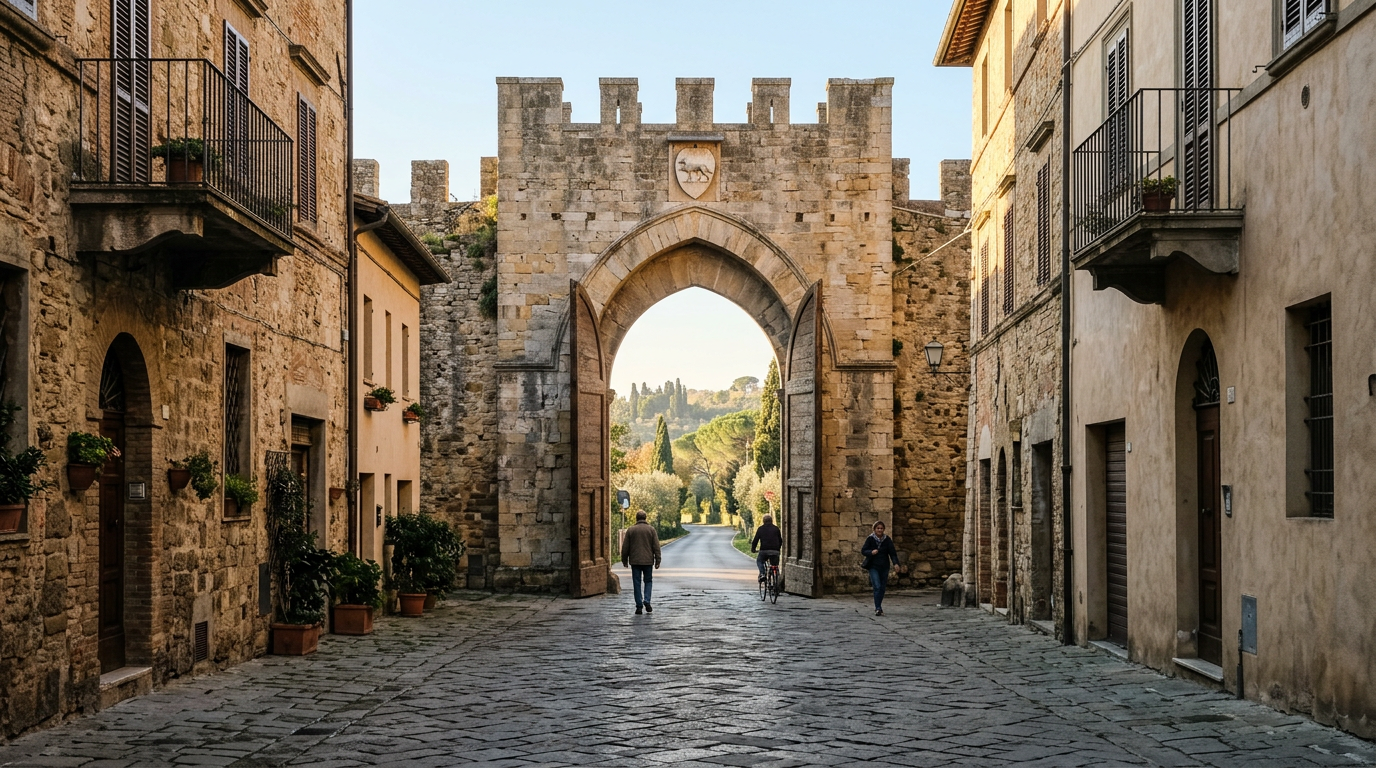
Porta Romana stands at the southern end of Via Romana, about fifteen minutes on foot from Ponte Vecchio. It is the best-preserved of Florence’s medieval city gates and one of the most monumental. It is also, for most visitors, completely unknown.
The gate marks the point where the historic centre opens into the areas that were outside the medieval walls. On one side, the dense urban fabric of Oltrarno. On the other, the beginning of the road south toward Rome that gave the gate its name.
Porta Romana: the history of the gate
Florence built its last set of medieval city walls between 1284 and 1333. These walls enclosed a much larger area than the previous circuit, taking in the neighbourhoods of San Frediano, Santo Spirito, and the area south toward the hills.
Porta Romana was one of the main southern gates in this circuit. It was constructed in 1326. The gate is built of pietra forte, the same sandy-brown sandstone used for most of Florence’s medieval buildings. It consists of a large central arch flanked by two smaller pedestrian arches.
Above the main arch, a fresco of the Madonna with saints was painted when the gate was built. The fresco is badly worn but still partially visible. Conserving it has been technically difficult because the porous stone and the exposed position make stabilisation complex.
The gate was originally equipped with a portcullis, a drawbridge over a small moat, and flanking towers. The towers were demolished in the 16th century when their defensive function became obsolete. The portcullis slot is still visible in the stonework of the arch.
During the Grand Ducal period, Porta Romana was the ceremonial entrance through which important visitors arrived in Florence from Rome and the south. The road through the gate, Via Romana, was widened and lined with public buildings to create an appropriate impression of urban grandeur.
How and when it was built
The construction of the third circuit of Florence’s walls was a major civic undertaking. The circuit ran for approximately 8.5 kilometres and included fifteen gates. Work on the circuit was interrupted by the plague of 1348 and was never fully completed. The sections to the north of the Arno were finished to a lower specification than the southern sections.
Porta Romana, in the southern section, was built to full specification. The thickness of the gate passage, approximately 8 metres, reflects the serious military intent of the original design. The walls on either side of the gate rise to about 7 metres and were originally topped with battlements.
The architect of the gate is not known. The Florentine commune employed a number of military engineers during this period, and the gate’s design reflects the state of the art in 14th-century military architecture.
The walls and gates were maintained by the commune through the medieval period but gradually fell into disuse after the Grand Duchy commissioned new defensive works in the 16th century. Most of the wall circuit was demolished during the urban expansion of the 1860s. Porta Romana survived because it was at the end of a major road rather than in the path of expansion.
The neighbourhood around the gate
The area around Porta Romana retains a character that is distinct from the more central parts of Oltrarno. It is a working neighbourhood, less visited than Piazza Santo Spirito and less prestigious than Via Maggio.
Piazza della Calza, immediately inside the gate on the Via Romana side, is a small square named after the oratory of the Compagnia della Calza, a Renaissance festive organisation that held their gatherings in the adjacent building. The oratory, now a cultural space, occasionally hosts concerts and exhibitions.
Via Romana runs north from the gate toward the centre. The street is lined with modest shops, a few restaurants, and several buildings of historic interest that are rarely mentioned in guides. The Istituto Statale d’Arte, a school of applied arts with roots in the 19th century, occupies a complex on the east side of the street.
The streets west of Porta Romana, toward Porta San Frediano, follow the line of the old city wall. Some sections of the wall survive as garden walls behind private properties. The area is residential and quiet.
Local bars and workshops in the area
Bar Settimini on Via Maffia, two blocks from Porta Romana, is a small neighbourhood bar with no pretensions and good coffee. It opens at 6:30 am and serves breakfast to the residents of the surrounding streets. A coffee costs 1.10 euros, which is the standard Florentine price.
The area around Porta Romana and Via Romana still has several traditional workshops, though fewer than a generation ago. A frame-maker on Via Romana has been in the same premises for decades. A cobbler on Via della Chiesa repairs shoes in a workshop that has not changed significantly since the 1970s.
The Oltrarno craft tradition is stronger near Porta Romana than in the more central parts of the neighbourhood. The lower rents in this part of the district have allowed artisans to continue working in spaces that would be converted to tourist shops or restaurants closer to Ponte Vecchio.
Osteria di Porta Romana on Via Romana serves straightforward Tuscan food at honest prices. The kitchen produces ribollita, bistecca, and pasta all’amatriciana depending on the season. A three-course lunch without wine costs around 20-25 euros.
How to get there from Oltrarno on foot
From Ponte Vecchio, walk south along Via Guicciardini. At Piazza de’ Pitti, turn left along Via Romana. Walk south for about ten minutes. Porta Romana appears at the end of the street.
The entire walk from Ponte Vecchio to Porta Romana takes approximately fifteen minutes at a normal pace. The route passes Palazzo Pitti, the entrance to Boboli Garden, and several notable buildings on Via Romana.
Alternatively, from Piazza Santo Spirito, walk south along Via Sant’Agostino and continue straight into Via Romana at Piazza Tasso. This route is slightly shorter and passes through a quieter section of the neighbourhood.
From Piazzale Michelangelo, Porta Romana is about twenty minutes on foot heading west and downhill. The bus line 12 connects Piazzale Michelangelo to Porta Romana in about eight minutes.
The gate itself is always accessible from the outside. There is no entry fee to pass through it. If you come in the morning before traffic is heavy, the passage through the arch in the low autumn light is genuinely impressive.
Where to stay
De’ Medici is a guesthouse in Oltrarno, with Porta Romana at a fifteen-minute walk south along Via Romana. The neighbourhood between the guesthouse and the gate is the authentic, residential Oltrarno that most visitors never reach.