The bridges of Florence: history and character
The bridges of Florence: their history
Florence owes its existence to the Arno crossing. The city began where it did because a ford, and later a bridge, made it possible to cross the river at that point. The ancient Roman road, the Via Cassia, ran from Rome to Bologna and required a reliable Arno crossing. Florence grew around that necessity.
The Romans built the first permanent bridge near the site of the current Ponte Vecchio. Evidence of this crossing has been found in archaeological investigations. The Roman bridge was wooden, like most early Roman bridges. It was replaced and repaired through the centuries.
The medieval city had several wooden bridges that were repeatedly destroyed by floods. The Arno is a treacherous river. Its water level in a heavy-rain year can rise six to eight metres above its normal level. Florence has a long history of bridges being swept away and rebuilt.
By the 14th century, the city had begun constructing stone bridges that could resist moderate flooding. The current bridge structure at the Ponte Vecchio dates to 1345, replacing an earlier stone bridge destroyed by the flood of 1333. The decision to build in stone was a response to repeated catastrophic losses.
Ponte Vecchio and its uniqueness
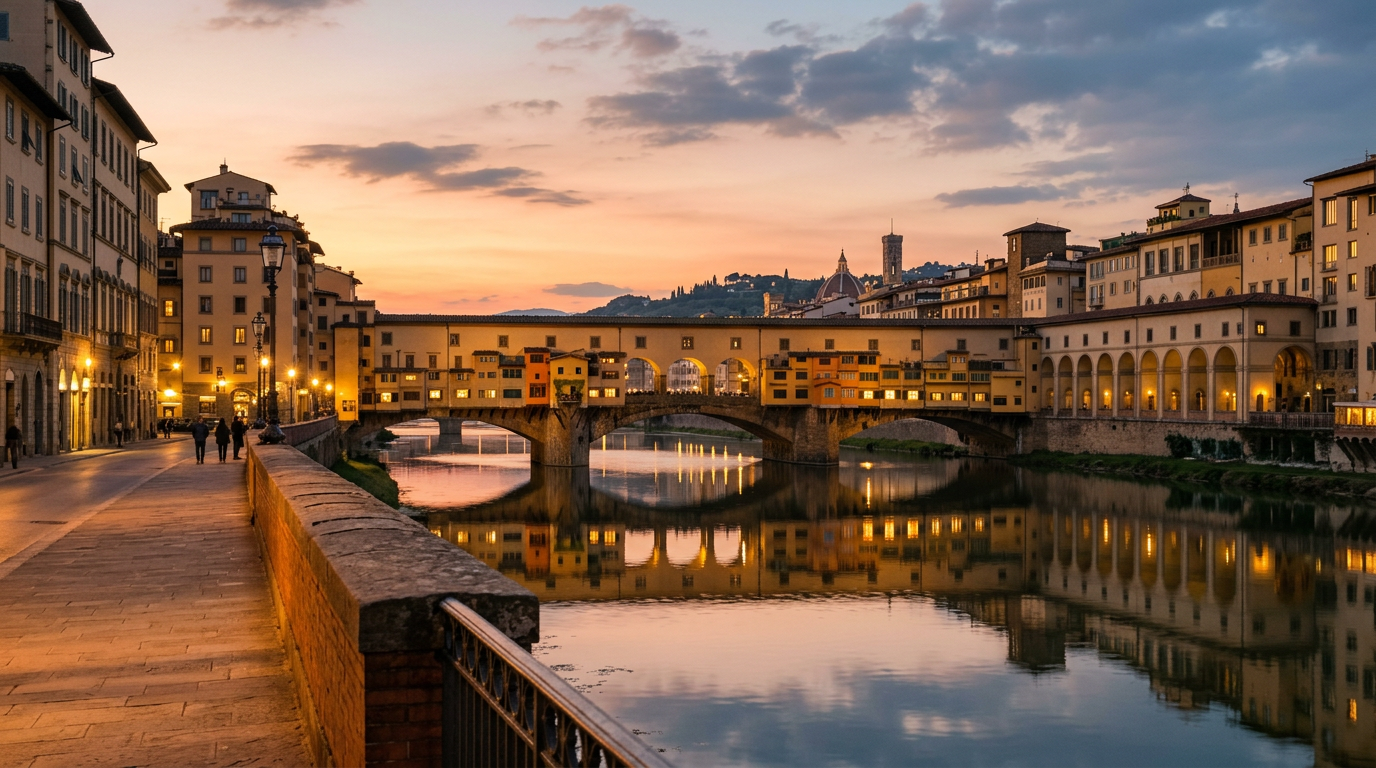
Ponte Vecchio, the old bridge, is the most famous bridge in Italy and one of the most famous in the world. Its distinctive appearance, with buildings projecting out from both sides over the water, is the result of its commercial use.
The bridge has had shops on it since the medieval period. Until 1593, these shops were occupied by butchers, fishmongers, and tanners who threw their waste directly into the Arno below. When Cosimo I de’ Medici moved the grand ducal court to Palazzo Pitti on the south bank, he built the Vasari Corridor, an elevated passageway running above the shops, to allow the court to move between the Uffizi and the Pitti without using the public streets.
Cosimo’s successor, Ferdinando I, cleared the bridge’s commercial occupants in 1593 and reserved the spaces for jewellers and goldsmiths. The connection between Ponte Vecchio and fine jewellery has been continuous since that date.
During the Second World War, the retreating German army destroyed all the bridges of Florence except Ponte Vecchio. The reason for this single exception remains disputed. The most popular explanation is that Adolf Hitler personally ordered its preservation on a visit to Florence in 1938. Documentary evidence for this is thin but the story persists. The bridge was preserved regardless of the reason, and it survived along with the medieval buildings on its sides.
The Ponte Vecchio today is extremely crowded during the day. The best time to see it is at dawn, before 7:00, when the light on the water is clear and the tourist numbers are minimal. Late evening, after 21:00, is the second best option.
Other bridges worth knowing
Ponte Santa Trinita is the most elegant bridge in Florence. The current structure was built in 1569 by Ammannati under Cosimo I de’ Medici, to a design that is sometimes attributed to Michelangelo, though this is not certain. It has three elliptical arches of remarkable flatness. Structurally, these low arches distribute the load in a way that was considered innovative in the 16th century.
The bridge was destroyed by the retreating German army in 1944 and reconstructed between 1948 and 1957. The reconstruction used original stone recovered from the Arno riverbed and attempted to reproduce the original exactly. The four statues representing the seasons at the bridge ends are from the original. One, the head of Spring, was missing until 1961 when it was found during dredging operations.
Ponte alla Carraia is the westernmost of the central Florence bridges and the most local in character. It has been rebuilt multiple times, most recently in 1948 after war damage. It is a functional crossing without architectural distinction. It connects Via dei Fossi on the north bank to Piazza Nazario Sauro in Oltrarno. At peak hours it carries a high volume of bicycle and foot traffic from neighbourhood residents.
Ponte alle Grazie, east of Ponte Vecchio, is the crossing used most often by people moving between the Uffizi area and the Oltrarno residential zones. It takes its name from a small oratory, the Oratory of Our Lady of Graces, that stood on one of the bridge’s medieval piers. The current bridge is a 20th century structure without historic character but it is useful for its location.
Legends of the bridges
The most persistent legend connected to Florence’s bridges concerns Dante Alighieri and the woman he immortalised as Beatrice. The meeting that Dante describes in his early work is traditionally placed near the Ponte Santa Trinita, on its south side. Whether Beatrice Portinari, the historical woman usually identified with Dante’s Beatrice, actually crossed this bridge and met the poet is impossible to verify.
The flood of 1333 is recorded in several contemporary chronicles as the most destructive the city had experienced. The chronicler Giovanni Villani describes the destruction of the bridges and the loss of life in vivid terms. The event was traumatic enough to be cited decades later as a reference point for time.
The story of the Nazi preservation of Ponte Vecchio has generated numerous theories and romanticised accounts. One version attributes it to a German consul named Gerhard Wolf who reportedly received the order to destroy the bridge and refused or delayed long enough for the Allies to arrive. This version is not fully documented but is widely repeated.
How to see them in the best light
The bridges are part of the visual experience of the Arno, and the Arno is best seen from other bridges or from the riverbank lungarni. Standing on Ponte Santa Trinita and looking east gives you the classic view of Ponte Vecchio with the hills behind. This view is best at late afternoon when the light comes from the west.
Standing on Ponte Vecchio and looking west toward Santa Trinita gives a different perspective. The three arches of Santa Trinita frame the sunset in January and February, when the sun sets almost directly in the line of the river.
The Lungarno Torrigiani on the south bank, between Ponte Vecchio and Ponte alle Grazie, offers a long south-facing view of the bridges and the north bank. Walk it in the morning. The north bank buildings facing you include the Uffizi, Palazzo Vecchio, and the domes of the city. The light at 8:00 in summer makes this one of the most beautiful urban walks in Italy.
From the hill above the Oltrarno, the Piazzale Michelangelo at 105 metres elevation, you see the entire sequence of the city’s bridges laid out in the Arno. This is the classic panoramic view. It is extremely crowded. Go before 8:00 or after 20:00.
Where to stay
De’ Medici is a guesthouse in Oltrarno, south of the Arno. The bridges are your connection between the two sides of the city. Every walk across the river begins and ends in the neighbourhood where you sleep.