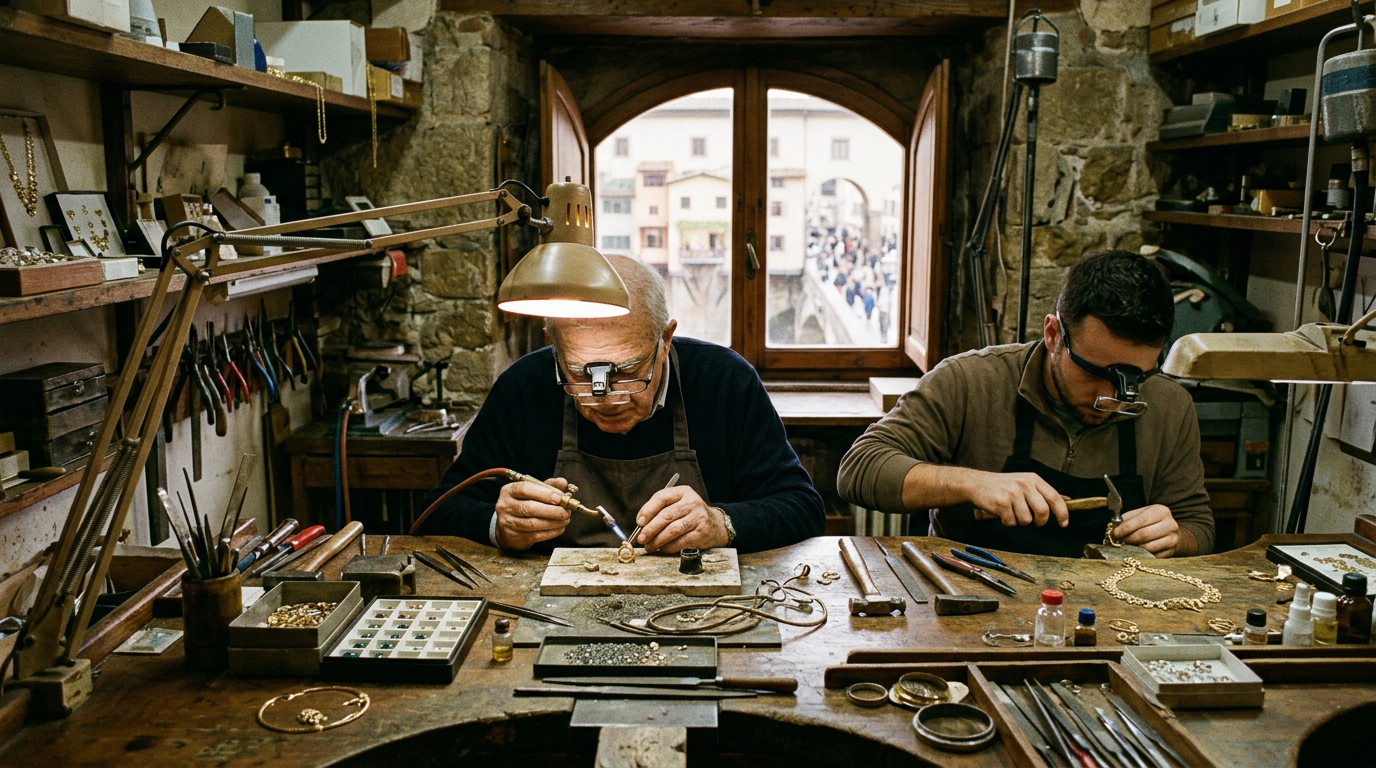
Florence goldsmiths: Ponte Vecchio and beyond
Florentine goldsmiths of Ponte Vecchio
Ponte Vecchio has had shops on its sides since the medieval period. The current occupants, jewellers and goldsmiths, are the result of a deliberate decision made in 1593 by Ferdinando I de’ Medici. He expelled the butchers who had occupied the bridge for centuries, complaining about the smells, and reserved the spaces for goldsmiths and jewellers.
The connection between Florence and fine metalwork is older than the bridge’s current tenants. The Arte del Fabbro, the smiths’ guild, was one of the most powerful in medieval Florence. Gold and silver work were produced in the city from at least the 12th century, and by the 15th century Florentine goldsmiths were working for courts across Europe.
Ghiberti, the sculptor who made the Baptistery doors, was trained as a goldsmith. Cellini, whose autobiography is one of the most vivid accounts of Renaissance artistic life, was a Florentine goldsmith who worked for the French court. The goldsmith’s tradition in Florence is not separate from the city’s artistic heritage. It is part of its foundation.
Today the workshops on Ponte Vecchio and via Por Santa Maria represent a wide range of quality and intention. Some are genuine artisan goldsmiths making objects by hand. Others are retail operations selling industrially produced jewellery at premium prices justified by the location.
The history of goldsmithing in Florence
The material basis of Florentine goldsmithing is specific. Florence was not a mining centre. The gold, silver, and gemstones used by Florentine craftspeople came from trade. Florence’s banking and merchant networks gave its craftspeople access to materials from across the known world.
The goldsmith’s workshop in Renaissance Florence was not only a production space. It was a training ground. Young artists, including Brunelleschi and Verrocchio, were apprenticed to goldsmiths before they became architects and sculptors. The discipline of working in small scale with precious materials trained the eye and the hand for larger commissions.
The specific techniques associated with Florentine goldsmithing include granulation, the application of tiny spheres of gold to a surface to create texture; filigree, the twisting of fine gold wire into openwork patterns; and niello, the inlaying of a black alloy into engraved metal surfaces to create contrast.
These techniques require different tools and different levels of training. A goldsmith who can produce fine filigree work, requiring steady hands and years of practice, commands higher prices and a different market than one who works primarily with standard castings.
Via Por Santa Maria and the workshops
Via Por Santa Maria runs from Piazza della Repubblica south to Ponte Vecchio. It was historically one of the main commercial streets in Florence, occupied by merchants and traders connected to the cloth and silk guilds. Today it is a jewellery and luxury shopping street.
The ground-floor spaces on Via Por Santa Maria and on the bridge itself range from internationally known brand names to smaller independent jewellers and working goldsmiths. The independently owned spaces are your target if you want handmade work and a direct relationship with the maker.
Look for workshops that are open to the street, where you can see a workbench with tools. A goldsmith who is actively working while serving customers is usually a craftsperson, not a retailer. Seeing a torch, a rolling mill, or a set of gravers on the workbench is a good sign.
The shops at the centre of Ponte Vecchio have the highest rents in Florence and prices reflect this. Moving slightly off the bridge, onto Via Por Santa Maria or onto Borgo Santi Apostoli running west, gives you access to workshops where the rent is lower and prices are therefore more reasonable.
How to recognise handmade jewellery
Handmade jewellery differs from cast or machine-made work in ways that are visible under close examination. Handmade objects have slight irregularities. The surfaces show tool marks, visible at an angle in good light. The weight distribution may be uneven. These are not flaws. They are signatures.
Cast jewellery, by contrast, has a uniform surface finish and perfectly regular forms. It is not inferior as jewellery, but it is not artisan work in the traditional sense. Most of the jewellery sold in the larger shops on Ponte Vecchio is cast rather than hand-fabricated.
Ask the seller directly whether the piece was made in the workshop. A genuine artisan goldsmith will be pleased to explain the process. A retailer of industrially produced goods may claim artisan production they cannot substantiate. If the answer to your question is vague, take it as information.
Hallmarks are required by Italian law on all precious metal objects. A hallmark on a piece of jewellery sold in Florence will show the metal quality and a maker’s identification mark. The presence of hallmarks is not a guarantee of artisan production, but their absence on a supposed antique or artisan piece should prompt questions.
What to buy and at what prices
A simple handmade gold band ring from a working goldsmith in Florence costs between 120 and 300 euros in 2026, depending on the weight of metal and the complexity of any surface treatment. A ring with filigree work costs between 200 and 500 euros.
Silver jewellery is significantly less expensive. A handmade silver pendant costs between 40 and 120 euros. A silver ring with stone setting costs between 60 and 180 euros. Silver is an appropriate entry point if you want to buy from a genuine artisan workshop without a large investment.
Custom commissions are the most interesting option if you have time. Describing what you want, discussing the design with the goldsmith, and returning to collect the finished piece one to two weeks later is the classical way of engaging with this craft. A custom ring in 18-carat gold costs from around 300 euros for a simple design. A more complex piece with set stones starts from 600 euros.
For vintage and antique jewellery, the antique dealers on Via Maggio in Oltrarno and the specialists in the Borghese Palace area carry legitimate pieces from the 18th through early 20th centuries. Prices vary widely. Bring knowledge or bring a trusted advisor.
Where to stay
De’ Medici is a guesthouse in Oltrarno, a short walk from Ponte Vecchio, Via Por Santa Maria, and the artisan streets of the south bank. The bridge and its surrounding workshops are part of the neighbourhood’s daily reality, not a separate attraction.