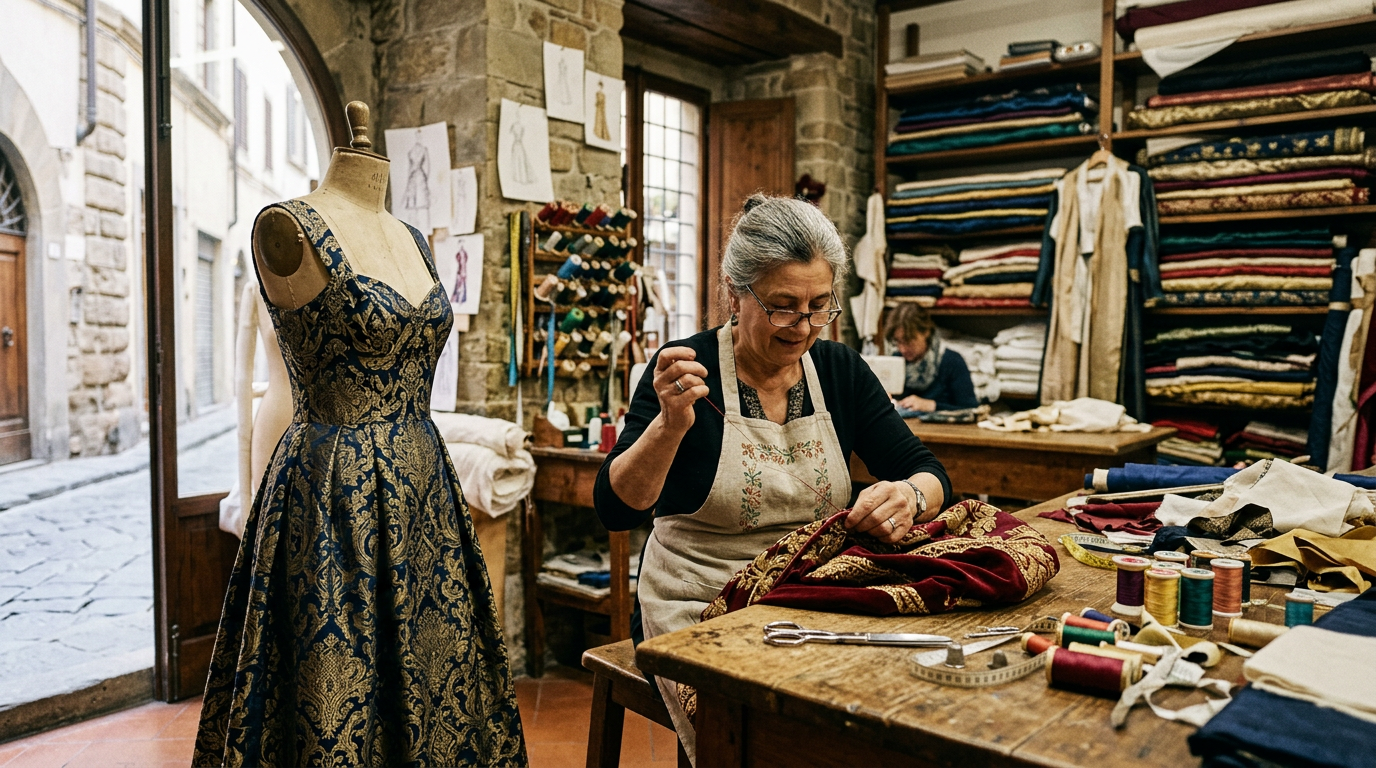
Florence artisan fashion: tailors and designers
Artisan fashion in Florence
Florence was the centre of Italian fashion before Milan assumed that role in the second half of the 20th century. Giovanni Battista Giorgini’s fashion shows at Villa Torrigiani in the 1950s launched Italian ready-to-wear internationally and established Florence as the original address of Italian style.
That moment is historical. Italian fashion is now centred in Milan. But Florence maintained a different tradition: the artisan tailor, the small atelier, the workshop that makes one garment at a time for a specific person. This tradition did not disappear when the fashion industry moved north. It adapted.
The artisan tailors and small designers who work in Florence today are not competing with the international fashion industry. They are offering something different: a relationship with a maker, a garment that fits a specific body, and a process that takes weeks or months rather than hours.
Oltrarno, as the neighbourhood of artisans, has a natural concentration of people working in this way. The streets around Piazza Santo Spirito, Via dei Serragli, and Borgo San Frediano have a small but notable cluster of independent designers, bespoke tailors, and fabric specialists.
Historic tailors
The sartoria, the tailor’s workshop, has a continuous history in Florence that predates the modern fashion industry by centuries. The Arte della Lana, the wool guild, and the Arte della Seta, the silk guild, were among the most powerful medieval guilds in the city. Their wealth built palaces and financed art. Their craft knowledge was transmitted through workshops for generations.
The historic sartorie that survive in Florence today work with a mix of bespoke and semi-bespoke production. A full bespoke suit, where a pattern is made from scratch for a specific customer, requires three to four fittings over two to three months. A semi-bespoke process, adapting a standard pattern to the individual, takes two to three fittings over four to six weeks.
Several tailors in the historic centre have been in continuous operation for over fifty years. They serve a local clientele that includes Florentine families who have used the same tailor across generations. These businesses do not rely on tourism and do not need to market themselves.
Finding them requires local knowledge or a recommendation. Asking at a traditional local hotel, a hairdresser, or any other local business is more productive than searching online. These businesses are often not well represented on the internet.
Emerging designers in Oltrarno
The past decade has seen a number of younger designers establish small studios in Oltrarno. Many trained in Italy or abroad in fashion and textile design before returning to Florence to work independently. They tend to produce small collections, work with Florentine or Italian-produced fabrics, and sell through their own studio spaces.
The business model is different from the traditional tailor. These designers produce limited runs of ready-to-wear pieces alongside custom orders. You can buy from their stock or commission something specific. The production scale is small, which means each piece is close to handmade even when it is not strictly bespoke.
Several studios have opened along Borgo San Frediano and the streets connecting it to Piazza del Carmine. These spaces are also typically retail spaces. You can walk in, look at what is available, and begin a conversation about a commission if nothing in stock suits you.
The fabrics these designers use are often sourced from the historic Florentine fabric houses and from the Prato textile district, 18 kilometres to the northwest. Prato has been a textile production centre since the medieval period and still produces fabrics for designers across Italy and Europe. Several of the emerging Oltrarno designers source directly from Prato mills.
How to find a bespoke garment
The first step is identifying what you want. A bespoke shirt, a tailored jacket, a made-to-measure pair of trousers, or a full suit are all different commitments in terms of time, fittings, and budget. Knowing before you make contact allows the tailor or designer to give you accurate information.
Contact in advance is essential. Walking into a sartoria or designer studio without an appointment is possible, but a phone call or email first is more respectful and more productive. Italian craftspeople appreciate people who treat their time seriously.
At the first meeting, bring reference images of what you want if you have them. This is not required but it accelerates the conversation. Discuss the fabric, the cut, and the occasion for which the garment is intended. A good tailor will ask questions that help them understand what you actually need.
The fitting process is not negotiable. Bespoke tailoring requires fittings. If you cannot return to Florence for multiple fittings, discuss whether the tailor works with remote clients, accepting measurements and photographs between visits. Some do. Others require physical presence for each stage.
Prices and production times
A bespoke shirt from a Florentine tailor costs between 150 and 400 euros in 2026, depending on the fabric, the number of fittings, and the reputation of the maker. This is significantly more than an off-the-shelf shirt from a quality brand. It is also a different object: made for your specific dimensions and your chosen fabric.
A bespoke jacket costs between 600 and 2,000 euros. A full suit costs between 1,200 and 4,000 euros. These prices put Florentine tailoring in the same range as established British and Neapolitan tailors. The quality justifies the investment if you wear the garment regularly.
Semi-bespoke, which adapts existing patterns, is less expensive. A semi-bespoke shirt costs 80 to 200 euros. A semi-bespoke jacket costs 400 to 900 euros. The fit is not as perfect as full bespoke, but it is dramatically better than ready-to-wear.
Production times for a shirt are typically four to six weeks. For a jacket or suit, eight to twelve weeks is standard. If you are commissioning something and travelling, discuss whether the garment can be shipped to you once complete. Most tailors will do this for trusted clients.
Where to stay
De’ Medici is a guesthouse in Oltrarno. The neighbourhood’s emerging designers and the historic centre’s established tailors are all reachable on foot. Staying here gives you the time and proximity to develop the relationships that good bespoke work requires.