Florence Antique Market Sunday: Complete Guide
Antique Markets in Florence: A Practical Guide
Florence is one of the best cities in Italy for antiques. The concentration of old wealth, the tradition of skilled craftsmanship, and the centuries of continuous habitation mean that remarkable objects circulate through the markets here at prices that are often lower than in Rome or Milan.
You do not need to be a specialist to enjoy the antique markets. Going with curiosity and a small budget is enough to find something worthwhile.
Antique markets in Florence
Florence has several distinct markets covering different price ranges and types of objects. The main ones are the monthly market at Santo Spirito, the permanent flea market at Piazza dei Ciompi, and the high-end antique fair Biennale dell’Antiquariato.
The Mercato delle Pulci (flea market) at Piazza dei Ciompi on the north side of the Arno operates daily except Monday. It is the most accessible market for casual visitors: open every day, permanent stalls, and a wide range of prices.
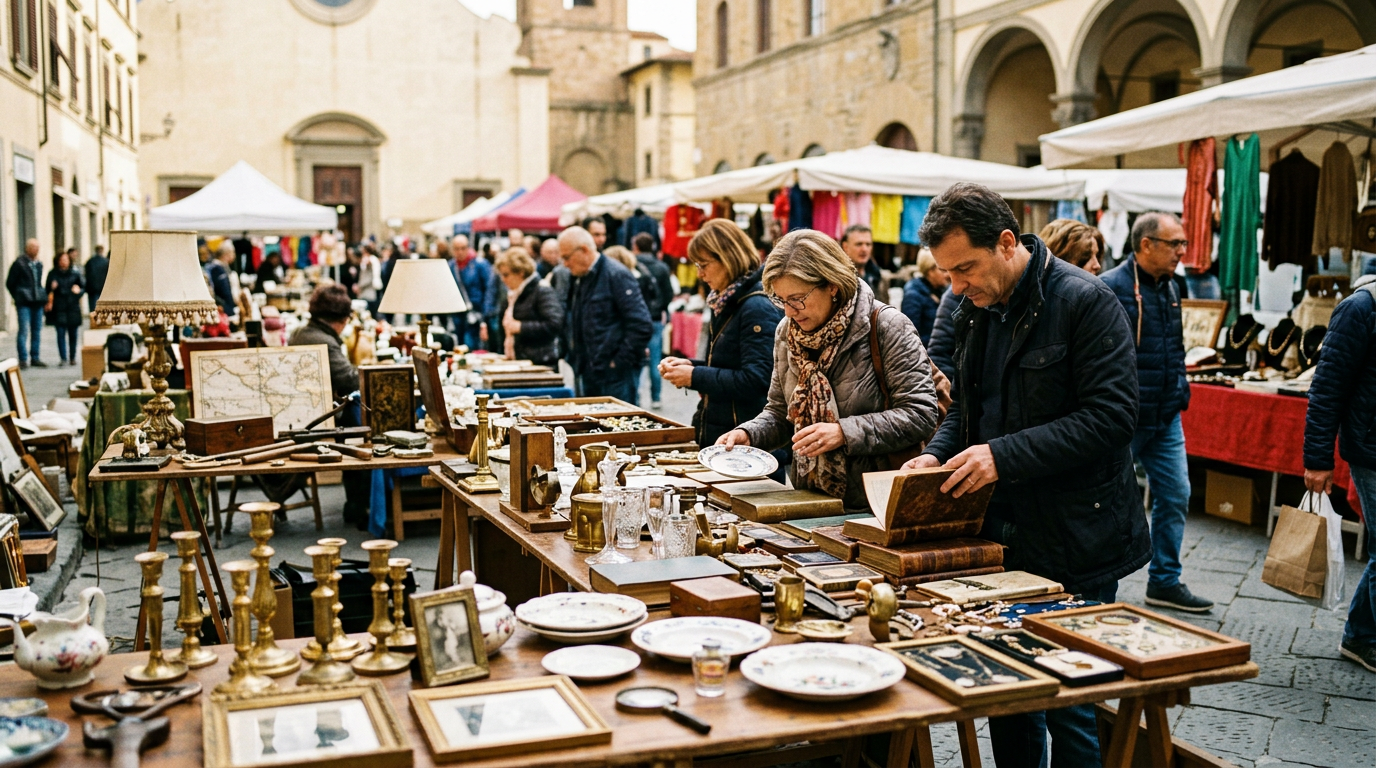
The monthly market at Santo Spirito is the best in terms of quality and atmosphere. It runs on the second Sunday of each month and draws dealers from across Tuscany.
For serious antique collectors, the Mostra Mercato dell’Antiquariato at Piazza dei Saltarelli near Palazzo Vecchio runs on the third Sunday of each month. The quality is higher and the prices reflect that.
Santo Spirito market every second Sunday
The antique market in Piazza Santo Spirito is held on the second Sunday of each month. Stalls set up from around 9 am and begin to pack down by 2 pm.
The square fills with around forty to sixty dealers selling a wide range of objects: silver, ceramics, jewellery, prints, maps, books, paintings, glass, textiles, and small pieces of furniture. The objects range in age from the 18th century to the mid-20th century.
Quality varies significantly. Some dealers are specialists with deep knowledge of what they sell. Others are generalists who buy from estate clearances and sell everything without detailed provenance.
Arriving early gives you the best choice and also avoids the crowd that builds between 10 and 11:30 am. By noon, the serious dealers have often sold their best pieces. By 1:30 pm, many stalls begin to pack up.
The market takes place in the same square as the organic food market, which runs on the same Sundays. You can combine both visits easily. The food market typically occupies the southern end of the square while the antiques stalls fill the northern end.
Nearby, Via Maggio is one of the most important streets for established antique dealers in Florence. Many of the shops on this street are open on Sunday mornings, and browsing the window displays after visiting the market is worthwhile even if you are not buying.
The Flea Market at Piazza dei Ciompi
Piazza dei Ciompi is a small square in the Sant’Ambrogio neighbourhood, about fifteen minutes on foot from Ponte Vecchio across the Arno. The permanent flea market here has operated for decades.
The stalls sell a lower-priced range of objects than the Santo Spirito market: old kitchen utensils, vintage clothing, second-hand books, Soviet-era watches, old photographs, postcards, and small decorative items. Objects from the post-war period and the 1970s are particularly well represented.
On the last Sunday of each month, the market expands significantly. Additional dealers set up in the surrounding streets, and the range of objects widens to include larger furniture and more valuable pieces.
The permanent stalls are open Tuesday to Saturday from roughly 9 am to 7 pm. Monday is the closing day for most stallholders.
Piazza dei Ciompi is also a pleasant place to eat. The Trattoria da Rocco at the nearby Mercato di Sant’Ambrogio serves a simple lunch at very low prices. This is a good market to combine with a morning at the food market and a lunch nearby.
How to bargain
Bargaining is accepted at both the Santo Spirito market and the flea market at Piazza dei Ciompi. At high-end antique shops on Via Maggio, it is less common and should be approached differently.
At market stalls, the simplest approach is to ask the price, then offer between 70 and 80 percent of it. If the dealer accepts immediately, you may have underbid. If they counter with a number between your offer and their original price, that is the normal process.
Bargaining works better when you are buying more than one item from the same stall. Offering to take two or three items together gives the dealer a reason to reduce the individual prices.
Do not bargain aggressively or suggest that an item is overpriced or of poor quality. This is considered bad manners by Italian dealers and will make the negotiation more difficult rather than easier.
Cash is strongly preferred at all markets. Having the exact or near-exact amount ready makes the transaction smoother and sometimes gets you a better price.
If a price seems very low for an object that appears valuable, ask the dealer about the provenance and condition. A low price sometimes reflects a problem that is not immediately obvious: a repair, a replacement part, or a provenance issue.
What to look for and what to avoid
Good categories for buying at Florentine antique markets include: printed ephemera (old maps, botanical prints, architectural engravings), sterling silver cutlery and small objects, ceramics from Tuscan manufacturers, and linen and embroidered textiles.
Maps and prints are particularly good value in Florence. The city has been a centre of engraving and cartographic production since the 16th century. Old prints of Tuscany, Florence, and the surrounding cities circulate regularly through the markets. Prices for genuine 18th-century engravings start at around 30-50 euros.
Sterling silver is sold by weight plus a dealer’s margin. Ask to see the hallmarks on any silver object. Italian silver from the 19th and early 20th centuries is typically marked with a purity stamp and a silversmith’s mark. If these are absent, the metal is likely plated.
Avoid buying oil paintings unless you have specific knowledge of what you are looking at. The market for paintings in Florence includes many reproductions, re-attributions, and objects of uncertain provenance. The prices are high and the risks are significant.
Also be cautious about terracotta or majolica pieces described as “antique.” Florence and the surrounding region produce a great deal of high-quality reproduction work. Some of it is very convincing.
Where to stay
De’ Medici is a guesthouse in Oltrarno, a three-minute walk from Piazza Santo Spirito and the second-Sunday antique market. You can be at the stalls by 9 am and back for breakfast by 10.