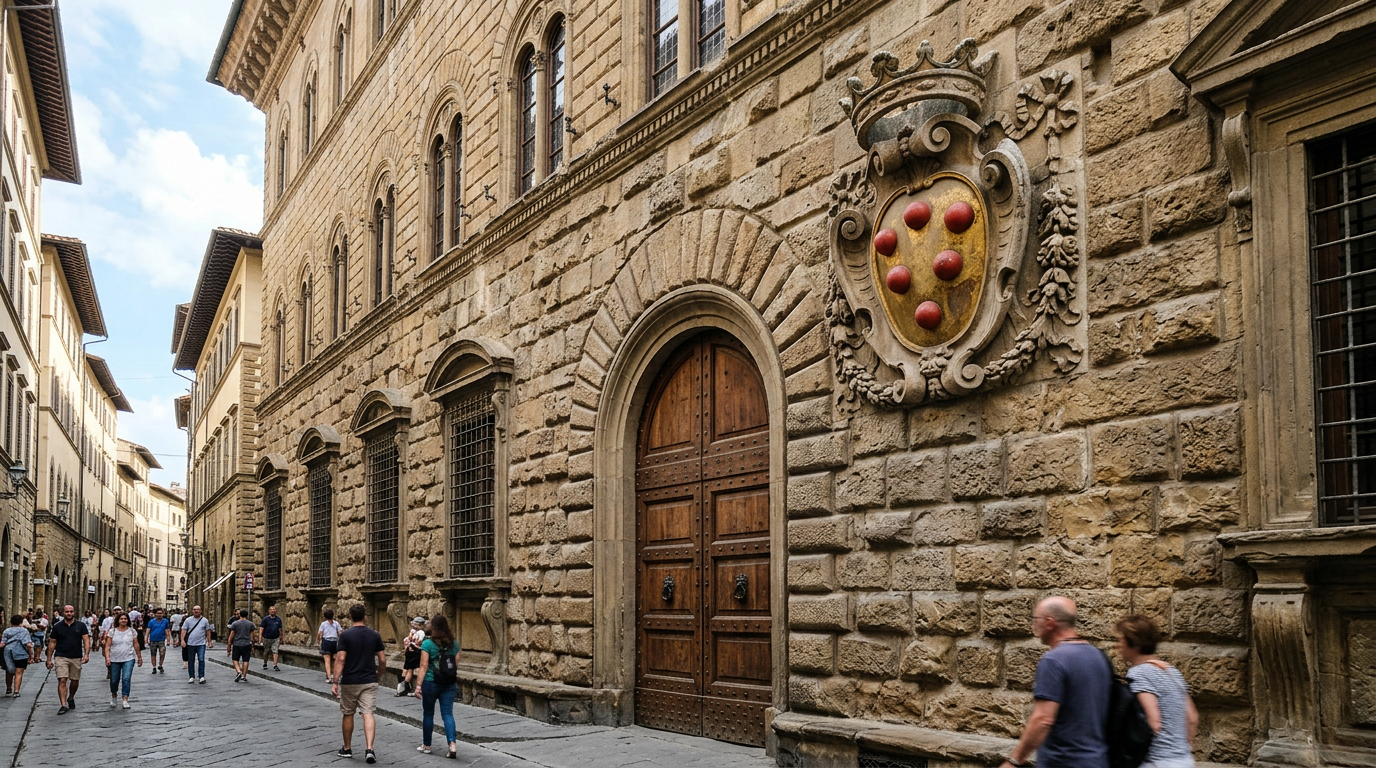
Florence Medici History Curiosities: Hidden Facts
The Medici: Facts You Will Not Find in the Guidebooks
The Medici family is one of the most documented dynasties in European history. Generations of historians, biographers, and novelists have written about them. Yet much of what circulates as fact about the Medici is simplified or distorted.
Here are aspects of the family that tend to be overlooked or misrepresented in popular accounts.
The Medici: facts you will not find in books
The Medici were not aristocrats. This is the most important thing to understand about them. They were bankers, merchants, and money-changers who accumulated wealth through commerce and financial services.
Their social and political rise was contested throughout the 15th century. Several attempts were made to overthrow them, including the Pazzi Conspiracy of 1478, in which Lorenzo de’ Medici’s brother Giuliano was murdered in the Duomo during High Mass. Lorenzo survived only because he was quicker than his attackers.
The Medici were also not a single coherent family with a unified project. Different branches of the family had different interests, different temperaments, and different relationships with the city. The contrast between Cosimo il Vecchio, a cautious and secretive operator, and Lorenzo il Magnifico, a public and cultural figure, illustrates how much variation existed within the same family.
The name “de’ Medici” means “of the Medici” in Italian, using the partitive article that indicated membership of a family group. The family is often referred to simply as the Medici, without the particle. Both forms are correct.
The Medici art collection
The Medici art collection began in the early 15th century and grew for over three hundred years. By the time of the last Grand Dukes, it encompassed tens of thousands of objects: paintings, sculpture, goldsmith’s work, gems, cameos, drawings, manuscripts, and scientific instruments.
Most of what is now in the Uffizi Gallery was originally part of the Medici collection. The Uffizi building itself was commissioned by Cosimo I as government offices (uffizi means offices) and the upper floor was converted into a gallery for the family collection by Francesco I in the 1560s.
The collection was not simply accumulated through purchase. The Medici received works as gifts, took objects as loan security from clients who defaulted, collected ancient Roman pieces, and commissioned new works from the leading artists of the time.
Lorenzo il Magnifico was particularly important as a collector of antiquities. His collection of ancient gems and cameos was the most important in Florence and influenced the work of artists, including the young Michelangelo, who had daily access to the objects in Lorenzo’s household.
The Cameo Farnese, a Hellenistic sardonyx cameo of the 3rd century BC now in Naples, passed through the Medici collection. The Lapis Lazuli Vase in the Uffizi, a Roman cameo vase with the initials LAUR MED carved into the base, is one of the most tangible relics of Lorenzo’s personal collection.
Renaissance patrons
The Medici were not the only important patrons in Renaissance Florence. The Tornabuoni, Strozzi, Pazzi, Rucellai, and Sassetti families were also significant commissioners of art and architecture.
Domenico Ghirlandaio’s fresco cycle in the Tornabuoni Chapel in Santa Maria Novella, painted between 1485 and 1490, was commissioned by the Tornabuoni family, not the Medici. It is one of the masterpieces of Florentine Quattrocento painting. The young Michelangelo worked briefly in Ghirlandaio’s workshop during the period the cycle was being painted.
The Rucellai family commissioned Leon Battista Alberti to design the facade of Santa Maria Novella, completed in 1470. This facade, the first in Florence to use classical proportional systems derived from Alberti’s theoretical writings, was a private commission by a family anxious to associate itself with the new humanist culture.
The competition between these families partly explains the extraordinary density of patronage in 15th-century Florence. Each family wanted to demonstrate its wealth, piety, and cultural sophistication through buildings and artworks. The Medici participated in this competition, but they did not monopolise it.
The lesser-known members of the dynasty
Poliziano (Angelo Poliziano), the poet and humanist who lived in the Medici household under Lorenzo, was not a Medici but was one of the most important figures in the cultural world they created. His translations from Greek, his Latin poetry, and his vernacular verse influenced generations of writers.
Anna Maria Luisa de’ Medici, the Electress Palatine, is the least celebrated and most consequential member of the dynasty. Born in 1667, she was the daughter of Cosimo III. When she died in 1743, she left the entire Medici collection to the city of Florence through a deed that prohibited the removal of any object from the city.
Without this act, the collection would almost certainly have been dispersed by the Habsburg-Lorraine dynasty that succeeded the Medici. The Uffizi, the Bargello, the Pitti, and the dozens of other Florentine collections owe their existence in Florence to this single woman.
Cardinal Leopoldo de’ Medici, the brother of Ferdinando II, was responsible for founding the Uffizi’s collection of artists’ self-portraits in the 17th century. He actively solicited self-portraits from the leading artists of the day, including Rembrandt and Velazquez. The Corridoio Vasariano’s collection of self-portraits is now the most important in the world.
How to visit the Medici sites
The main Medici sites in Florence include: Palazzo Medici Riccardi on Via Cavour (the original family palace, with the Magi Chapel by Benozzo Gozzoli), the Cappelle Medicee at San Lorenzo (Michelangelo’s New Sacristy and the Princes’ Chapel), the Uffizi Gallery, and Palazzo Pitti with Boboli Garden.
Palazzo Medici Riccardi is open Monday to Sunday except Wednesday. Entry costs 10 euros. The Magi Chapel contains one of the most ambitious and beautiful fresco cycles of the 15th century, painted between 1459 and 1461.
The Cappelle Medicee at San Lorenzo are open Tuesday to Sunday. Entry costs 9 euros. Michelangelo’s tombs of Lorenzo and Giuliano de’ Medici in the New Sacristy are among his most profound sculptural achievements.
For the complete Medici experience in one neighbourhood, spend a morning at Palazzo Pitti and Boboli Garden and an afternoon walking through Oltrarno. The neighbourhood’s concentration of Renaissance palaces, built by families who followed the Medici Grand Dukes south of the Arno, is the best context for understanding the dynasty’s urban impact.
Where to stay
De’ Medici is a guesthouse in Oltrarno, steps from Palazzo Pitti and the Boboli Garden. The guesthouse name is a direct reference to the family that transformed this neighbourhood into the centre of a Renaissance grand duchy.