Florence Legends and Stories: Oltrarno Guide
Legends of Oltrarno: Stories of the Neighbourhood
Every old city accumulates stories. Florence is older than most, and Oltrarno, the neighbourhood south of the Arno, has been inhabited continuously since Roman times. The layers of history produce a rich sediment of legend, rumour, and collective memory.
Some of these stories are documented. Others are impossible to verify. The most interesting ones sit in the space between fact and invention.
Legends of Oltrarno
Legends in Oltrarno tend to cluster around particular types of place: old palaces, churches, narrow alleys, and the gates in the medieval city wall. These are the places where the past is most physically present, and where the imagination most easily fills the gaps in the record.
The neighbourhood also has a tradition of secrecy. Oltrarno was for centuries the home of artisan guilds, which had their own rituals and internal hierarchies. Florentine aristocrats built their palaces here precisely because the south bank was less public and less scrutinised than the centre north of the Arno. This culture of discretion fed the growth of legend.
Not all Florentine legends originate in Oltrarno, but the neighbourhood has contributed significantly to the city’s store of stories. Several are described here, with notes on their historical basis where this is known.
The ghost of Palazzo Pitti
The most persistent legend associated with Palazzo Pitti involves the ghost of Bianca Cappello, the Venetian noblewoman who became the mistress and eventually the wife of Francesco I de’ Medici, Grand Duke from 1574 to 1587.
Bianca and Francesco died on the same day, 19 October 1587, within hours of each other. The official version was that both died of malaria contracted during a stay at the Medici villa at Poggio a Caiano. The simultaneous deaths fuelled immediate suspicion. Francesco’s brother, Cardinal Ferdinando de’ Medici, who became Grand Duke immediately afterwards, was widely suspected of having arranged their poisoning.
No definitive historical evidence of poisoning has ever emerged. But the story persisted. Bianca’s ghost was said to appear in the rooms of Palazzo Pitti, particularly in the apartments facing the inner courtyard, on the anniversary of her death.
The legend is partly sustained by the fact that Bianca was genuinely unpopular with the Florentine aristocracy, who resented a Venetian woman’s influence over the Grand Duke. After her death, her memory was systematically suppressed by the Medici court. This suppression itself became part of the legend.
Stories of the alleyways
Via dei Vellutini, a short alley off Piazza Santo Spirito, takes its name from the vellutai, the velvet weavers who worked here in the medieval and Renaissance periods. According to local tradition, the alley was also used at night by members of a compagnia laudese, one of the religious brotherhoods that organised processions and devotional events in medieval Florence.
These brotherhoods met in the oratories attached to churches, sometimes late at night for nocturnal devotions. The sound of their chanting in the narrow alleys contributed to stories of supernatural presences. Several alleys in Oltrarno acquired reputations for strange nocturnal sounds that were later interpreted as ghostly.
The sotterranei (underground passages) of Oltrarno are the subject of numerous stories, most of them impossible to verify. The topography of the neighbourhood, built on the slope of a hill with a high water table at the base, means that many buildings have cellars that were once connected by service passages. Some of these passages still exist but are mostly inaccessible.
Stories of secret passages connecting Palazzo Pitti to the Boboli Garden and beyond are probably based on the actual service corridors that exist within the building complex. The Corridoio Vasariano, the elevated walkway above the streets, generated its own stories: the Grand Duke reportedly used it to move through the city invisibly, observing without being seen.
Secrets of the churches
The oratory of the Compagnia dei Neri, once located in Oltrarno, was the headquarters of the brotherhood that provided spiritual comfort to condemned men before their execution. The brothers accompanied prisoners to the scaffold, showed them images of the Virgin, and afterwards buried the bodies.
This confraternity, like others in Florence, maintained strict secrecy about its membership. Members wore hooded robes at public functions, which gave them an air of mystery. The streets where they processed at night became associated with fear and supernatural occurrence.
Santa Maria del Carmine has its own stories. The Brancacci Chapel frescoes were damaged in a fire in 1771 that destroyed most of the rest of the church’s interior. The frescoes survived largely intact. This survival was attributed by some to miraculous protection. The more straightforward explanation is that the chapel walls are of a different construction from the rest of the church and were less exposed to the fire.
The crypt of Santa Felicita contains burials dating from the Roman period. The church stands on one of the oldest Christian sites in Florence, and the subterranean layers beneath it are archaeologically significant. Some accounts suggest the existence of a Roman-era road level below the current foundations, though systematic excavation has not been carried out.
True stories and invented ones in the neighbourhood
Distinguishing between documented history and popular legend in Oltrarno is not always straightforward. The historical record is extensive but uneven. Documents survive in the Florentine state archives for many buildings and families, but gaps are frequent.
The story of Bianca Cappello’s poisoning falls into a category of events that were plausible, widely believed at the time, and never definitively proven. Modern forensic analysis of the bodies of Francesco and Bianca, exhumed in the early 2000s, found traces of arsenic. This supports the poisoning theory without conclusively proving it.
Other stories have clear documentary origins. The legend of the “Buca di San Lorenzo”, a supposed underground passage beneath the church of San Lorenzo, is based on actual drainage channels visible in the crypt. These were constructed in the medieval period and have no secret or sinister purpose.
The most interesting legends are those that reflect genuine social tensions: resentment of foreign-born nobles, suspicion of fraternal organisations, fear of nocturnal activity in the streets. These tensions were real. The stories that grew from them tell you something true about the society that produced them, even when the specific events they describe are invented.
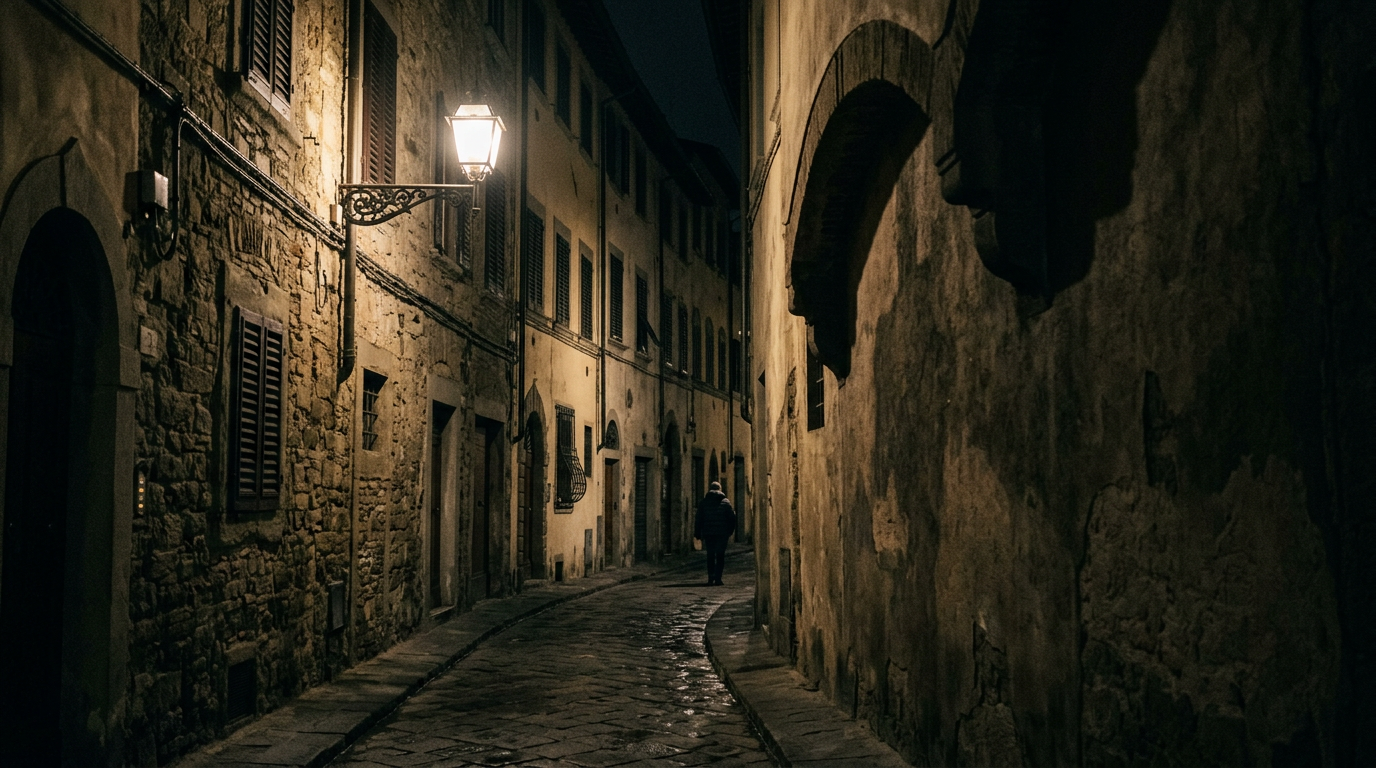
Walking through Oltrarno in the evening, you are in the same physical space where these stories took shape. The alleys are still narrow. The palace walls still rise three storeys without windows at street level. The sense of enclosed, layered history that fed the legend-making tradition is still present.
Where to stay
De’ Medici is a guesthouse in Oltrarno, in the neighbourhood where centuries of history have layered fact and story into the stone of the streets. The legends are all within walking distance.