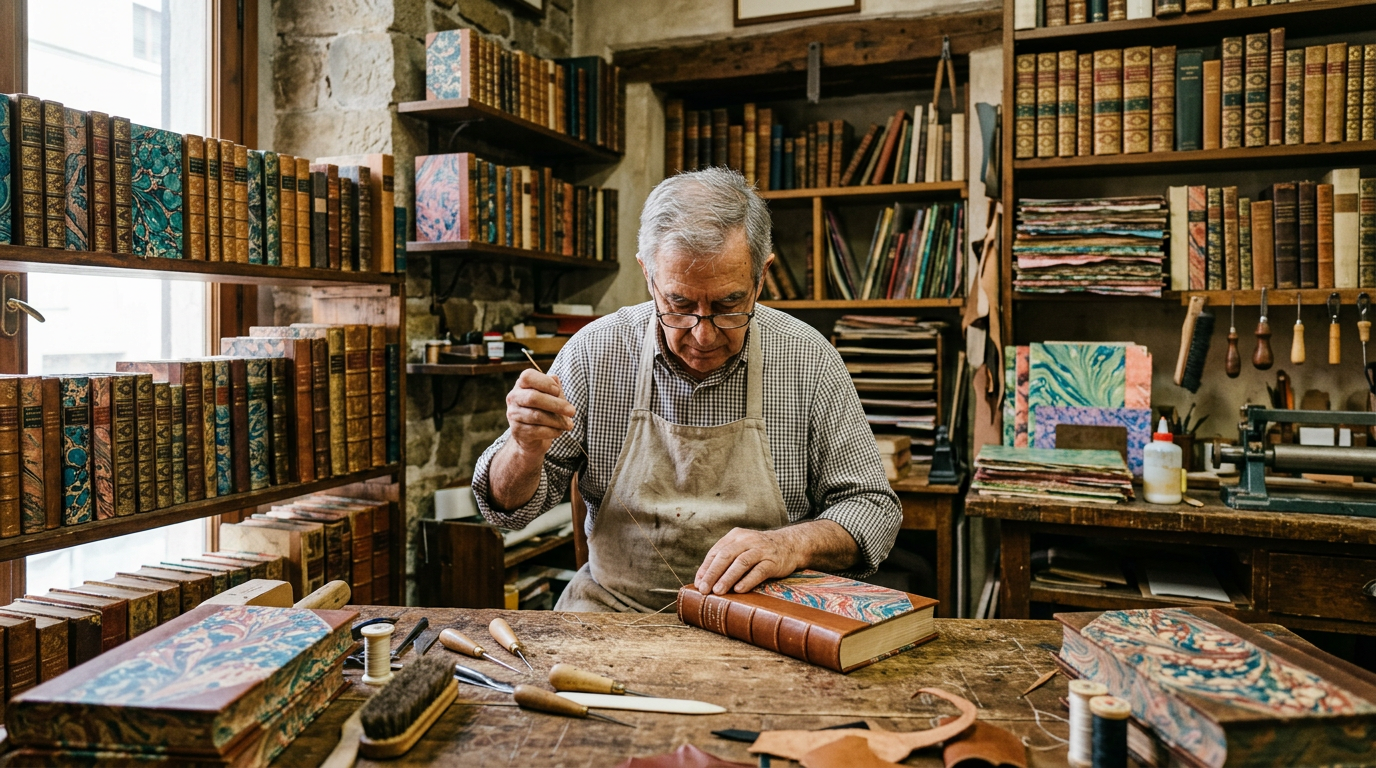
Florence artisan bookbinders: a living tradition
Artisan bookbinders of Florence
The bookbinding tradition of Florence is one of the most distinctive and most durable of the city’s many craft legacies. It is connected to Florence’s central role in the history of Western writing, manuscript production, and eventually printed books.
The Medici were passionate collectors of manuscripts and books. The Biblioteca Medicea Laurenziana, founded in the 15th century and housed in a building designed by Michelangelo, contains some of the most important manuscripts in the world. The demand for high-quality bindings that this collection generated helped establish Florence as a centre of bookbinding craft.
By the 16th and 17th centuries, Florentine binderies were exporting their work across Europe. The distinctive marbled paper that became associated with the city was developed here, inspired by Ottoman and Persian marbling traditions but transformed into something uniquely Florentine.
Today the city has several dozen active bookbinders, ranging from large commercial operations to tiny one-person workshops in Oltrarno. The proportion making things truly by hand, using traditional techniques and materials, is smaller. But it exists, and the quality it produces is outstanding.
Florentine marbled paper
Carta marmorizzata, the swirled, patterned paper associated with Florence, is produced by floating paint on a thickened liquid base and carefully laying a sheet of paper on the surface to transfer the pattern. Each sheet is unique because the floating paint moves differently every time.
The technique requires a specific combination of materials. The size, the thickened liquid base, is traditionally made from carrageenan seaweed or from carragheen. The paints must be water-based and ground finely. The paper must be prepared with a mordant, usually alum, to accept the transfer.
Patterns in Florentine marbled paper include the combed pattern, the peacock pattern, and the antique spot pattern. Each is created by drawing a comb or stylus through the floating paint before the transfer. The peacock pattern is the most dramatic and requires the most skill.
Genuine hand-marbled paper costs between 8 and 25 euros per sheet depending on size and complexity. Machine-printed imitations, widely sold in tourist shops, cost 1 to 3 euros and are identifiable by their uniform pattern repetition and plastic texture.
The genuine article has an irregular, flowing quality that changes as you move the paper. No two sheets are identical. The surface has a slight texture from the paint transfer. Looking at the back of the sheet, you can see the paper prepared with the alum mordant, which gives it a slightly different feel from standard paper.
Still-active workshops
Giulio Giannini e Figlio on Piazza Pitti is one of the oldest continuously operating bookbinderies in Florence. The shop has been at its current address since 1856. The ground floor sells finished products, including marbled paper, notebooks, and leather-bound albums. The workshop above is active. The binding techniques used are traditional.
Il Torchio on Via dei Bardi has been producing hand-marbled paper and hand-bound books for several decades. The workshop is small. You can see the marbling process through the window or by arrangement. Products include notebooks, frames for photographs, and loose sheets of paper.
Legatorio Piazzesi on Piazza Santa Croce is slightly outside Oltrarno, north of the Arno, but is worth including for the quality and range of its work. One of the oldest marbling workshops in Florence, it produces paper using techniques documented from the 17th century.
Several newer workshops have opened in Oltrarno in the past decade. These tend to be run by younger artisans who trained traditionally but have updated their product range to include items that function in contemporary daily life. Notebooks designed for laptop users, card holders, and agenda formats are common.
What to buy and at what prices
A hand-marbled paper notebook with a leather cover, A5 size, costs between 25 and 55 euros in a genuine Florentine bindery. The same object produced industrially and sold in tourist shops costs 10 to 20 euros. The visible difference in quality is significant. The genuine article is an object that will last for decades.
A set of four hand-marbled sheets in A4 size makes an excellent and affordable purchase. Expect to pay between 15 and 35 euros for a set from an active workshop. These can be framed, used as wrapping paper, or kept as examples of the craft.
Leather-covered photo albums from a genuine bindery range from 40 to 150 euros depending on size and the quality of the leather. The binding structure, the way the album is sewn and glued, determines how well it will hold up over years of use. Ask to open and close the album several times before buying. It should lie flat without resistance.
Bespoke bookbinding, where you bring your own text or chose specifications for a new book, is available from most workshops. A custom-bound book or diary with your choice of paper, binding structure, and cover material takes two to four weeks to produce. Prices start at around 60 euros for a basic notebook and rise with complexity.
How to visit a bookbinding workshop
The best way to visit a bookbinding workshop is to go during working hours and introduce yourself simply. Tuesday through Friday is typically the best time. Monday is often used for administration and planning. Saturday is variable.
A genuine bookbinder will not be offended by a polite visit. If the door is open and the person inside is working, approaching the threshold and asking if a brief visit is possible is entirely appropriate. Most artisans in Oltrarno are happy to explain their work to genuinely curious visitors.
Several workshops now offer scheduled lessons in bookbinding or paper marbling. A two-hour lesson in hand marbling costs between 40 and 70 euros per person. A half-day bookbinding workshop costs between 60 and 120 euros. These are genuine skill-transmission experiences, not tourist entertainment.
Booking a lesson requires contact in advance. Most workshops accept enquiries by email or phone. Response times can be slow. Plan this at least a week in advance if you want to guarantee a place.
Where to stay
De’ Medici is a guesthouse in Oltrarno, within walking distance of the most significant active bookbinding workshops in Florence. The neighbourhood is the natural base for exploring a craft that has defined Florentine cultural identity for five centuries.