Florence Historic Gardens Visit: Oltrarno Guide
Historic Gardens of Oltrarno: A Practical Guide
Oltrarno has more historic garden space per square kilometre than any other neighbourhood in Florence. Three major historic gardens are accessible within a fifteen-minute walk of each other, all on the hillside above the south bank.
These are not public parks in the modern sense. They are designed landscapes with centuries of history, created by wealthy families and the Grand Ducal court as extensions of the palaces they served.
Historic gardens of Oltrarno
The three main historic gardens in Oltrarno are Boboli, Bardini, and the Giardino delle Rose. Each has a different character, a different relationship to the hillside, and a different degree of accessibility.
Together they represent a continuous green space running from behind Palazzo Pitti to the bastion above San Niccolò, covering the south-facing slopes of the Colle di San Giorgio and the Colle di San Miniato.
Visiting all three in a single day is possible but tiring. A better approach is to visit Boboli and Bardini together on one morning, and reserve the Giardino delle Rose for a separate, shorter visit.
Boboli Garden: practical tips
Boboli is the largest historic garden in Florence and one of the most important in Italy. It covers approximately 45,000 square metres behind Palazzo Pitti. The garden was begun in 1549 under the direction of Niccolò Tribolo for Eleonora di Toledo, wife of Cosimo I de’ Medici, and was expanded and modified over the following two centuries.
Entry to Boboli is included in the combined ticket for Palazzo Pitti and its museums. The combined ticket costs 16 euros for adults. Boboli can also be entered directly from the garden entrance on Piazza de’ Pitti, using the same combined ticket.
The garden opens at 8:15 am every day except the first and last Monday of each month. It closes between 4:30 pm in winter and 7:30 pm in summer, with seasonal variations. The exact closing time is posted at the entrance and on the official museum website.
To avoid the worst crowds, arrive before 9:30 am or after 4:00 pm. The central axis, from the Amphitheatre behind the palace to the Kaffeehaus at the top, is always the most crowded section. For a quieter experience, turn off the main axis immediately and explore the side terraces and wooded paths.
The Grotta del Buontalento, just inside the main entrance from Piazza de’ Pitti, is the single most unusual feature of the garden. It was designed by Bernardo Buontalento between 1583 and 1593 and is decorated with artificial stalactites, frescoes, and niches containing copies of Michelangelo’s Prisoners. Admission to the grotto is by timed entry, usually included in the garden ticket.
The Isolotto, an oval pond with a central island featuring a fountain, is in the western section of the garden about fifteen minutes from the main entrance. It is less visited than the central axis and more peaceful. The island is planted with lemon trees in terracotta pots.
Water in Boboli in summer is available from fountains in several locations. Bring a reusable bottle. The garden can be very hot between 11 am and 3 pm in July and August.
Giardino Bardini: the neighbourhood’s secret
The Giardino Bardini is one of the least-known major gardens in Florence. It occupies the hillside above Via de’ Bardi, between the Costa San Giorgio and the Bastione di San Giorgio, covering about four hectares.
The garden was originally part of a larger garden complex that stretched across the hill. It was acquired by the antiquarian Stefano Bardini at the end of the 19th century and later donated by his heirs to the Italian state. After a long period of neglect, it was restored and reopened to the public in 2005.
Entry is through two gates: one on Via de’ Bardi at number 1r, and one on Costa San Giorgio higher up the hill. The garden is open daily except Monday. Entry costs 10 euros, or is included in a combined ticket with Villa Bardini and the museum inside it.
The garden is divided into three distinct areas arranged vertically on the slope. The lower section, nearest Via de’ Bardi, has a formal Italian garden with box hedges and a central path. The middle section is a wild English-style landscape with irregular planted areas and views through the trees. The upper section is terraced with wisteria-covered pergolas and culminates in a belvedere with one of the best views of the Florence skyline.
The wisteria pergola in spring, usually in late April and early May, is extraordinary. The flowering is abundant and the scent pervasive. Come early in the morning when the light is from the east and the garden is quiet.
In summer, the garden can be entered directly without a museum ticket on some days. Check the website before you visit.
Giardino delle Rose on Via delle Rose
The Giardino delle Rose is a public garden on the hillside between Piazzale Michelangelo and Piazza Poggi, above the Lungarno. It is free to enter and maintained by the city of Florence.
The garden is most famous in late spring, when the rose collection is at its best. There are approximately 400 varieties of rose from around the world, plus a collection of Japanese azaleas that bloom slightly earlier. The main flowering period is from late April to late May.
Outside the rose season, the garden is a pleasant place to sit and look at the view. Several benches face north toward the city. The garden occupies a natural terrace about forty metres above the Lungarno, and the view takes in the entire historic centre from a slightly higher angle than the Lungarno itself.
Access is on foot from Piazzale Michelangelo (walk down the ramp on the east side of the square) or from Piazza Poggi (take the path that climbs between the Kaffeehaus and the old city wall). The walk from Oltrarno takes about twenty minutes.
There are no facilities in the garden. No café, no toilets. Bring water.
How to visit them without crowds
The timing trick for all three gardens is the same: arrive at opening time. Boboli and Bardini both open before 9 am. The Giardino delle Rose has no fixed opening time but is essentially empty before 8:30 am.
For Boboli, the combination of early arrival and moving immediately away from the main central axis is the most effective strategy. The wooded paths in the western section of the garden are rarely crowded at any time of day.
For Bardini, the smaller scale means that even on busy days the garden never feels unpleasantly full. Weekday mornings are reliably quiet. Avoid weekend afternoons in spring when the wisteria draws larger crowds.
The Giardino delle Rose is almost always quiet except during the peak rose season in May. At other times of year, you may have it largely to yourself.
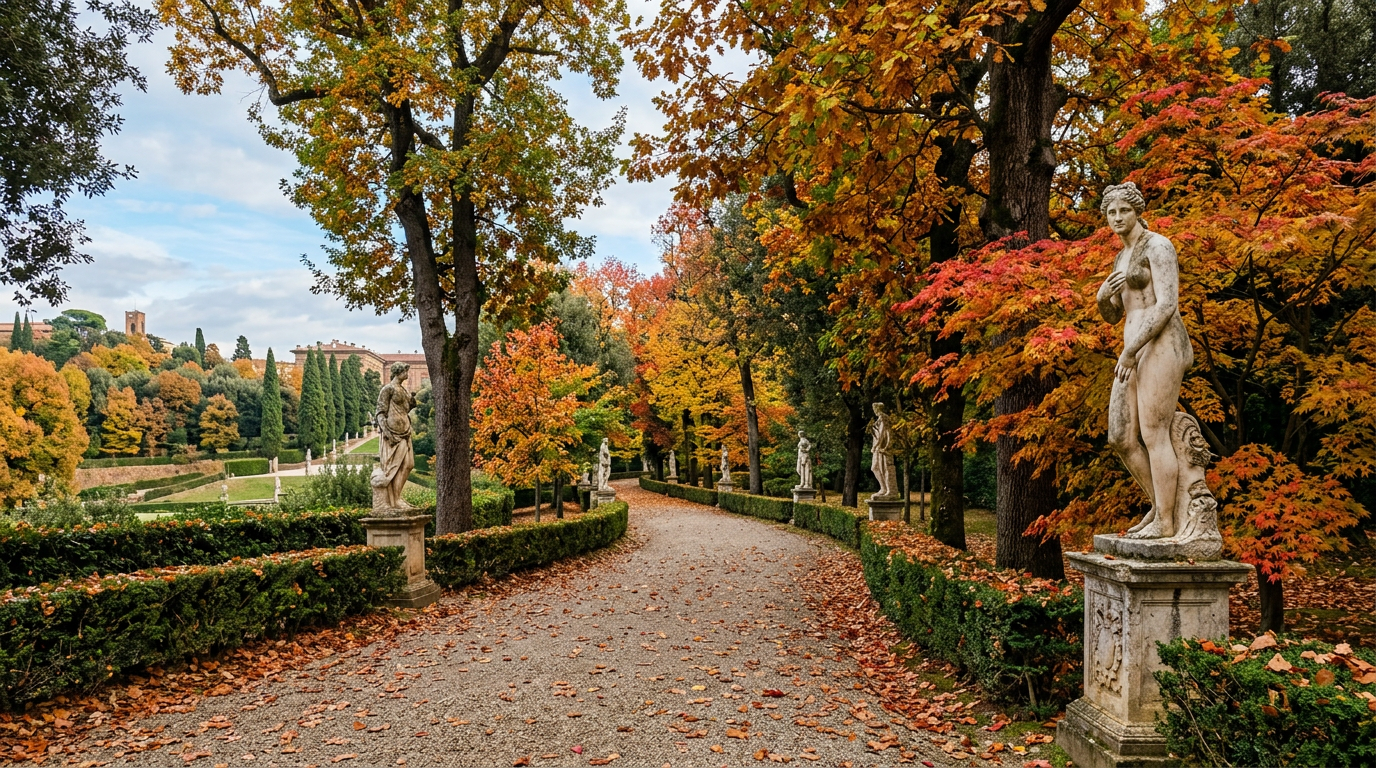
All three gardens are at their best in the two shoulder seasons: April to early June and mid-September to November. Summer heat is significant on south-facing hillside slopes. Winter visits are possible but the gardens are less colourful. Spring is the peak season for flowering and the most spectacular time to visit.
Where to stay
De’ Medici is a guesthouse in Oltrarno, a short walk from the entrances to Boboli Garden and Giardino Bardini. The hillside gardens are part of the neighbourhood’s fabric, not a separate destination.