Florence Photography Best Places: Oltrarno Guide
Photography in Florence Oltrarno: Where and When to Shoot
Florence is one of the most photographed cities in the world. This creates a paradox: the most beautiful places are also the most crowded, and the most iconic images are the most difficult to make your own.
Oltrarno offers a way out of this problem. The neighbourhood south of the Arno has viewpoints and streets that are largely unknown to most photographers, alongside a few famous ones that can still be worked with the right timing.
Photographing Oltrarno
Oltrarno’s photographic character is different from the tourist Florence north of the Arno. The streets are narrower, the buildings lower, the light more variable. There are no obvious monuments to point your camera at. The rewards come from patient observation of the ordinary.
Laundry hanging between buildings, a cat on a doorstep, an old man reading in a courtyard, a craftsman at a window: these are the images that Oltrarno offers. They are less spectacular than the Duomo at dawn, but they are more genuinely Florentine.
This guide covers both the iconic locations and the less-known ones, with specific advice on timing and technique.
The best viewpoints
Piazzale Michelangelo is the most famous viewpoint in Florence. The panorama from here covers the entire city: the Duomo, the Palazzo Vecchio tower, the hills of Fiesole in the background, and the Arno running below. It is genuinely excellent.
The problem is crowds. Between 9 am and 8 pm in summer, the square is busy with tour groups and day visitors. The best time to photograph from here is at dawn, between 5:30 and 7:00 am, when the light comes from the east and hits the Duomo directly. Alternatively, come after 9 pm in summer when the crowds thin and the city lights begin to appear.
The terrace of San Miniato al Monte, about ten minutes uphill from Piazzale Michelangelo, offers a higher and slightly different view. The Duomo appears above the roofline rather than against the sky. The additional elevation gives more depth to the image. This viewpoint is significantly less crowded than Piazzale Michelangelo at almost any time of day.
Ponte Santa Trinita, on the north side of the Arno, looks south toward Oltrarno and the hills above San Miniato. In the morning, the bridge is lit from the east, and the baroque statues at its four corners are in good light. This is a relatively underused viewpoint for looking back at Oltrarno.
The terraces of Giardino Bardini on Costa San Giorgio are among the best photographic locations in Florence. The garden rises steeply above Via de’ Bardi, and the upper terraces provide a view of the Duomo across the rooftops of central Florence. Entry costs 10 euros. The garden is rarely crowded.
The best hours for light
Florence in summer has predictable light conditions. The sun rises between 5:30 and 6:00 am and sets between 8:00 and 8:30 pm. The best light for photography occurs in the two hours after sunrise and the two hours before sunset.
Early morning light in Florence is exceptionally good in summer. The city is quiet before 7 am. The streets are empty. The low angle of the sun picks out architectural detail that midday light flattens. The golden hour after sunrise in July and August produces warm, raking light that is ideal for photographing facades, doorways, and street details.
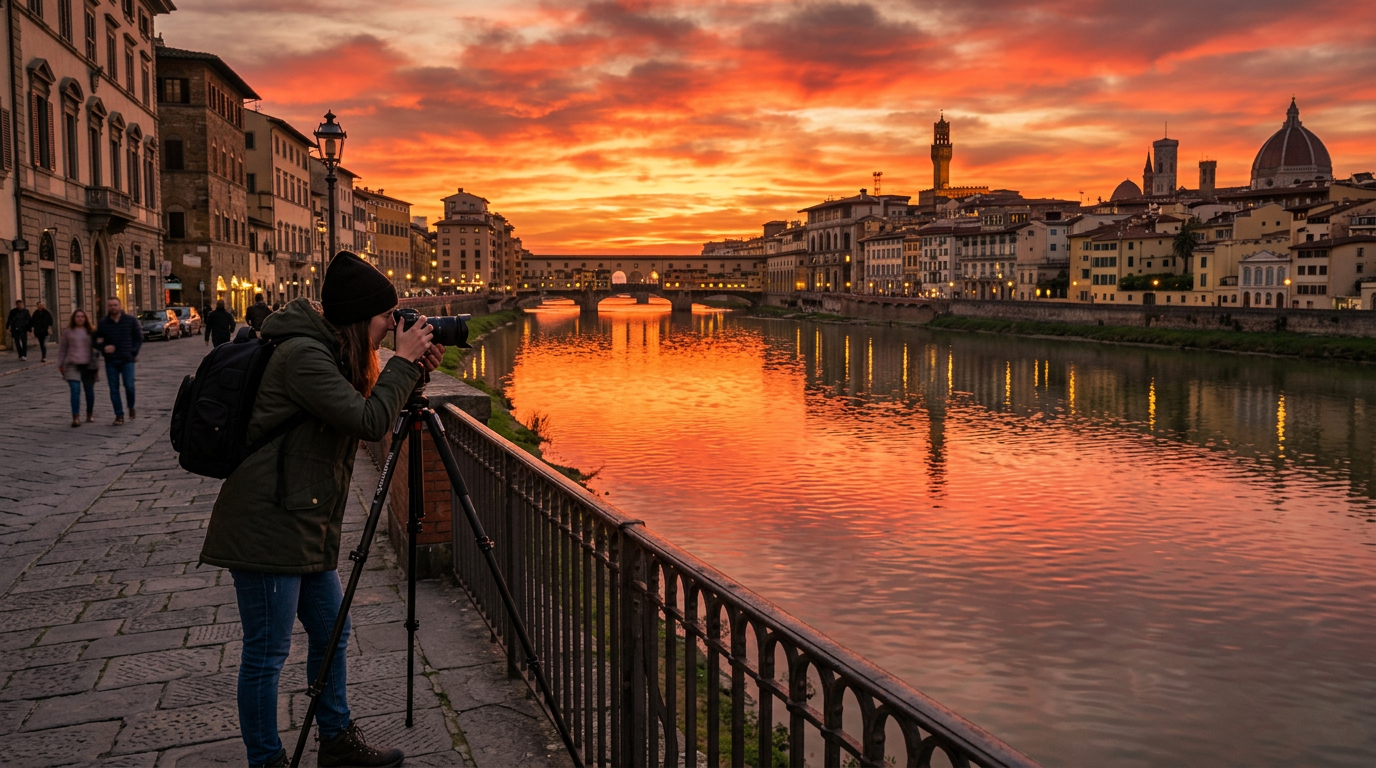
Late afternoon and evening light is also excellent, particularly in September and October when the sun is lower and the air clearer after the summer haze. The Lungarno at sunset, with the west light reflecting off the Arno, is one of the classic Florence images and can be made at any time of year.
Midday in summer is the most difficult time for photography in Florence. The light is harsh and vertical. Shadows are black. Colours are washed out. If you must shoot at midday, work in the shade of the narrow alleys where the light is reflected rather than direct.
Overcast days are underestimated by many photographers. The diffuse light of a cloudy day eliminates harsh shadows and reveals the true colours of stone and fresco. For interior shots and for photographing church facades with complex carved detail, an overcast sky is often better than direct sunlight.
The most photogenic streets
Via Toscanella, south of Piazza Santo Spirito, is a narrow residential street with a continuous line of Renaissance and medieval buildings. In the morning, the east-facing side catches the first light of the day. The street is almost always empty of tourists.
Via dei Bardi, running along the base of the hillside above the Arno, has a quality of compressed urban space that is unusual even by Florentine standards. The buildings rise directly from the narrow pavement. In the early morning before traffic appears, the street has a stillness that is worth photographing.
Borgo San Jacopo, the street parallel to the south bank of the Arno, has several points where breaks in the building line give direct views down to the river. These are easy to miss if you are walking fast. Look for gaps between buildings on the north side of the street.
Via dello Sprone, between Via Maggio and Piazza del Frescobaldi, is only about two hundred metres long but passes through a compressed section of Renaissance urban fabric. The building at the corner with Via Maggio has a carved stone shield and a Medici arms visible from the street.
Piazza della Passera is perhaps the most photogenic small square in Oltrarno. It is surrounded by low buildings, has a few tables and chairs from the surrounding bars, and a quality of informal, everyday life that is hard to find in more central locations.
How to find the less-photographed corners
The most effective strategy is to move perpendicular to the obvious routes. If most people walk along Via Maggio, walk one block east or west of it. If everyone photographs Piazzale Michelangelo, walk another ten minutes uphill to San Miniato.
Move slowly. Most missed images are missed because the photographer is walking rather than standing still. Find a position that looks interesting and wait. Give the scene time to develop: a person to pass, the light to shift, a cat to move.
Come back to the same place more than once. A street that looks ordinary at 10 am may be transformed at 7 pm when the low light and the evening activity of the neighbourhood change its character entirely.
Look for graphic elements: the intersection of shadow and light on a stone wall, the geometry of an arched doorway, the pattern of a cobblestone pavement. Oltrarno’s architecture provides an abundance of these, and they are consistent regardless of the time of year.
Talk to the residents of the neighbourhood. People who live in Oltrarno know every corner and can often direct you to details and viewpoints that appear in no published photograph. The reward for this kind of conversation is images that genuinely belong to you rather than to the established visual vocabulary of Florence.
Where to stay
De’ Medici is a guesthouse in Oltrarno, surrounded by the streets, courtyards, and viewpoints described in this guide. You can walk out of the door and begin photographing immediately.