Dante Florence Places to Visit: Walking Guide
Dante and Florence: The Places to Visit
Dante Alighieri was born in Florence in 1265 and was exiled from the city in 1302. He never returned. He died in Ravenna in 1321, having spent the last twenty years of his life writing the work that made him immortal.
The relationship between Dante and Florence is one of the most complicated in literary history. The city exiled him and threatened him with death if he returned. He responded by putting many Florentines, including some of his personal enemies, in Hell. The score is difficult to call.
Dante and Florence: the places to visit
Florence claims Dante as its own despite having expelled him. The city has erected statues to him, named streets and schools after him, and maintains a small museum in the neighbourhood where he was born. Dante’s own feelings about Florence, expressed throughout the Commedia, were considerably more ambivalent.
Visiting the Dante-related sites in Florence requires you to hold two ideas at once: the city as the place that formed Dante, and the city as the place he spent his adult life attacking. Both are present in the surviving buildings and locations.
The sites described here are all within the historic centre of Florence. Most are north of the Arno, but the connection to Oltrarno is straightforward: the bridge crossing takes five minutes, and many visitors combine the Dante trail with an afternoon in the south bank neighbourhood.
The Dante trail in the centre
The area around Piazza Santa Croce and the streets northwest of it toward the Bargello forms the core of Dante’s Florence. He was born in this neighbourhood, worshipped in the baptistery, attended school nearby, and spent his youth in the streets around what is now Via Dante Alighieri.
The street named after him runs east from Via del Proconsolo toward Piazza San Pier Maggiore. The route passes several sites associated with the poet’s life and with the history of the early Florentine commune that shaped his political thought.
Dante’s Florence was a city of intense factional conflict. The Guelfs and Ghibellines, the White and Black Guelfs, the guilds and the nobility: the political landscape of late 13th-century Florence was as fractured as any in Europe. Dante participated actively in this politics. He served as one of the six Priors of the city in 1300, a term that lasted two months and set in motion the events that led to his exile.
Walking through the neighbourhood around Via Dante Alighieri, you are in the streets where this world existed. The buildings are largely later reconstructions, but the street plan preserves the medieval layout. The proportions of the blocks and the distances between them correspond roughly to what Dante would have experienced.
Casa di Dante and the Baptistery
The Casa di Dante at Via Santa Margherita 1 is a small museum dedicated to Dante’s life and works. The building is a late-medieval structure on or near the site traditionally identified as Dante’s birthplace. There is no definitive archaeological evidence linking this specific building to the poet, but the location is consistent with the documentary record.
The museum contains illustrated editions of the Commedia, portraits of Dante from various centuries, and explanatory panels covering his life and works. The collection is modest but informative. Entry costs 4 euros.
The Baptistery of San Giovanni, facing the Duomo on Piazza del Duomo, is one of the most important buildings in Dante’s emotional geography. He was baptised here in 1266. He refers to it in the Inferno as “il mio bel San Giovanni”, my beautiful San Giovanni, in a tone of tender nostalgia that makes the exile’s grief palpable.
The exterior of the Baptistery is covered in the same white and green marble geometric patterns as San Miniato al Monte. The interior contains a magnificent Byzantine mosaic programme covering the entire ceiling dome, dating from the late 13th century and completed partly during Dante’s lifetime.
Ghiberti’s famous bronze doors, the “Gates of Paradise” that face the Duomo, were completed in 1452, over a century after Dante’s death. The originals are now in the Museo dell’Opera del Duomo. The doors on the east, north, and south sides of the Baptistery have been replaced with copies.
Entry to the Baptistery costs 15 euros, combined with access to the Duomo complex.
Santa Croce and the cenotaph
The basilica of Santa Croce is the burial church of many of Florence’s most celebrated citizens. Michelangelo is buried here, as is Galileo, Machiavelli, and the composer Luigi Cherubini.
Dante is not buried here. He died in Ravenna and is buried there. Ravenna has repeatedly refused Florentine requests to return the remains. The city that exiled Dante has been trying to reclaim him for centuries.
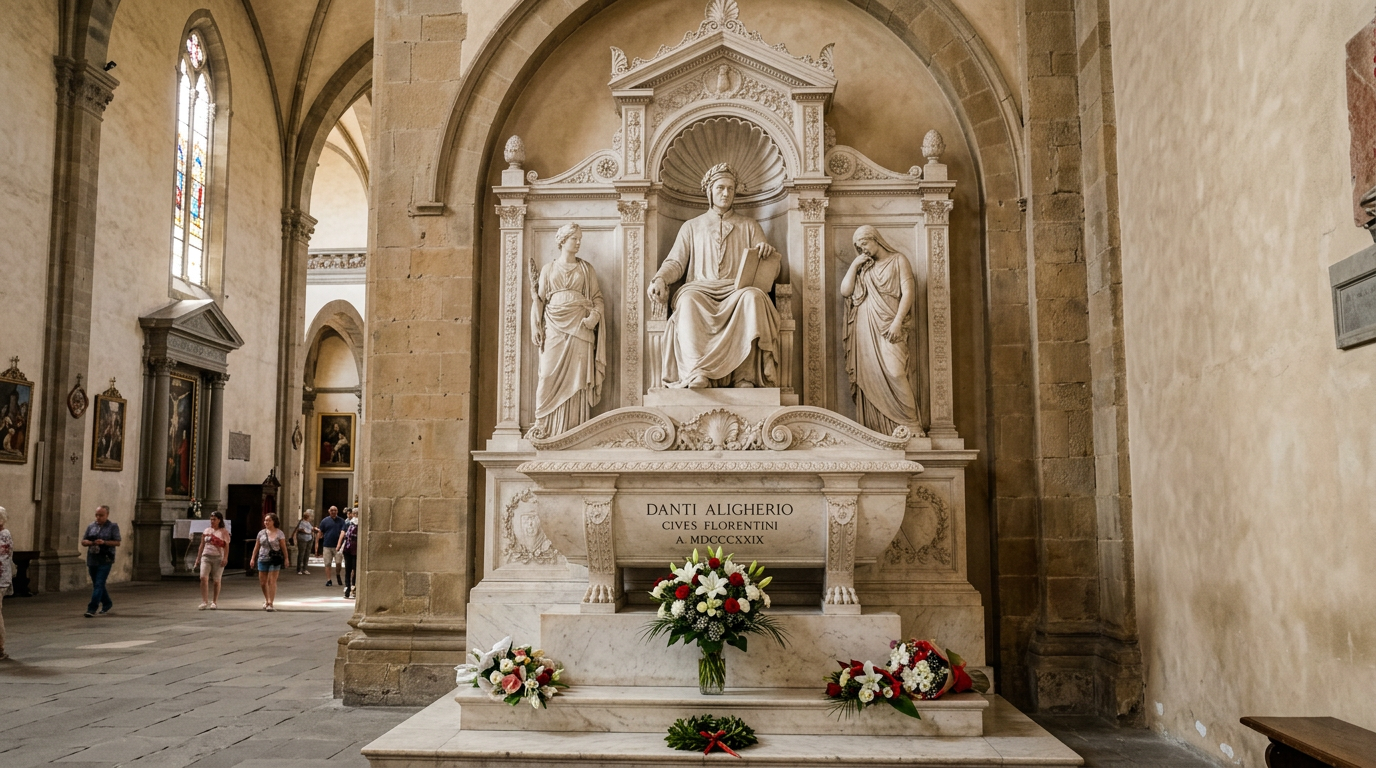
In compensation, Florence erected a cenotaph to Dante in Santa Croce in 1829. The monument, by the sculptor Stefano Ricci, shows Dante seated with Italy represented as a mourning figure beside him. The inscription reads: “Onorate l’altissimo poeta” (Honour the greatest poet), a quote from Inferno Canto IV.
The cenotaph is in the south aisle of Santa Croce. Entry to the basilica costs 8 euros. The building also contains important frescoes by Giotto in the Bardi and Peruzzi Chapels, and the Pazzi Chapel by Brunelleschi in the first cloister.
How to read Dante while walking through Florence
The Commedia is dense with references to Florence and to specific Florentines. Reading selected cantos while walking the city creates a direct connection between the text and the physical place.
Inferno Canto X is particularly useful for Florence. In this canto, Dante encounters Farinata degli Uberti, a Ghibelline leader who opposed the Guelfs, and Cavalcante de’ Cavalcanti, the father of Dante’s closest friend. The conversation is about politics, family, and the cost of faction. Reading it in the neighbourhood around Palazzo degli Uberti (near Piazza della Signoria) makes the historical background concrete.
Inferno Canto XV contains Dante’s meeting with his teacher Brunetto Latini. Dante treats Brunetto with profound respect despite placing him in Hell. The canto is one of the most moving in the Inferno and repays slow reading anywhere in the city.
Purgatorio Canto XI contains a meditation on artistic fame using Florentine painters as examples. Cimabue, Giotto, and the poets Guittone d’Arezzo and Guido Guinizelli all appear. Reading this canto in the Uffizi or in Santa Croce, where Giotto’s frescoes survive, is a way of connecting the living art to the poet’s analysis of it.
A bilingual edition of the Commedia with Italian and English on facing pages is the most practical format for reading while travelling. The editions by Charles Singleton or Allen Mandelbaum are widely available and are the most useful for non-specialist readers.
Where to stay
De’ Medici is a guesthouse in Oltrarno, a ten-minute walk across the Arno from the heart of Dante’s Florence. The neighbourhood connection to the poet is real: Dante crossed the Arno to reach the churches and gardens on the south bank, and the city he described was visible from both sides of the river.