Florence Historical Curiosities Oltrarno Guide
Historical Curiosities of Oltrarno: What Most People Miss
Florence rewards the attentive visitor. The city has been documented, catalogued, and guided for centuries, but there is still an enormous amount that goes unnoticed, even by residents who have lived here for years.
Oltrarno is particularly rich in details. The neighbourhood developed over many centuries, and the buildings reflect each layer of that development. Knowing what to look for transforms a walk through familiar streets into a genuine discovery.
Historical curiosities of Oltrarno
The neighbourhood of Oltrarno contains several hundred listed historic buildings. Most of these are never mentioned in any guidebook. The majority of visitors, if they enter Oltrarno at all, follow a route from Ponte Vecchio to Santo Spirito and back. The rest of the neighbourhood remains largely unexplored.
The details described here are all visible from the street, without entering any building. No special access is required. All you need is the willingness to slow down and look.
Details no one notices
The tabernacles on street corners are one of the most visible and least-noticed features of Oltrarno. These small shrines, usually containing an image of the Virgin or a saint, were placed at intersections throughout medieval and Renaissance Florence to mark the boundaries between parishes and to provide a focus for neighbourhood devotion.
Oltrarno has more surviving tabernacles than any other part of Florence. Many still contain devotional images and fresh flowers. The tabernacle at the corner of Via dei Serragli and Via Santa Monaca dates from the 15th century and contains a glazed terracotta roundel in the style of Luca della Robbia.
The pietra buccherata (perforated stone) rings set into the bases of many palace walls along Via Maggio and Via dei Bardi are often mistaken for decorative elements. They are in fact hitching posts for horses, with a hole through which a rope could be threaded. The diameter of the ring and the height from the ground correspond to standard measurements used throughout Tuscany in the 16th and 17th centuries.
Door knockers and door handles on the historic palaces of Oltrarno deserve more attention than they usually receive. Many are original 16th and 17th-century ironwork. The ring knockers with lion-mask backplates on several doors in Via Maggio are particularly fine examples. Some have been in place for over four hundred years.
Stories behind the palaces
Via dei Bardi takes its name from the Bardi family, the medieval banking dynasty that was among the most powerful in Europe in the 14th century. The Bardi bank financed Edward III of England and several Italian city-states before collapsing in 1345, partly as a result of Edward’s default on his debts.
The Bardi complex on Via dei Bardi has been subdivided and rebuilt over centuries, but several buildings in the street retain medieval elements. The building at number 36 has an exterior staircase visible from the street that dates from the 14th century. This type of external stair was common in medieval Florence but has mostly disappeared through later rebuilding.
Palazzo Capponi delle Rovinate on Via dei Bardi takes its name from a landslide (“rovinate”) that destroyed part of the hillside above and damaged the building in 1547. The slope above Oltrarno, now stabilised with retaining walls and terracing, was prone to this type of event before the modern interventions of the 19th century.
The Borgo San Jacopo, the main street running parallel to the south bank of the Arno, is named after the church of San Jacopo sopr’Arno, which still stands partway along it. “Sopr’Arno” means “above the Arno”, a reference to the medieval flood level rather than the current ground level. The church floor is now several metres above the normal water level.
Hidden symbols on the facades
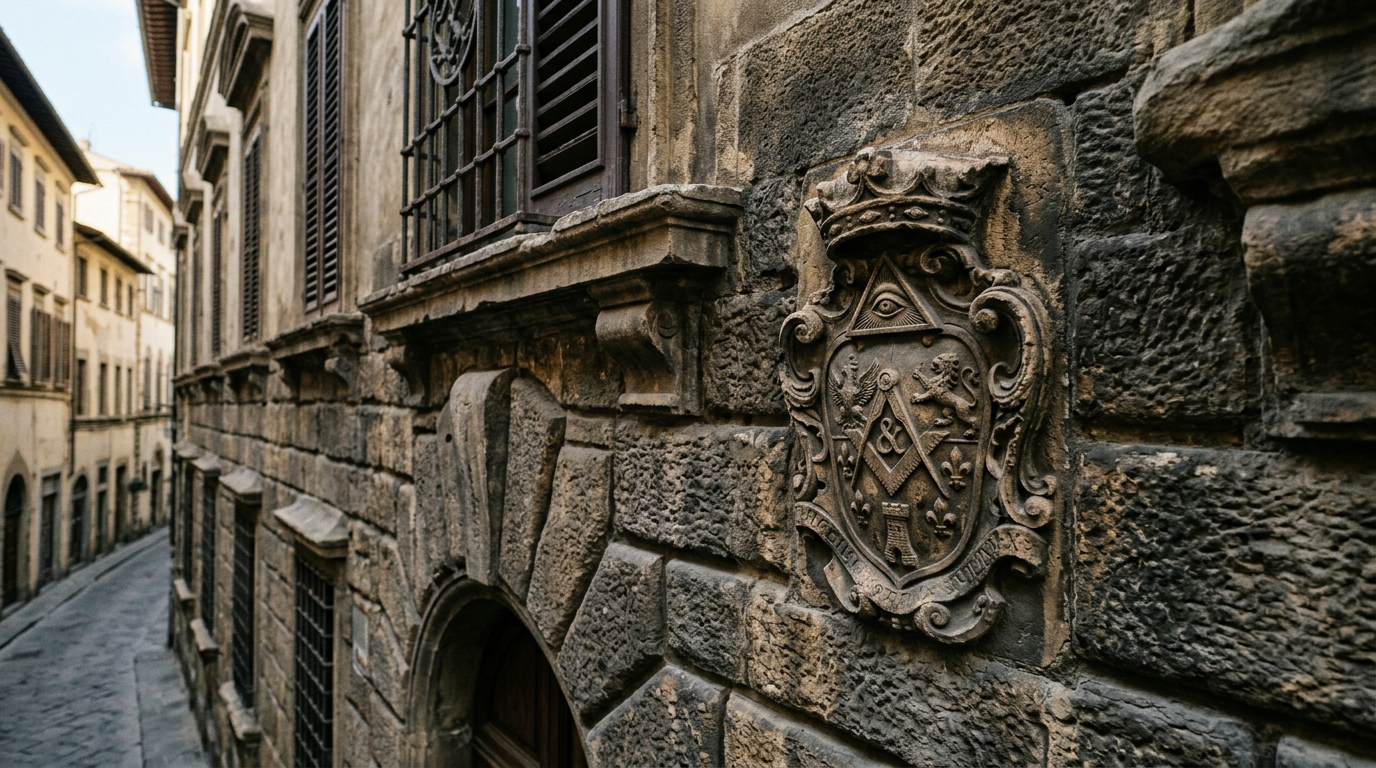
Florentine palace facades carry a great deal of encoded information if you know how to read them. The coats of arms carved in stone above doorways or on the corners of buildings identify the families who built them. Florence had a well-developed system of heraldry from the medieval period, and these shields are still readable if you know the visual vocabulary.
The Medici arms, a shield with six balls (palle), appear on buildings throughout Oltrarno that were owned by or associated with the Grand Ducal family. These are most common near Palazzo Pitti and along Via Guicciardini. Counting the number of balls tells you something about the period: the original arms had twelve, which were gradually reduced over the 15th century.
Building inscriptions are another overlooked source of information. Many palaces in Oltrarno have stone plaques recording the date of construction, the name of the patron, or a brief statement of intent. These plaques are usually placed above the main entrance or on a corner. Some are in Latin, others in Italian. Many are legible even without linguistic knowledge of Latin.
Flood markers are common on the facades of buildings near the Lungarno. These are small stone or metal plaques marking the water level reached during historic floods. The flood of 1966, which damaged or destroyed a significant proportion of Florence’s art and archive collections, left markers on several buildings. The highest marks are on buildings closest to the river.
How to see the neighbourhood with fresh eyes
The most effective technique is to walk slowly and look up. The upper storeys of Oltrarno’s buildings contain details that are completely invisible to anyone walking at a normal pace: carved stone friezes, terracotta decorations, painted inscriptions, and in some cases the remnants of outdoor frescoes.
Carry a pair of small binoculars if you want to examine details on upper floors. This sounds eccentric but is entirely practical. The detail on a stone shield four storeys up is impossible to read with the naked eye.
Walk the same streets at different times of day. A street that looks unremarkable in the midday heat looks completely different in the low autumn light of early morning. Shadows reveal surface texture and carved detail that flat midday light completely suppresses.
Pick one building and look at it for five minutes. Choose any building on Via Maggio, Via dei Bardi, or Borgo San Jacopo. Identify the construction materials, the window proportions, any carved decoration, the state of repair. Five minutes of concentrated attention on one building teaches you more about Florentine architecture than an hour of general walking.
Ask residents about their buildings. Many Florentines know a great deal about the history of the building they live in. An unexpected conversation in a building entrance can open a layer of local knowledge that no guidebook contains.
Where to stay
De’ Medici is a guesthouse in Oltrarno, in the neighbourhood where every street holds details that reward careful attention. You can begin discovering them the moment you step outside.