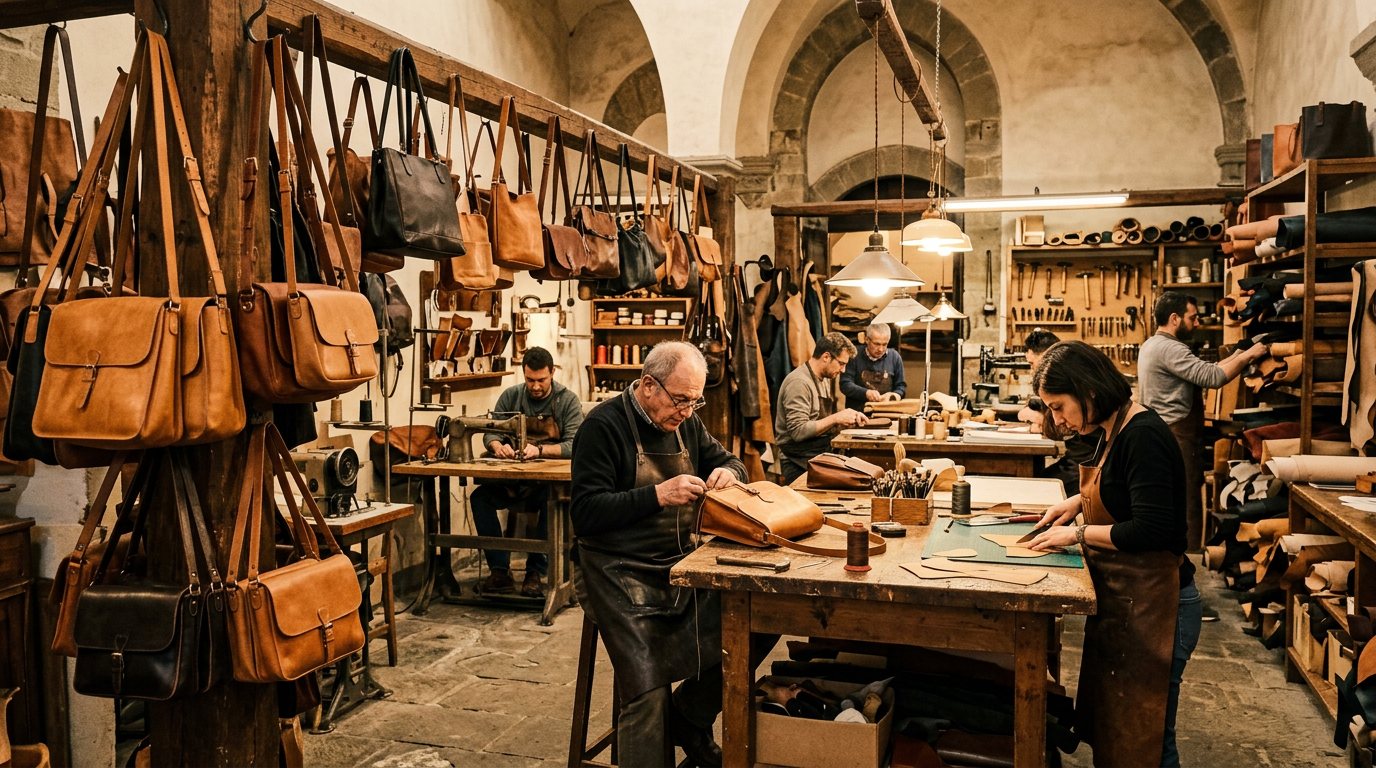
Florence Leather Crafts Guide: Oltrarno and Beyond
The Complete Guide to Florentine Leather
Florence has been a centre of leather production since the Middle Ages. The city’s tanners, dyers, and craftsmen formed one of the most important guilds of the medieval commune. Today, the tradition continues in a smaller but still significant number of workshops, concentrated in Oltrarno and around the Santa Croce neighbourhood north of the Arno.
Florentine leather is internationally recognised for its quality. But the market also contains a significant amount of low-quality imported goods sold under Florentine labels. Knowing the difference before you buy is important.
The complete guide to Florentine leather
The history of Florentine leather is inseparable from the history of the city’s economy. The Arte dei Vaiai e Pellicciai, the guild of furriers and leather workers, was one of the seven major guilds (Arti Maggiori) that governed medieval Florence. The guild controlled the production and sale of finished leather goods and was influential in the civic government of the commune.
The Arno river was essential to the industry. Tanning requires large quantities of water. The tanneries of medieval Florence were concentrated near the river, and the smells produced by the tanning process were a constant feature of urban life. The process has been modernised, but artisan leather workshops still depend on the same basic chemistry of vegetable tanning, the use of tannin from oak bark or chestnut to convert raw hides into durable leather.
Florence today has roughly 200 businesses in the leather sector, ranging from large workshops employing several dozen people to single craftspeople working alone. The quality, price, and focus vary enormously.
The Scuola del Cuoio at Santa Croce
The Scuola del Cuoio (Leather School) is the most famous leather workshop in Florence. It is located in the cloister of the church of Santa Croce, in the rooms behind the sacristy of the basilica.
The school was founded in 1950 by the Franciscan monks of Santa Croce and the Gori and Casini families of Florentine craftsmen, with the aim of providing vocational training for young men orphaned by the Second World War. The original pedagogical mission has evolved, but the school still teaches traditional Florentine leather-working techniques.
Today the Scuola del Cuoio functions as a working atelier and retail space. Visitors can enter the workshop, watch craftspeople at work, and purchase finished products. The range includes wallets, belts, bags, briefcases, and small leather accessories.
Prices are honest and reflect the quality of the workmanship. A small wallet starts at around 30-40 euros. A medium-sized bag costs between 100 and 300 euros. Larger pieces and custom commissions are more expensive.
The workshop is open Monday to Saturday, 9:30 am to 6:00 pm. Entry is free. Access is through the cloister of Santa Croce, which requires a paid ticket to the basilica complex (8 euros), or through a separate entrance on Via San Giuseppe.
Leather workshops in Oltrarno
Oltrarno has a significant concentration of leather workshops, particularly around Via della Vigna Nuova, Via dei Serragli, and the streets south of Piazza Santo Spirito.
Stefano Bemer on Via San Niccolò is one of the finest bespoke shoemakers in Italy. The workshop has been producing handmade shoes for individual clients for decades. The waiting time for a bespoke pair is several months, and prices begin at around 1,500-2,000 euros. The workshop is worth visiting even if you are not buying, as it represents the highest level of the craft.
Oltrarno Artigiano Collettivo on Via dei Vellutini is a collective of artisans sharing workspace. Several leather craftspeople work here alongside gilders, bookbinders, and furniture restorers. The collective holds open workshop events and welcomes visitors. The leather workers produce bags, belts, and small accessories at mid-range prices.
Officina Nora on Via Santo Spirito makes leather bags and accessories using both traditional and contemporary designs. The workshop is small and the production is genuinely local. Prices for a medium bag start at around 120-150 euros.
Cornice e Cuoio on Via Toscanella specialises in leather notebooks, albums, and stationery items. The hand-bound notebooks use traditional Florentine paper alongside Florentine-tanned leather covers. These are among the most practical and authentic souvenirs available in the city.
How to recognise real handmade leather
Real vegetable-tanned leather has a distinctive smell: earthy, faintly sweet, with a quality that synthetic materials and chrome-tanned industrial leather cannot replicate. If a bag or wallet has no smell, or smells of chemicals, it is not vegetable-tanned leather.
Vegetable-tanned leather changes colour with use. It starts as a lighter colour and develops a patina, called “patina” in Italian, as it is used and handled. The colour deepens and the surface acquires a richness that is impossible to fake. Industrial leather does not develop this kind of patina.
Look at the cut edges of the leather. In a genuine handmade piece, the edges are burnished smooth by hand, using a tool and friction. The edge should be even, slightly rounded, and the same colour as the surface. In machine-made or cheap goods, the edges are painted with coloured resin, which creates an unnaturally perfect edge that chips off with use.
Check the stitching. Hand-stitching uses two needles and a saddle-stitch technique, which creates a strong lock stitch. The stitches are even but not mechanically perfect. Machine stitching is more regular and the thread lies differently in the channels.
Ask the seller directly whether the piece was produced in Florence or in Italy. A reputable workshop will tell you honestly. Avoid shops that make vague claims about “Florentine style” or “Italian design” without specifying where the work was done.
Prices and what to buy
A genuine handmade Florentine leather wallet costs between 30 and 80 euros depending on the workshop and the complexity of the design. Anything below 20 euros for a wallet is almost certainly not handmade in Florence.
A belt of vegetable-tanned leather with a simple buckle costs between 40 and 80 euros. Custom belts with personalised length and hardware cost more.
A medium handbag from a quality Oltrarno workshop costs between 100 and 300 euros. Smaller bags start at around 60-80 euros.
The best value for a practical souvenir is a leather notebook cover or a simple card wallet. These are genuinely made in Florence, easy to transport, and represent the craft at a price that is affordable without compromise on quality.
Personalisation (initials or monograms embossed into the leather) is offered by many workshops and usually costs an additional 10-15 euros. This adds a few minutes of working time and permanently distinguishes the piece.
Buy from workshops where you can see the craftspeople at work. This is not always possible in retail shops, but the Scuola del Cuoio, Officina Nora, and the Oltrarno Artigiano Collettivo all allow visitors to see the production process. Seeing the work being done is the best guarantee that what you are buying is genuine.
Where to stay
De’ Medici is a guesthouse in Oltrarno, in the neighbourhood where many of Florence’s finest leather workshops are still operating. You can visit the craftspeople, watch them work, and buy directly in the same streets you walk through every day.