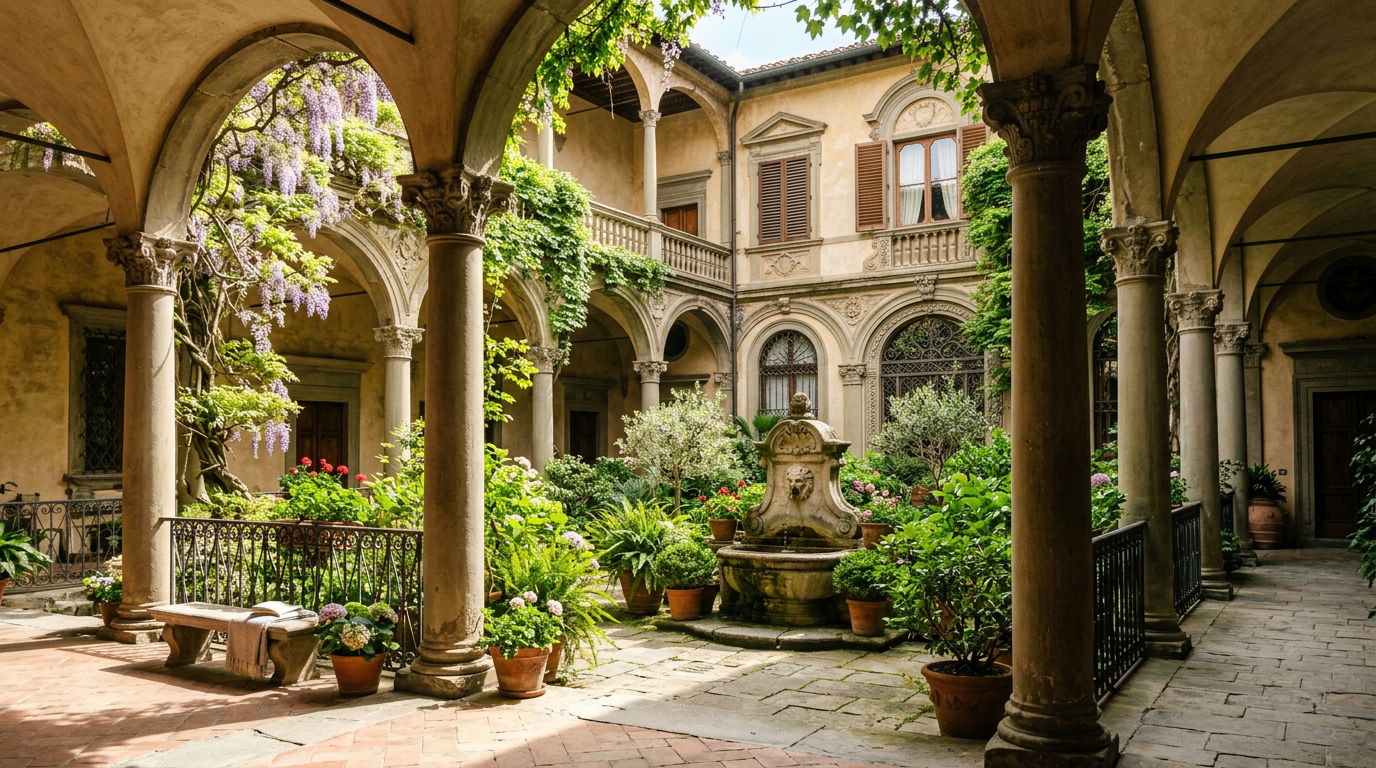
Florence Secret Palace Courtyards Oltrarno
The Secret Courtyards of Florence Oltrarno
Florence keeps many of its best things hidden behind closed doors. The palaces that line Via Maggio, Via dei Serragli, and Borgo San Jacopo present solid stone facades to the street. But behind those facades, invisible from the pavement, lie courtyards of extraordinary quality.
These courtyards are not museums. They are the private or semi-private centres of buildings that have been in use for centuries. Many are still accessible if you know when and how to approach them.
The secret courtyards of Oltrarno
Oltrarno has a higher concentration of Renaissance palaces than any other neighbourhood in Florence outside the historic centre north of the Arno. Between the 15th and 17th centuries, wealthy Florentine families built their palaces on the south bank, drawn by lower land prices and the proximity to the Pitti family’s residence.
A typical Renaissance palace in Oltrarno follows a predictable layout. The street facade is rusticated stone, imposing and largely windowless at street level. A large arched doorway opens onto an androne, a covered passage that leads through to the courtyard behind.
The courtyard was the practical and symbolic centre of the building. It provided light and air to the rooms around it, housed the building’s well, and served as the setting for family ceremonies, business meetings, and social events.
Many of these courtyards have survived intact. The buildings around them have been converted into apartments, offices, or hotels, but the courtyards themselves remain.
How to enter historic palace courtyards
The simplest way to see a palace courtyard in Oltrarno is to walk through the open front door. Many of these buildings have the main entrance unlocked during daylight hours because they still function as residential buildings.
When you see a large arched doorway standing open, walk through it. Most andrones are accessible from the street. If the courtyard is private and not open to visitors, there will usually be a locked gate or a sign. In the absence of these, you can reasonably proceed.
Do not enter apartments, offices, or any clearly private spaces. Stand in the courtyard, look at the architecture, and leave when you have finished. Residents and building managers generally tolerate visitors who behave quietly and respectfully.
During events such as the Giornate FAI (Italian Environment Fund open days, usually held in spring and autumn), many palace courtyards that are normally closed are opened to the public. The FAI publishes a list of participating sites on its website. Entry is typically free or costs a small donation.
Some buildings have concierges who can answer questions about the history of the courtyard. If you speak a little Italian, or if the concierge speaks English, these conversations are often rewarding.
The most beautiful courtyards in the neighbourhood
Palazzo Guadagni on Piazza Santo Spirito is one of the most distinctive buildings in Oltrarno. Built around 1505, it is now a small hotel. The courtyard is visible from the reception and accessible to guests, but visitors who enter politely are usually not turned away.
Palazzo Pitti is the most famous building in Oltrarno, but its ceremonial courtyard by Bartolomeo Ammannati, completed in 1560, is often underestimated. The courtyard is one of the grandest Renaissance spaces in Florence. Entry to the palace complex costs 10 euros, which includes the courtyard.
Palazzo Capponi delle Rovinate on Via dei Bardi has a courtyard with a stone loggia on two sides. The building has been in the Capponi family since the 15th century, with interruptions. The exterior gives little indication of the quality of the space behind.
Palazzo Fenzi on Via San Gallo (north of the Arno, worth a detour) has a courtyard that was transformed in the 18th century with a classical colonnade. The building now belongs to the University of Florence. The courtyard is accessible during university opening hours.
In Via Maggio, several palaces have courtyards worth finding. Via Maggio 26, once the residence of Bianca Cappello, the mistress and later wife of Francesco I de’ Medici, has a small but refined courtyard. The building now contains apartments and offices.
When the doors are open
Most buildings in Oltrarno with accessible courtyards are open from roughly 8 am to 8 pm on weekdays. On weekends and public holidays, access is less predictable.
The Giornate FAI take place twice a year, usually in March and October. These are the best opportunities to see normally closed spaces. The autumn edition often coincides with the Autumn in Florence events organised by the city.
Some buildings host ground-floor exhibitions, shops, or cultural events that provide legitimate reasons to enter and see the courtyard. Art galleries in repurposed palace spaces are increasingly common in Oltrarno.
The period around 21 March, the spring equinox, and the Festa della Toscana on 30 November sometimes sees additional openings of historic buildings. Check the city’s event calendar in advance.
Stories of the palaces and their courtyards
The cortile of Palazzo Zanchini on Via dei Serragli, largely unknown even to residents, contains a stone well dating from the 16th century. The pulleys and chains are still in place above it.
Palazzo Almeni on Borgo San Jacopo was built for the chancellor to Duke Cosimo I de’ Medici. The courtyard retains its original proportions and a stone inscription recording the date of construction in the 1550s.
Via dei Bardi takes its name from the Bardi banking family, one of the most powerful in medieval Florence. Their original complex occupied much of the street. The buildings have been subdivided and rebuilt over centuries, but several retain medieval elements in their internal courtyards.
The Corridoio Vasariano, Cosimo I’s elevated walkway connecting Palazzo Vecchio to Palazzo Pitti, passes above several streets in Oltrarno. Looking up from certain courtyards, you can see the underside of the corridor passing overhead, connecting the public city to the private world of the Grand Duke.
Walking through Oltrarno with this in mind transforms the experience. Every closed door becomes a question. Every open doorway is an invitation.
Where to stay
De’ Medici is a guesthouse in Oltrarno, in the neighbourhood where these hidden courtyards are most concentrated. You can explore them at your own pace, starting from your front door.