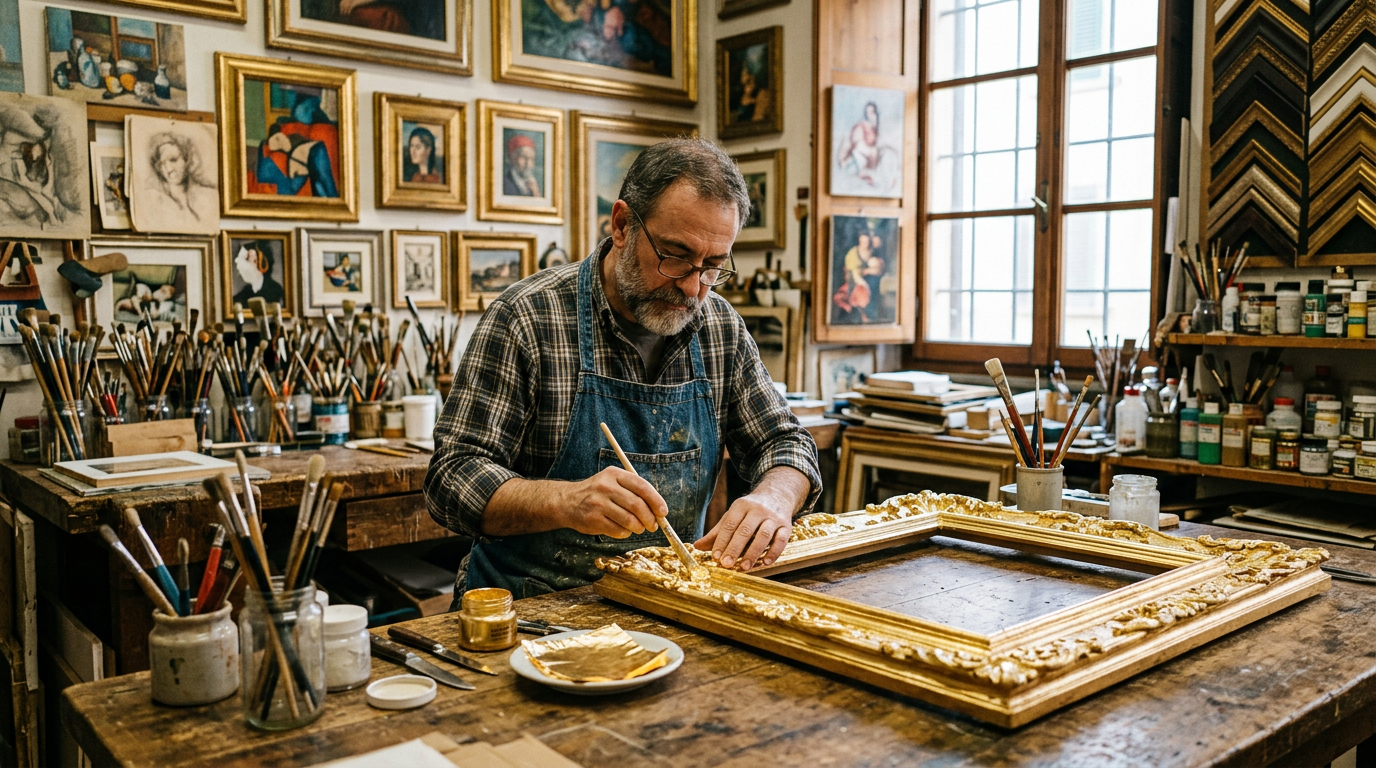
Florence frame-makers: the art of gilded frames
Florentine frame-makers
The picture frame is one of the most overlooked objects in the history of art. In Florence, it is taken seriously. The gilded, carved frames that surround Renaissance paintings in the Uffizi and other Florentine museums were made in workshops in this city, by craftspeople whose skill was as valued as that of the painters themselves.
The relationship between painting and frame in the Renaissance was intimate. Frames were often commissioned at the same time as the painting. They were integral to the object’s meaning and its setting in a church or private chapel. The frame was not an afterthought. It was architecture in miniature.
The Florentine tradition of frame-making continued through the Baroque, Neoclassical, and into the 19th century. The workshops that produced frames for Florentine patrons and collectors maintained techniques that changed slowly over centuries. When museum conservation departments began systematically restoring their collections in the 20th century, Florentine frame-makers were called to reproduce and restore historic frames.
Today, a handful of active workshops in Oltrarno continue this tradition. They make new frames using historic techniques and restore antique frames for museums, institutions, and private clients.
The art of gilded frames
A gilded frame in the Florentine tradition is made from carved wood, usually limewood or poplar, covered in multiple layers of gesso, a mixture of calcium carbonate and glue. The gesso surface is sanded and polished until perfectly smooth. Only then is the gold applied.
There are two main gilding methods. Water gilding, the more demanding, uses a thin layer of bole, a clay preparation, as the final base before the gold. The gold leaf, made from genuine gold beaten to a thickness of about 0.1 micrometres, is laid onto the moistened bole and burnished with a tool to a brilliant, mirror-like finish.
Oil gilding uses a slightly different adhesive base and produces a matte gold. It is less labour-intensive and less brilliantly reflective. Most historic frames use water gilding on the flat areas that can be burnished and oil gilding on the curved and relief areas.
Gold leaf is sold in booklets of 25 sheets, each measuring about 8 by 8 centimetres. The leaf is fragile enough to be disturbed by breath. It is handled with specialised brushes called gilder’s tips, which pick up the leaf electrostatically. The skill involved in laying gold leaf smoothly, without tears or bubbles, takes years to develop.
The carved details of a Florentine frame are made either by hand carving directly in the wood, or by pressing wet gesso into moulds to create the decorative relief elements. Historic frames use hand carving for the primary elements and moulded pastiglia for the smaller details. Identifying which method was used tells you something about the period and quality of a frame.
Still-active artisan workshops
Oltrarno has several frame-making workshops that continue to use traditional methods. They are not easy to find from the street. Some operate in the interior of buildings accessed through courtyards. Others occupy ground-floor spaces on smaller streets without visible signage.
The streets around Sdrucciolo de’ Pitti and Via Maggio have the highest concentration. Walking these streets slowly and looking at ground-floor windows and open doors will reveal working spaces. The smell of sawdust and linseed oil, and the sound of scraping or hammering, are reliable indicators.
Several of these workshops also sell finished frames directly. The range includes small frames for standard photographic print sizes, available from around 60 to 200 euros, and large format frames for paintings, priced from several hundred to several thousand euros depending on size and complexity of the carving.
If you are interested in a frame for a painting or print you own, bring a photograph of the object and its dimensions. A Florentine frame-maker will advise on appropriate proportions and profiles based on the period and style of the work.
How to commission a frame
Commissioning a frame from a Florentine artisan is a straightforward process once you have made contact. The initial conversation establishes the dimensions, the style, the gilding method, and the budget.
The frame-maker will usually show you samples of different profiles and finishes. For a painting in a Renaissance or Baroque style, the traditional Florentine cassetta profile, with a flat, recessed inner panel, a moulded outer edge, and carved relief details, is the most historically appropriate.
For a contemporary work, plainer frames with gold leaf on simple profiles are an option. Florentine gilders make these with the same technique regardless of the aesthetic. A simple gilded frame of good size, measuring 60 by 80 centimetres, costs between 250 and 600 euros depending on the profile complexity and the gilding method.
Production times range from two weeks for simple profiles to two months for complex carved frames. If you need the frame shipped internationally, add shipping costs and allow additional time. Most workshops will pack frames properly for transport.
Prices and production times
A standard 40 by 50 centimetre gilded frame from a Florentine artisan in 2026 costs between 150 and 350 euros. A larger format, 80 by 100 centimetres, with carved decoration, costs between 500 and 1,500 euros depending on the complexity of the carving and the gilding.
Frame restoration, making an existing damaged antique frame whole again, is priced by the extent of the work. Minor repairs and re-gilding of a small area might cost 100 to 250 euros. A complete re-gilding and structural repair of a large frame can cost 1,000 euros or more.
Production time for a new frame of moderate complexity is typically three to six weeks. Complex carved frames take two to four months. If you are commissioning from abroad and visiting Florence specifically to collect the frame, establish a realistic timeline at the start.
Visit in person if at all possible, even if only to discuss the commission. The conversation is more productive in the workshop, where you can see and handle samples, than by email. Once you have agreed on the details, most arrangements can be completed remotely.
Where to stay
De’ Medici is a guesthouse in Oltrarno, the neighbourhood where Florence’s frame-making tradition survives in active workshops. You can walk to the artisan streets in under ten minutes and find the working craftspeople who continue one of the city’s most distinctive art forms.