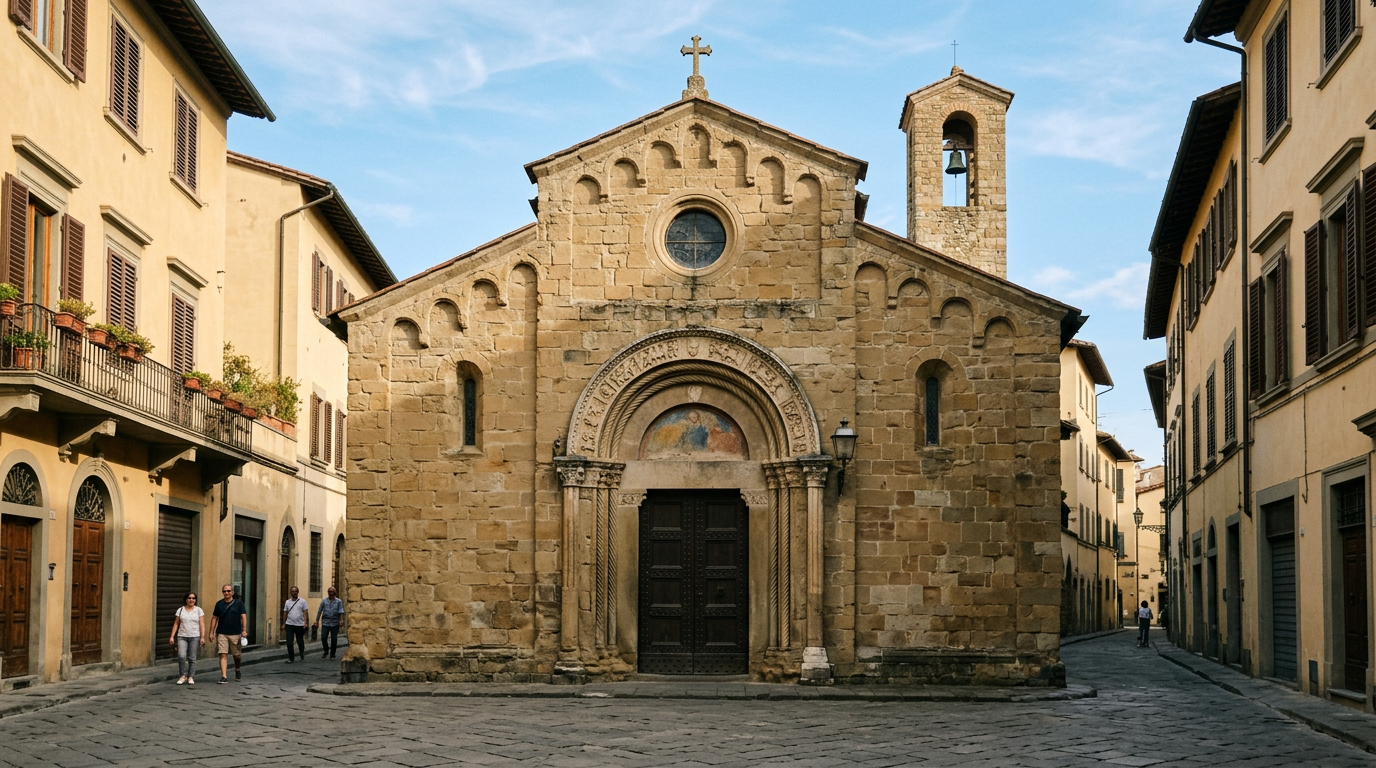
Florence Lesser-Known Churches Oltrarno Guide
Florence’s Lesser-Known Churches in Oltrarno
Florence has more churches than most cities have streets. The Duomo and Santa Croce attract enormous crowds. But within walking distance, particularly in Oltrarno, stand churches of extraordinary quality that most visitors never enter.
These are not second-rate substitutes for the famous ones. Several contain works that would be considered masterpieces anywhere else in Italy. The difference is that here you can stand in front of them alone.
The lesser-known churches of Oltrarno
Oltrarno, the neighbourhood south of the Arno, contains an exceptional concentration of religious architecture. The neighbourhood developed largely outside the original medieval walls, and its churches reflect centuries of patronage by Florentine noble families.
Many of these churches are still active parishes. They open in the morning for Mass and reopen in the afternoon. Entry is free. The only cost is a small donation to light the candles near an altar, which is optional.
The churches described here are all within fifteen minutes on foot of each other. You can visit two or three in a single morning without feeling rushed.
Santa Felicita: the hidden chapel
Santa Felicita stands on the south side of Piazza Santa Felicita, about thirty metres from Ponte Vecchio. It is the first church you encounter if you enter Oltrarno from the bridge.
The building is ancient. A church has stood on this site since at least the 4th century, making it one of the oldest Christian sites in Florence. The current facade is a 19th-century renovation, but the interior retains important elements from earlier periods.
The reason to visit Santa Felicita is the Capponi Chapel, immediately to the right of the entrance. Jacopo Pontormo painted the chapel between 1525 and 1528. The Deposition altarpiece is one of the defining works of Florentine Mannerism.
Pontormo’s palette is extraordinary: pinks, lime greens, and pale blues that have no precedent in the painting of his time. The composition is complex and emotionally intense. Christ’s body floats above the ground, supported by mourning figures whose expressions suggest grief without sentimentality.
The Annunciation panels on the side walls of the chapel are also by Pontormo and are equally fine. The entire chapel takes about ten minutes to look at properly, but it deserves more.
Opening hours: Monday to Saturday, 9:30 am to 12:00 pm and 3:30 pm to 5:30 pm. Closed Sunday morning. Sunday afternoon visits are possible from 3:30 pm.
Santi Apostoli: one of the oldest
The church of Santi Apostoli stands on Piazza del Limbo, just off Via Por Santa Maria, technically north of the Arno but on the edge of the Oltrarno zone. It is included here because it is one of the most important early Christian sites in the city.
According to local tradition, Santi Apostoli was founded by Charlemagne in 786 AD. The historical record suggests a date slightly later, but the current building dates largely from the 11th century, making it one of the oldest surviving churches in Florence.
The interior is simple and severe. Three naves are separated by columns of green marble taken from Roman buildings. The absence of later additions gives the church an unusual austerity that contrasts sharply with the elaborate interiors of most Florentine churches.
The main reason to visit is the architectural space itself. The 11th-century columns and the Romanesque proportions create a quality of silence and stillness that is rare in Florence.
The church also contains the flint stones supposedly used to light the Holy Fire in Jerusalem, brought back by Godfrey of Bouillon after the First Crusade. These are still used in the Easter Saturday ceremony of the “Scoppio del Carro” in Piazza del Duomo.
Opening hours: Monday to Saturday, 10:00 am to 12:00 pm and 5:00 pm to 7:00 pm.
Santo Spirito: Brunelleschi’s masterpiece
The church of Santo Spirito is the most important architectural monument in Oltrarno. Filippo Brunelleschi designed it in 1428. Construction began in 1444, after his death, and continued for several decades.
The exterior is plain, almost unfinished in appearance. The facade was never completed to the original design. Do not judge the church by what you see from the piazza.
The interior is a revelation. Brunelleschi planned the church as a perfectly proportioned space based on a modular system derived from classical Roman architecture. Forty columns of pietra serena stone define the nave and aisles. The grey of the stone against the white plaster walls creates a cool, rational beauty that is unlike anything else in Florence.
The church contains thirty-eight side chapels, each framed in the same grey stone arches. Many contain altarpieces from the 15th and 16th centuries. The most important is Filippino Lippi’s Nerli Altarpiece in the Nerli Chapel, painted around 1494.
The sacristy, designed by Giuliano da Sangallo in 1488, contains a bronze crucifix attributed to Michelangelo. The attribution is debated by scholars but is widely accepted. The crucifix is delicate and poised, and represents a very early work if the attribution is correct.
Entry to the church is free. Entry to the sacristy costs 2 euros.
Opening hours: Monday, Tuesday, Thursday, and Friday from 9:30 am to 12:30 pm and from 4:00 pm to 5:30 pm. Wednesday closed in the afternoon. Saturday and Sunday: 11:30 am to 12:30 pm and 4:00 pm to 5:30 pm.
How to visit them
Plan your visits for the morning. Most churches open around 9:30 or 10:00 am and close at noon for a two-hour break. If you miss the morning opening, come back after 3:30 or 4:00 pm.
Dress appropriately. Bare shoulders and shorts above the knee are not permitted in Italian churches. A light scarf or shawl is sufficient to cover bare shoulders. Keep a layer in your bag when visiting churches in summer.
Avoid visiting during Mass. Check the parish notice boards outside each church for the times of services. Masses are usually held in the early morning and early evening. Entering a church during Mass as a tourist is considered disrespectful.
Carry coins for the candle machines and for making small donations. These machines illuminate the altarpieces and help fund the maintenance of the buildings. A few euros goes a long way in a small parish church.
Take time with each church rather than rushing between them. The quality of your experience improves significantly if you sit for five minutes in each church rather than scanning the interior and moving on.
Where to stay
De’ Medici is a guesthouse in Oltrarno, within walking distance of all three churches described here. Santa Felicita is a three-minute walk, Santo Spirito is seven minutes, and Santi Apostoli is twelve minutes across Ponte Vecchio.