Florence artistic ceramics: majolica and workshops
Artistic ceramics of Florence
Ceramics and pottery have been produced in Tuscany for at least three thousand years. The Etruscans who preceded the Romans in this region produced sophisticated pottery, including the distinctive bucchero ware, a fine black ceramic made through a specific firing technique. The tradition of pottery production has been continuous in Tuscany since that time.
The specific artistic tradition associated with Italian ceramics internationally is majolica, the tin-glazed earthenware painted with opaque colourful decorations. This technique, which arrived in Italy from Spain via Mallorca in the 14th and 15th centuries, was adopted and developed in several Italian pottery centres. Faenza, Deruta, Castelli, and in Tuscany, the areas around Montelupo Fiorentino and Siena, became major production centres.
Florence itself was more of a consumer than a producer of majolica during the Renaissance. The Medici collected Spanish and Italian majolica as precious objects. Their collection, now partly in the Bargello museum, shows the range and quality of what they valued.
Today, ceramic production in and around Florence includes both traditional majolica work and contemporary studio ceramics. The distinction matters when you are buying. Traditional majolica has a specific historical character. Contemporary studio ceramics are individual works by living artists.
The history of Tuscan majolica
Montelupo Fiorentino, 20 kilometres west of Florence on the Arno, was one of the major production centres for practical and decorative majolica from the 14th century onwards. At its peak in the 16th and 17th centuries, Montelupo was producing ceramics for the Florentine court, for export to northern Europe, and for domestic use throughout Tuscany.
The characteristic Montelupo style features bright, bold colours, often including deep blues, oranges, and yellows, with figurative and geometric decoration. Soldiers, merchants, animals, and architectural scenes appear on plates and jugs. The style has been continuously imitated and is still produced today.
The Museo della Ceramica di Montelupo is worth visiting if you want to understand the historical context before buying. It is open Tuesday through Sunday. Entry costs about 6 euros. The train from Florence takes about 25 minutes. A combined trip to the museum and the active workshops in the town gives you both context and the opportunity to buy.
In Florence itself, the connection to ceramics has always been more artistic than industrial. The della Robbia workshop, active in the 15th century, produced large-scale glazed terracotta works in a distinctive blue and white palette. Andrea della Robbia’s roundels of infants appear on the facade of the Ospedale degli Innocenti. Their white against blue glaze, slightly different from standard majolica, became one of the most recognisable visual elements of the Florentine Renaissance.
Workshops in Oltrarno
Several ceramic workshops operate in Oltrarno, though they are less numerous than the leather or bookbinding establishments. The most easily accessible tend to be on the streets around Piazza Santa Croce side and the western sections of the neighbourhood.
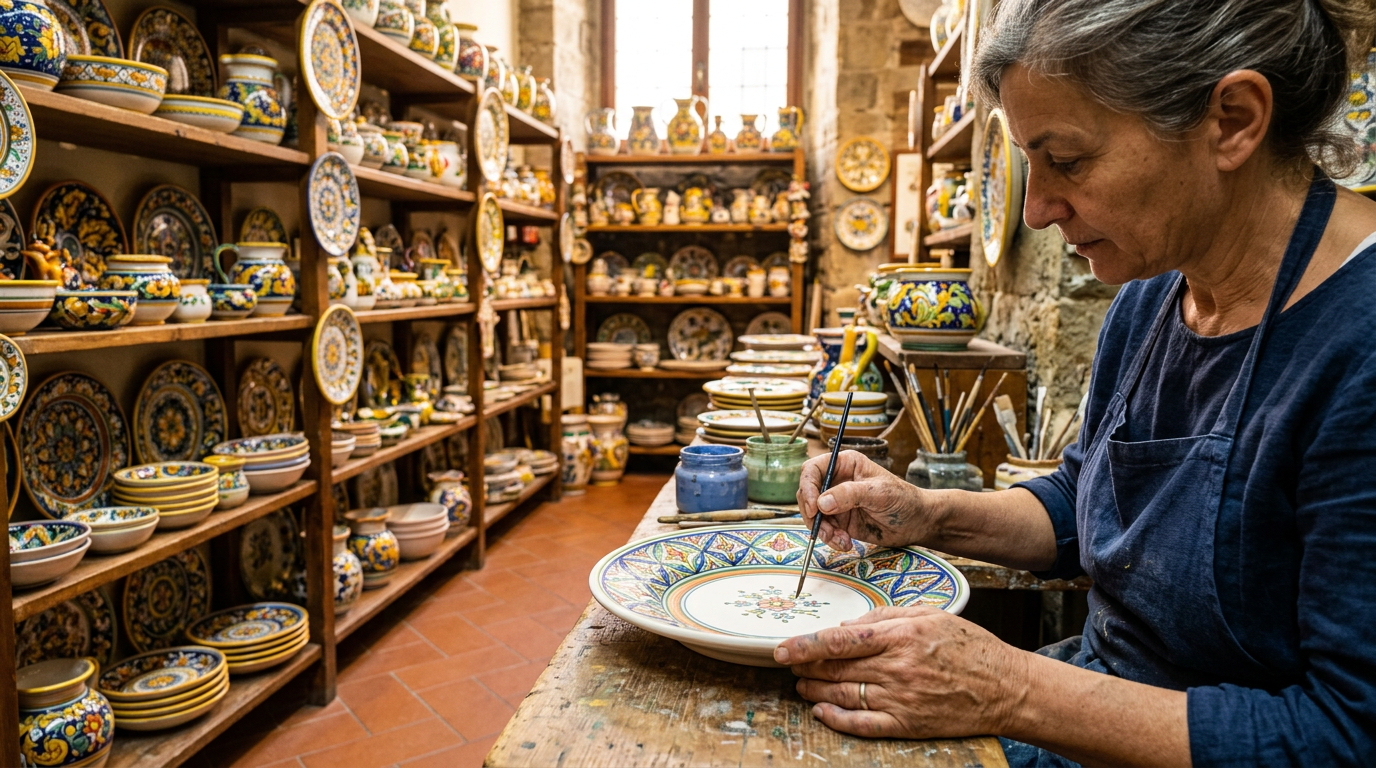
Look for spaces where pottery is actively being made or decorated. Ceramic workshops are identifiable by the smell of clay and glaze, the presence of a kiln, shelves of unfired work, and the visible traces of pigment and clay dust on surfaces and clothing.
Some workshops combine production and retail. You see the work being made, you can ask about the process, and you can buy directly from the stock. Others are production-only and sell through the Montelupo outlets or through shops in the city.
Contemporary studio ceramics from Florence-based artists are available at a few galleries and shops in Oltrarno. These are not traditional majolica. They are individual works by artists who may use any ceramic tradition they choose. The prices and the product are different, but the quality can be exceptional.
If you are specifically looking for traditional Tuscan majolica, the selection in the city itself is more limited than in Montelupo or Deruta. The dedicated shops along Via degli Strozzi and in the tourist areas near the Duomo carry a range of quality from genuine artisan work to industrial imitation. The price is the most reliable distinguishing factor.
What to buy and at what prices
A hand-painted majolica plate from a genuine Tuscan workshop costs between 25 and 80 euros depending on size and the complexity of the decoration. A 24-centimetre plate with a traditional Montelupo pattern costs around 35 to 55 euros from an artisan workshop. The same design in an industrial version from a tourist shop costs 10 to 20 euros.
Coffee sets, consisting of six small cups and saucers, cost between 60 and 150 euros in genuine artisan versions. A single handmade bowl, suitable for pasta or salad, costs between 20 and 60 euros. Decorative tiles, 15 centimetres square with hand-painted patterns, cost between 15 and 40 euros each.
Bespoke commissions are possible at most ceramic workshops. A set of dinner plates painted with a specific pattern of your choice takes about four to eight weeks to produce. A complete dinner service for six people costs between 400 and 1,200 euros depending on the number of pieces and the complexity of the decoration.
The most expensive contemporary studio ceramics from established Florentine artists cost from 200 to several thousand euros per piece. These are individual artworks, not tableware, and are priced as such.
How to recognise quality
Turn a plate over and look at the base. Genuine majolica has an unglazed base that shows the natural terracotta clay, typically a pale orange or red colour. The base is rough to the touch. Industrial ceramics often have a fully glazed base that is smooth and uniform.
Look at the decoration closely. Hand-painted work has slight variations in line width and colour density. The brush strokes are visible. Even the most skilled hand painter leaves evidence of the brush. Printed or transfer-applied decoration is perfectly uniform and has no brush-stroke evidence.
The weight of the piece tells you something about the wall thickness. Genuinely handmade ceramics vary in wall thickness and therefore in weight. Very light, perfectly uniform ceramics are typically slip-cast in industrial moulds.
Check the quality of the glaze surface. Genuine majolica has a slightly uneven glaze surface due to the manual application. Perfectly smooth, mirror-like glaze indicates industrial production.
Ask about firing temperature. Traditional majolica is fired at relatively low temperatures, around 950 to 1020 degrees Celsius. This gives it a specific density and sound when tapped. Higher-fired ceramics, stoneware and porcelain, are different materials with different properties.
Where to stay
De’ Medici is a guesthouse in Oltrarno. Ceramic workshops and the decorative arts tradition of Florence are accessible from here on foot, and the short train ride to Montelupo provides a deeper understanding of Tuscan ceramic history.