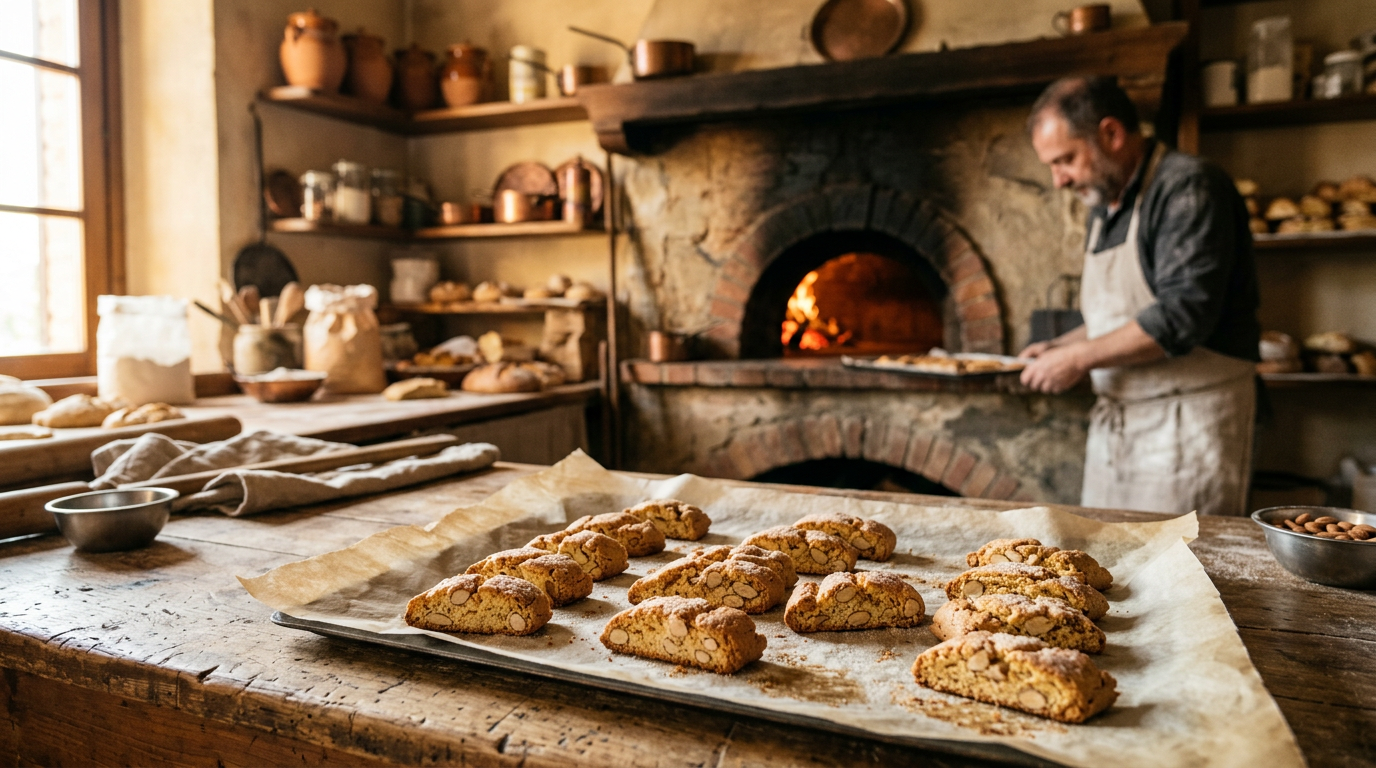
Florence artisan cantuccini: the real thing
Artisan cantuccini of Florence
Cantuccini are the most widely exported Tuscan food product after olive oil and Chianti. You find them in airports, in supermarkets across Europe, and in Italian restaurants from London to Tokyo. Most of what you encounter outside Tuscany is a poor imitation of the real thing.
The genuine article is made with whole almonds, flour, sugar, eggs, and a small amount of butter or lard. The dough is shaped into logs, baked once, sliced diagonally while still warm, and baked again until hard and dry. The result is a very hard, very dry biscuit that does not soften unless dunked in liquid.
This hardness is not a fault. It is the design. The cantuccino was developed as a long-lasting travel food. Soldiers and merchants could carry them for weeks without deterioration. The combination with vin santo, which softens the biscuit and releases the almond flavour, was a later refinement that became the traditional way of ending a Florentine meal.
The word cantucci, the plural of cantuccio, refers to the corner or end piece of bread or a baked good. The biscuits were named for their shape. In Tuscany they are called cantuccini or biscotti di Prato, the latter referring to the city of Prato near Florence, which claims the definitive version.
The history of the Tuscan cantuccino
The cantuccino in its current form dates from the 17th century. The pastry chef Antonio Mattei of Prato is credited with establishing the definitive recipe in the 19th century. His shop, Biscottificio Antonio Mattei, still operates in Prato. It is about 18 kilometres from Florence and about 20 minutes by train.
Visiting Mattei’s shop is worth the short journey if you want to understand what the benchmark cantuccino tastes like. They sell their biscuits in blue paper bags that have not changed in design for over a century. The price is around 8 to 12 euros for a 300-gram bag.
In Florence itself, the production of cantuccini is distributed among pastry shops and small producers. The artisan version differs from the industrial one in the quality of the almonds, the proportion of ingredients, and the absence of artificial preservatives or flavourings.
Artisan cantuccini have a shorter shelf life than industrial ones, typically two to four weeks rather than six months. This is a sign of quality, not a problem. If you are buying them to take home, purchase them as close to your departure date as possible.
Pastry shops in Oltrarno
Oltrarno has a small number of genuine pasticcerie that make cantuccini by hand in small batches. These are not easily found on tourist maps. They serve the neighbourhood primarily and do not focus on marketing to visitors.
The shops around Via dei Serragli and Via Romana tend to stock locally made biscuits alongside bread and other baked goods. Ask specifically for cantuccini artigianali, artisan cantuccini, rather than accepting packaged goods from the counter.
Some bakeries in the neighbourhood make cantuccini only on specific days of the week. Tuesday and Friday are common baking days for biscuits in traditional Florentine bakeries. Arriving on a baking day means you get them as fresh as they are ever available.
Prices for artisan cantuccini in Oltrarno range from 12 to 18 euros per kilogram in 2026. A 200-gram bag, which is a reasonable amount for one or two people, costs between 3 and 5 euros. This is significantly less than the 7 to 15 euros charged for similar quantities in tourist shops near the Duomo.
How to pair them with vin santo
Vin santo is a traditional Tuscan dessert wine made from white grapes, usually Trebbiano and Malvasia, that have been dried on reed mats for several months before pressing. The drying concentrates the sugars. Fermentation happens slowly in small barrels sealed in a warm attic over a period of three to five years.
The result is a wine of variable sweetness and high alcohol content, typically 16 to 18 percent. It can be amber or golden in colour. The best examples have flavours of dried apricot, nuts, honey, and a hint of oxidation that comes from the barrel ageing.
The traditional pairing is simple. Pour about 4 to 6 centilitres of vin santo into a small glass. Take a cantuccino and dip the end into the wine for about 5 to 10 seconds. Eat the softened portion. Repeat. The wine softens the biscuit and the biscuit absorbs the wine’s perfume.
Do not soak the cantuccino for too long. It will break apart in the glass. The ideal is a biscuit that is soft on the dunked end but still dry and crunchy further back. This contrast of textures is part of the experience.
A 375-millilitre half bottle of a decent Tuscan vin santo costs between 12 and 25 euros from a wine shop in Florence. A full 750-millilitre bottle ranges from 18 to 60 euros depending on producer and age. The vin santo from smaller producers in Chianti Classico or Chianti Rufina tends to be better than the mass-market versions.
Where to buy without paying tourist prices
The tourist shops near the Duomo, Ponte Vecchio, and the Uffizi sell cantuccini in decorative packaging at prices that reflect location rather than quality. A box of industrial cantuccini in an attractive tin near the Piazza della Repubblica can cost 15 to 25 euros for 300 grams of product that costs 4 euros in a supermarket.
For better quality at lower prices, buy from neighbourhood pastry shops and food stores. The Conad supermarket on Via dei Serragli stocks local products at normal prices. The small alimentari on the same street and its side streets often carry artisan biscuits from nearby producers.
The Mercato di Santo Spirito has occasional food vendors selling locally made products including biscuits. The selection changes week to week. Saturday mornings tend to have the best variety.
If you want the most serious cantuccini available in Florence, take the 20-minute train ride to Prato and visit the Mattei shop directly. The return ticket costs about 4 euros. Bring an empty bag. You will fill it.
Where to stay
De’ Medici is a guesthouse in Oltrarno. The neighbourhood’s bakeries and food shops are your practical resource for buying artisan cantuccini and vin santo at fair prices, without the tourist markup that defines the area north of the Arno.