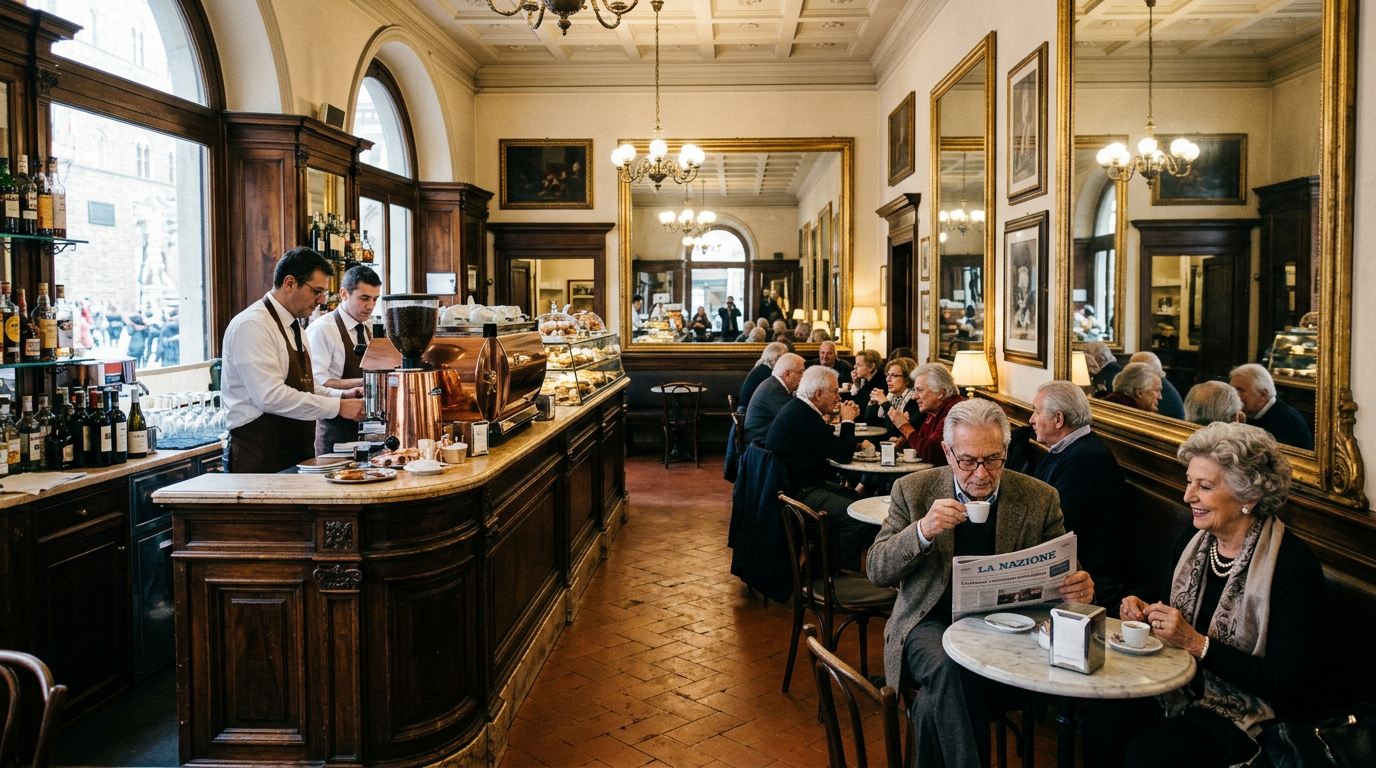
Florence historic cafes: where to drink coffee well
Historic cafes of Florence
Coffee arrived in Florence in the 17th century via the Ottoman trade routes. The first Florentine coffee houses opened in the mid-1600s, initially near the churches and markets where merchants gathered. By the 18th century, the cafe had become an important civic institution, a place for intellectual exchange as much as for drinking.
The great Florentine cafes of the 19th century occupied prominent positions on the main thoroughfares. They were large, ornate, and expensive. The intellectuals and artists who gathered there, from the Italian Risorgimento onwards, used the cafe as a substitute for the club or the salon.
Several of these historic establishments survive. They are genuine relics of 19th and early 20th century cafe culture, with original decor, marble counters, and a history that is visible in the architecture. They also charge significantly more than the neighbourhood bars where Florentines drink their daily coffee.
Understanding the difference between a historic cafe and an authentic neighborhood bar is useful. Both have value, but for different reasons and at different prices.
Coffee culture in the city
The Italian relationship with coffee is unlike any other in the world. It is not just a drink. It is a ritual with a specific set of rules that vary by city, neighbourhood, and time of day.
In Florence, the standard morning coffee is a short espresso drunk standing at the bar. You order, you pay at the register first or simultaneously with ordering, you drink in about two minutes, and you leave. This is not a social performance. It is a functional part of the morning.
The cappuccino exists and is drunk in the morning only. Ordering a cappuccino after 11:00 in a traditional bar in Florence marks you as a tourist. No Florentine drinks milk in their coffee after late morning. This is not a rule that is enforced, but it is observed.
Caffe macchiato, an espresso with a small dash of steamed milk, is the acceptable bridge if you want something between a black espresso and a full cappuccino. It is acceptable at any time of day.
Caffe americano, hot water diluted espresso, exists on menus in tourist-oriented establishments. It is not drunk by Florentines. If you need a large, weak coffee, ask for a caffe lungo, a longer espresso pulled with more water. It is not the same as a filter coffee but it is what the Italian bar can provide.
Historic cafes in the centre
Caffe Rivoire on Piazza della Signoria opened in 1872. The original purpose was as a chocolate shop for the Savoy court. Today it sells coffee and pastries at prices that reflect the location. A coffee at the table costs 5 to 8 euros. At the bar, a standard espresso costs around 2.50 euros, compared with 1.20 euros in a neighbourhood bar.
Caffe Gilli on Piazza della Repubblica dates from 1733 in its original form, though the current location opened in 1910. The interior is a textbook example of early 20th century Italian cafe design. It is beautiful. The coffee is good. The prices are elevated.
Caffe Giacosa on Via della Vigna Nuova has a specific cultural importance. The Negroni cocktail is connected to this address, or more precisely to the original Caffe Casoni that preceded it. Today it operates as a Roberto Cavalli cafe. The history is worth knowing even if the current experience is not exceptional.
Caffe delle Giubbe Rosse on Piazza della Repubblica is famous for its early 20th century association with the Italian Futurist movement. Writers including Giovanni Papini and Giuseppe Prezzolini gathered here. The cafe still operates. The connection to its intellectual past is tangible in the way few things in Florence are.
Coffee in Oltrarno
The coffee experience in Oltrarno is fundamentally different from the historic tourist cafes. The neighbourhood has a network of small bars that have served local residents for decades. They are not famous. They are not designed for visitors. They make excellent coffee and charge normal prices.
An espresso in a neighbourhood bar in Oltrarno costs 1.20 euros, standing at the counter. A cappuccino costs 1.50 to 1.80 euros. A croissant, called a cornetto in Italian, costs 1.20 to 1.50 euros. Breakfast in a normal Florentine bar is one of the cheapest and most satisfying meals in Italy.
The bars on Piazza Santo Spirito and the surrounding streets are your most convenient base. They open early, around 7:00. They are full of neighbourhood residents from 7:30 to 9:00. After 10:00, the crowd shifts toward visitors and the atmosphere changes.
The bar on the corner of Via dei Serragli tends to be reliable. Look for places where the coffee machine is clean and clearly well-maintained. A dirty portafilter or a machine that smells of old coffee is a sign of poor standards. The machine matters almost as much as the quality of the beans.
How not to look like a tourist at the bar
The first rule is to pay at the register before ordering if there is a register separate from the bar. This system, in which you get a receipt and hand it to the barista, is standard in traditional Florentine bars. Walking up to the bar and ordering without paying first will create a small but noticeable moment of confusion.
In smaller, more informal neighbourhood bars, you often order and pay directly at the bar. There is no single rule. Watch what other customers are doing when you arrive and copy them.
Stand at the bar to drink. Sitting at a table costs more in most historic cafes and some neighbourhood bars. In Oltrarno neighbourhood bars, seating is usually not an option anyway. The bar is small and the table, if there is one, is for eating a pastry, not for extended sitting.
Do not ask for the wifi password, do not take long to decide, and do not photograph your coffee extensively before drinking it. These behaviours are tolerated but they slow things down. The bar at 8:00 in the morning is a machine for delivering caffeine to working people. Respect the rhythm.
Leave a small tip if you want to, but do not feel obligated. Tipping at the Italian bar is not expected. If you are a regular or if the barista has made something with care, leaving 20 or 30 cents on the counter is a natural gesture. Nothing more is expected.
Where to stay
De’ Medici is a guesthouse in Oltrarno, where neighbourhood bars make coffee at the normal Florentine price of 1.20 euros. Start every morning in the neighbourhood before visiting the monuments and you will understand the city better for it.