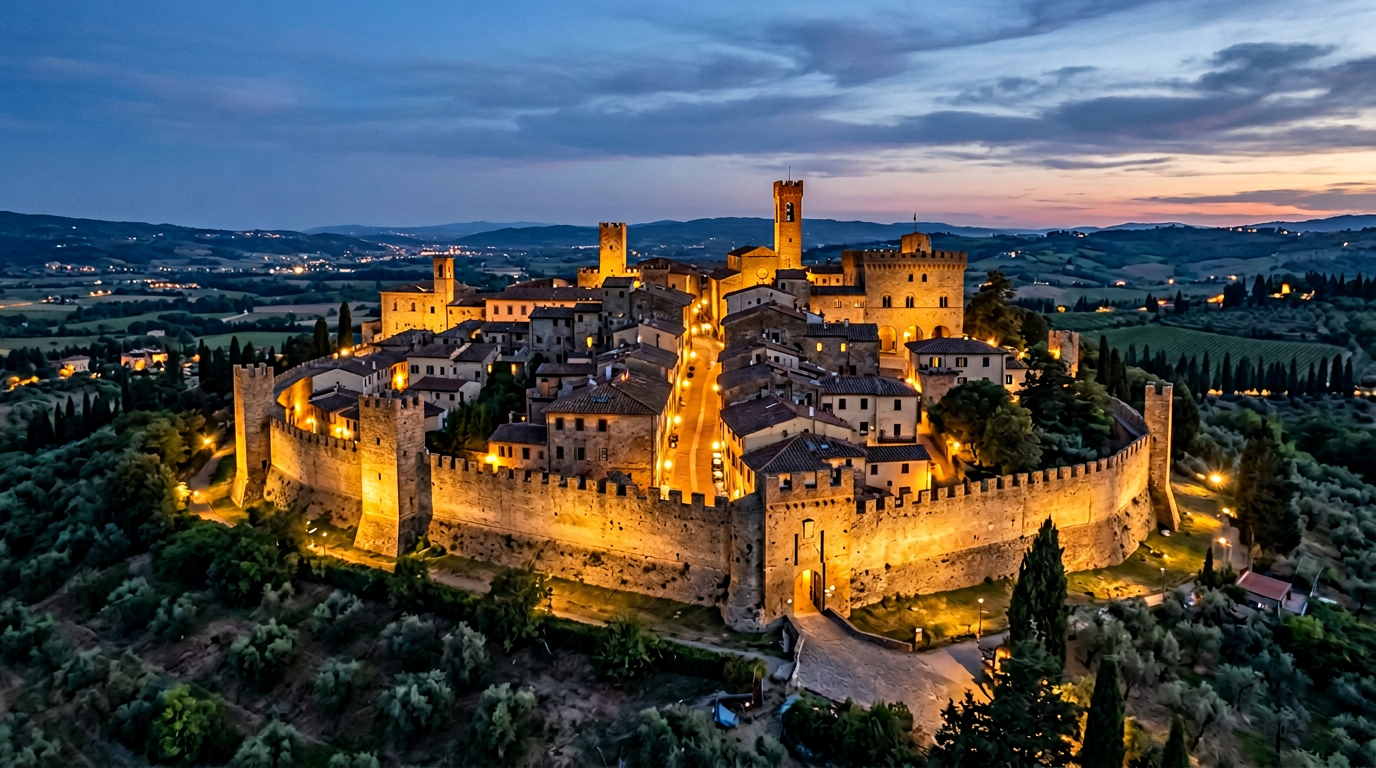
Boccaccio Florence Certaldo: History and Places
Boccaccio and Medieval Florence: A Literary History
Giovanni Boccaccio was born in 1313, probably in Certaldo, the Tuscan town his father came from. He spent much of his adult life in Florence and Naples. His masterwork, the Decameron, was written between 1348 and 1353 and is one of the defining texts of Italian literature.
Boccaccio is less famous than Dante, whose Commedia was completed a generation earlier, and less celebrated than Petrarch, his close friend and correspondent. But the Decameron had a more direct influence on the development of prose narrative than either of the other two writers. Chaucer’s Canterbury Tales, written a generation later, is directly modelled on it.
Boccaccio and medieval Florence
Boccaccio grew up between Florence and Naples. His father, Boccaccino di Chellino, was a merchant and agent of the Bardi banking family, and moved between the two cities on business. Giovanni spent his adolescence in Naples, where he received an excellent education and began writing in Italian as well as Latin.
He returned to Florence in the early 1340s, just before the Bardi and Peruzzi banking houses collapsed in the wake of Edward III of England’s debt default. The financial crisis, the political instability of the commune, and then the catastrophic plague of 1348 all formed the background to Boccaccio’s mature life and work.
The Decameron is dated by its framing narrative to the plague year of 1348. A group of seven women and three young men flee Florence for a villa in the hills and spend ten days telling stories: a hundred stories in total, organised in themes that include love, wit, fortune, and the ingenuity required to survive in a treacherous world.
The plague that frames the Decameron was real. Boccaccio’s description of its effects on Florence in the opening pages is one of the most detailed contemporary accounts of the Black Death anywhere in Europe. He describes the abandonment of social norms, the breakdown of family bonds, the smell of the streets, and the unprecedented volume of death.
The Decameron and the city
The city of Florence appears throughout the Decameron as a social world defined by money, wit, and the exercise of power. Many of the stories are set specifically in Florence or involve Florentine characters. Boccaccio’s Florence is a merchant city, ambitious and calculating, where intelligence and cunning are valued more highly than virtue.
The geography of the Decameron is recognisable in the modern city. The storytellers’ villa in the hills is understood to be in the area of Fiesole, north of Florence. The opening plague scene is set in the streets of the city centre.
Several stories refer to identifiable locations: the church of Santa Maria Novella (where the group meets before leaving for the villa), the streets of the Oltrarno neighbourhood, and the markets and workshops of the medieval commercial city.
Reading the Decameron with a modern map of Florence in hand is a useful exercise. The distances between locations, the social geography of different neighbourhoods, and the physical texture of the city in the 14th century all become clearer when you can trace the characters’ movements on the ground.
Boccaccio sites in Florence
There is no dedicated Boccaccio museum in Florence. Unlike Dante, who has a museum in the house supposedly connected to his birth, Boccaccio’s Florentine presence is less formally commemorated.
The church of Santo Stefano al Ponte, on Via Por Santa Maria just north of Ponte Vecchio, contains a plaque marking the spot where Boccaccio reportedly gave public lectures on Dante’s Commedia. In 1373, the Florentine commune appointed Boccaccio to deliver a series of public lectures on the poem. He was the first person to lecture on Dante in this way, and the lectures helped establish the Commedia as a canonical literary text.
The Badia Fiorentina on Via del Proconsolo, one of the oldest churches in Florence, is associated with Boccaccio’s early life in the city. His father is recorded as a benefactor of the church. The building, founded in the 10th century, has a beautiful cloister that is occasionally open to visitors.
The area around Piazza della Repubblica and the former Mercato Vecchio (old market) is the setting for several of the Decameron’s Florentine stories. The Mercato Vecchio was demolished in the 1880s to build the current Piazza della Repubblica. A commemorative plaque on one of the arcades records what was lost.
Certaldo: the hometown
Certaldo is a small town about 35 kilometres southwest of Florence in the Valdelsa valley. It can be reached by train from Florence Santa Maria Novella in approximately 40 minutes, with a change at Empoli. The train service runs regularly throughout the day.
Certaldo is divided into two parts: Certaldo Basso, the modern lower town on the valley floor, and Certaldo Alto, the medieval hilltop village connected to the lower town by a funicular.
Certaldo Alto is one of the best-preserved medieval villages in Tuscany. The main street, Via Boccaccio, runs through the centre of the village from gate to gate. The buildings are all of red-orange brick, in the style typical of the Valdelsa valley.
The Casa del Boccaccio at Via Giovanni Boccaccio 18 is traditionally identified as the house where the writer lived and died in 1375. The current building is largely a reconstruction from the early 20th century, following the original destruction by bombing in 1944. Inside, a small museum contains portraits of Boccaccio, illustrated editions of the Decameron, and documents related to his life and work. Entry costs 5 euros.
The Oratorio dei Santi Michele e Jacopo, adjacent to the Casa del Boccaccio, contains an important Cenacolo fresco. The church is open for visits during the museum’s opening hours.
Certaldo Alto also has a Palazzo Pretorio, the medieval communal palace with a facade covered in terracotta coats of arms. The palace contains frescoed rooms and a collection of civic objects from the medieval and Renaissance periods. Entry costs 5 euros.
How to connect literature to history
The most effective way to use the Decameron as a guide to Florence is to read individual stories while you are in the city, rather than before or after your visit.
The opening pages of the Decameron, describing the plague, are worth reading while you are in the historic centre north of the Arno. Boccaccio describes the bodies in the streets, the closure of shops and churches, and the escape of the wealthy from the city to their country villas. Standing in Piazza della Signoria or near the Duomo while reading this passage makes the historical event unexpectedly vivid.
The stories set in Oltrarno and on the south bank of the Arno are harder to locate precisely, but the general atmosphere of the neighbourhood Boccaccio describes, its commercial energy, its mixture of social classes, and its proximity to the river, still corresponds to something recognisable.
For Certaldo, read the biographical sections about Boccaccio’s later life before visiting. The contrast between the cosmopolitan Florence of the Decameron and the quiet provincial town where he chose to retire and die is genuinely interesting.
Where to stay
De’ Medici is a guesthouse in Oltrarno, in the neighbourhood that appears throughout the Decameron as a setting for merchant life, wit, and the pleasures of the city. The literary Florence that Boccaccio described is the same physical city you walk through today.