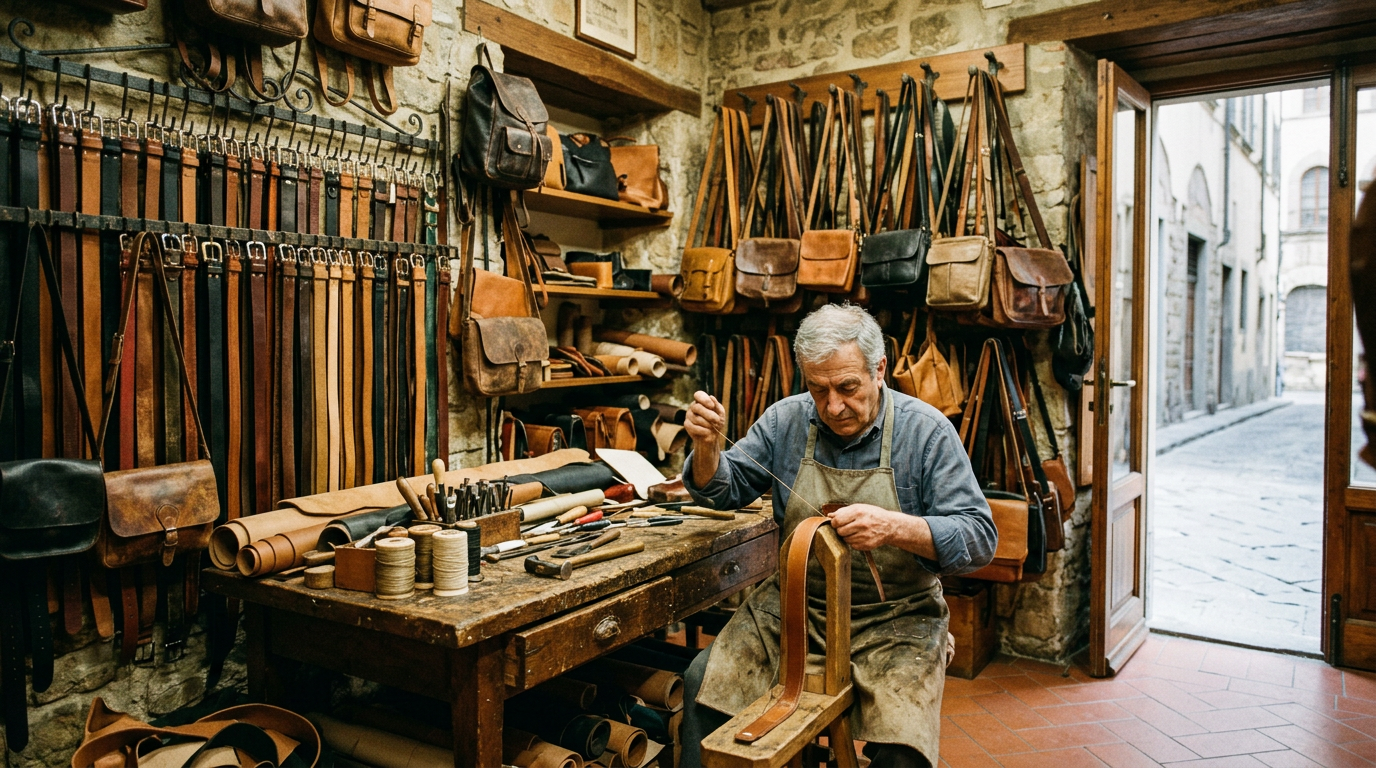
Florence leather artisans in Oltrarno
Leather in Oltrarno
Florence has been connected to leather working for over a thousand years. The medieval tanning industry was concentrated on the south bank of the Arno because the process required large quantities of water and the Arno provided it. The neighbourhood’s name, Oltrarno, meaning beyond the river, reflects its historical identity as the working and industrial part of Florence.
The tanneries are long gone. The smell and the noise of a functioning tanning district would be incompatible with today’s residential neighbourhood. But the craft tradition that the tanneries fed, the leatherworkers, saddlers, shoemakers, and bag-makers who depended on local tanned hides, survived the disappearance of the industry.
The leather workshops of Oltrarno today work with imported hides, mostly from Italian tanneries in Santa Croce sull’Arno, about 35 kilometres west of Florence. This town remains one of the main tanning centres in Europe. The connection between Florence and Italian tanning is still geographic and economic, even if it is no longer local.
What remains in Oltrarno is the skill: the knowledge of how to cut, stitch, and construct leather goods by hand. This knowledge is passed within workshops and families. It produces objects of a quality and durability that industrial leather goods cannot match.
The Florentine tanning tradition
The Arte dei Vaiai e Pellicciai, the guild of furriers and leather workers, was one of the fourteen major guilds of medieval Florence. Its members included the tanners who processed raw hides, the curriers who worked the tanned leather to soften and colour it, and the leather workers who made finished goods.
The guild system created a rigorous quality standard. Members were inspected and could be fined for producing substandard work. This enforcement of standards over centuries built the reputation that Florentine leather still trades on today.
The specific character of Florentine leather work is partly technical and partly material. The use of vegetable tanning, which uses plant-derived tannins rather than the chrome salts used in faster industrial processes, produces a leather that is stiffer initially but softens with use and develops a patina over time. Vegetable-tanned leather lasts for decades.
The Santa Croce tanneries, which supply most of the leather used in Florentine workshops today, produce vegetable-tanned leather in several varieties. The most prized is the cuoio, the heavy, stiff leather used for bag bases and structural elements. The softer nappa, more supple and comfortable against skin, is used for linings and accessories.
Leather artisan workshops
The streets most associated with leather workshops in Oltrarno are Via dello Sprone, Sdrucciolo de’ Pitti, Via dei Guicciardini, and the smaller streets connecting them. This is the historic core of the neighbourhood’s leather district.
Most workshops sell directly from the workspace. You walk in, look at what is on display, and if nothing suits, you can ask about custom work. The maker is usually present. This directness is the defining advantage of buying from a workshop rather than a shop.
Several workshops specialise in specific products. Some make bags and travel goods exclusively. Others focus on small leather goods: wallets, card holders, key rings, and belts. A few make footwear using traditional construction methods. Understanding what a workshop specialises in before you enter helps you ask better questions.
The Scuola del Cuoio in the Franciscan complex of Santa Croce, north of the Arno, is a leather school founded in 1950 where young leather workers are trained. It has a retail shop connected to the school. Prices are reasonable and quality is reliable. It is a more structured and tourist-ready version of the Oltrarno workshop experience, but the work is genuine.
How to recognise handmade leather
The clearest indicators of handmade leather work are visible at the edges. Machine-cut leather has very clean, precise edges. Hand-cut leather has a slightly less perfect edge, sometimes showing the drag of the knife. Burnished edges, rubbed smooth after cutting, indicate attention to detail.
Look at the stitching. Hand stitching is done with two needles working in opposite directions, creating a stitch that locks on both sides of the leather. It is less uniform than machine stitching but far more durable. If one thread breaks in hand stitching, the seam does not unravel. Machine stitching fails progressively once one thread is damaged.
Examine the hardware. Buckles, rings, and clasps on a handmade bag should be solid brass or solid steel, not plated zinc. You can test zinc by its light weight and by the tendency to tarnish quickly. Solid brass hardware is heavier and maintains its finish for years.
Smell the leather. Vegetable-tanned leather has a clean, slightly sweet, natural smell that strengthens pleasantly with age. Chrome-tanned leather has a chemical smell that does not improve. The smell is not definitive but it is informative.
The price is a rough guide. A handmade leather bag in genuine vegetable-tanned leather from an Oltrarno workshop costs between 120 and 450 euros depending on size and complexity. Anything priced significantly below this range is either machine-made or uses inferior materials.
Where to buy without falling into tourist traps
The main tourist trap in Florentine leather shopping is the San Lorenzo market, which surrounds the church of San Lorenzo north of the Arno. Many stalls here sell leather goods at prices that suggest artisan quality. Most of what is sold is machine-made in factories, often in Asia, and imported.
Buying from a workshop in Oltrarno rather than a market stall is the most reliable way to get genuine handmade goods. In a workshop, you can see the tools, speak to the maker, and observe the quality directly. In a market stall, you cannot.
The workshops on Sdrucciolo de’ Pitti and Via dello Sprone are more expensive than the market stalls but offer genuine handmade goods at prices that reflect the actual cost of production. A wallet from an Oltrarno workshop costs 40 to 80 euros. The same object from San Lorenzo market costs 15 to 25 euros. The difference in durability over ten years is dramatic.
If you are uncertain, ask the workshop if you can watch the maker work for a few minutes. A genuine artisan will have no problem demonstrating. A retailer of imported goods will find this request awkward.
Where to stay
De’ Medici is a guesthouse in Oltrarno, where Florence’s genuine leather workshops are concentrated within a few streets. From here you can walk to the artisan district in under five minutes and buy directly from the people who make what you are buying.