Florence artisans: authentic workshops in Oltrarno
Authentic artisan workshops of Florence
The artisan identity of Florence is not a marketing invention. It is the result of a specific historical and economic trajectory that began in the medieval guild system and survived, in modified form, into the present.
The guilds of medieval Florence organised craftspeople into powerful institutions that controlled production standards, set prices, and governed entry into the trade. The Arte dei Fabbricanti, the Arte dei Vaiai e Pellicciai, and dozens of other guilds represented every major craft. Their political power was real enough to influence city government.
When the guild system declined in the 18th and 19th centuries, the craft skills survived in workshops that passed techniques from master to apprentice. The industrial revolution changed how things were made in most of Europe, but Florence’s artisan sector adapted rather than disappeared. The quality of handmade objects maintained a market among collectors, restorers, and discerning buyers.
Today, Oltrarno contains one of the highest concentrations of genuine working artisan workshops in any European city. The number has decreased over the past two decades, and the trend continues, but what remains is real.
What makes a workshop authentic
The word artigianale, artisan, has been applied to an increasingly broad range of commercial activities. In Florence, cafes, chocolate shops, and even large pasta manufacturers describe themselves as artigianale. Understanding what the word genuinely means, and what it does not mean, matters.
A genuine artisan workshop makes things by hand using traditional techniques. The person making the object has learned the skill over years of practice, typically through direct apprenticeship with an experienced craftsperson. The tools may include machines but the defining operations require human judgement and manual skill.
The scale is small. A genuine artisan is not running a factory. A single craftsperson or a small team of three to five people produces a limited number of objects, each one slightly different from the last. This is the defining distinction from industrial production.
The workshop is also typically a retail space. You buy directly from the maker. There is no distributor, no retailer, no brand intermediary. The price you pay goes to the person who made the object.
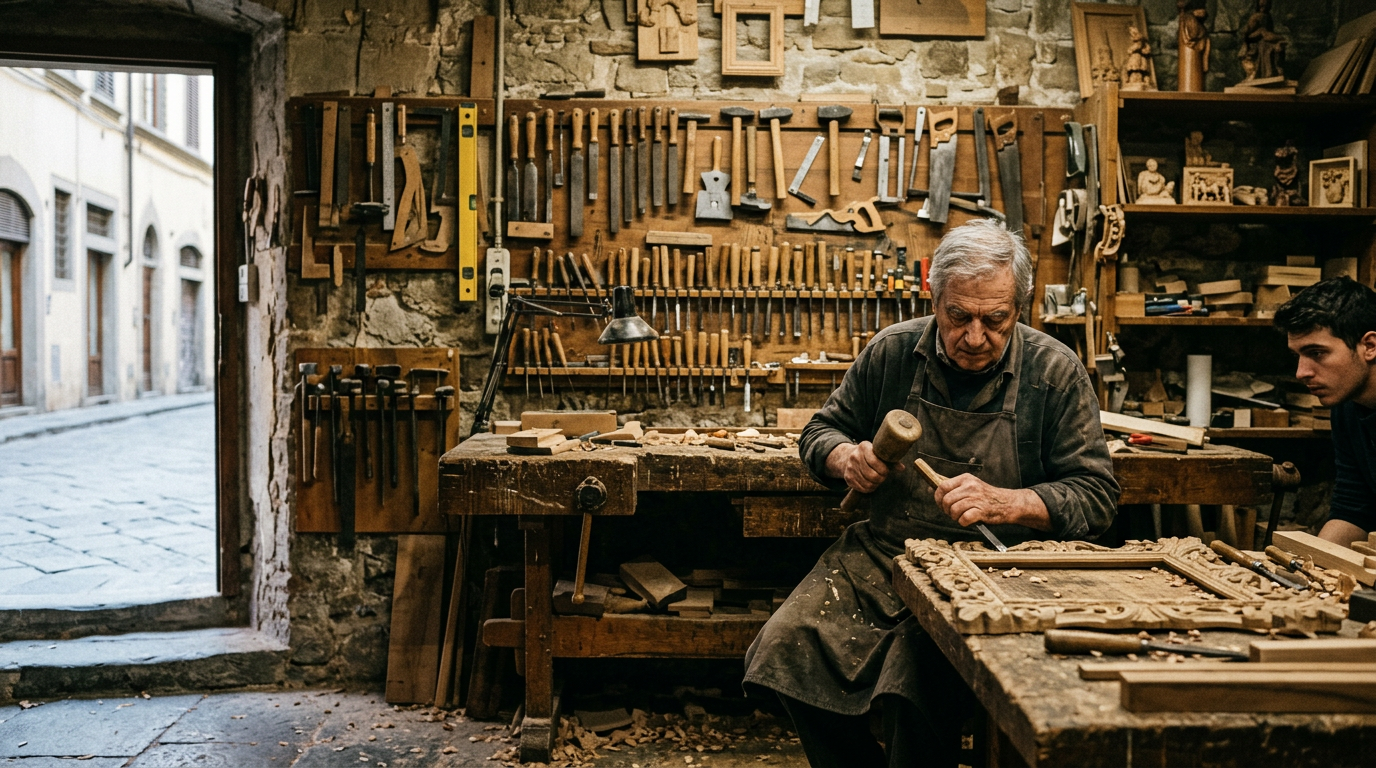
Physical signs of a genuine workshop are observable. The floor has dust or shavings. The workbench shows use. The air smells of the materials being worked. Tools are accessible and worn. The maker is present and working, not standing behind a counter selling to visitors.
Crafts still alive in Oltrarno
Bookbinding is one of the most visible surviving crafts in Oltrarno. Several active binderies use traditional techniques including Florentine marbled paper, gold tooling on leather covers, and hand-sewn binding structures. These workshops produce notebooks, photo albums, and bespoke objects for clients including major libraries and private collectors.
Picture framing with traditional gilded frames is another living craft. The process of applying gold leaf to a carved frame requires dozens of steps and years to learn properly. Florentine frames have a specific character and a specific history: many Renaissance paintings you see in museums were originally framed by workshops in this neighbourhood.
Furniture restoration is concentrated in Oltrarno and operates largely outside the tourist economy. The restorers work primarily for museums, institutions, and private clients who own antique furniture. Their work is invisible to most visitors but represents one of the highest concentrations of craft skill in the city.
Leather working occupies several workshops, particularly around Via dello Sprone and Sdrucciolo de’ Pitti. The Florentine tradition of leather craftsmanship, connected to the medieval tanning industry that processed hides on the south bank of the Arno, produces bags, wallets, belts, and accessories of varying quality. The genuine artisan workshop and the tourist shop selling machine-made goods are sometimes neighbours. The differences are visible if you know what to look for.
How to visit workshops
Many Oltrarno workshops welcome visitors, but this requires respectful behaviour. You are entering a working space, not a museum or a shop. The craftsperson is there to work, not primarily to perform for visitors.
Walk slowly through the artisan streets. Peer through open doors. If you see work in progress that interests you, wait at the threshold and make eye contact. A nod is usually an invitation to step inside. Entering without acknowledgement is intrusive.
Do not handle materials or tools without being offered the opportunity. Do not photograph the workspace without asking. These seem like obvious courtesies but they are frequently ignored.
Be prepared to buy something if the workshop sells directly. You are taking the craftsperson’s time and attention. Visiting to watch and buy nothing is acceptable for a short visit. An extended conversation followed by walking away with nothing is less so. Even a small purchase, a notebook, a leather card holder, a hand-gilded bookmark, honours the exchange.
Some workshops now organise scheduled visits and demonstrations. These are more structured and cost between 15 and 50 euros per person depending on the activity and duration. Ask at your accommodation for current contacts. These organised visits are sometimes the only way to see processes that are otherwise conducted behind closed doors.
The value of local craftsmanship
The question of why artisan craft matters in a world of industrial production has several answers.
One answer is economic. Every purchase from an artisan workshop puts money directly into the local economy. It supports a skilled person and, by extension, a tradition that took generations to build. Industrial production extracts value. Artisan production creates and sustains it locally.
A second answer is cultural. The skills practised in Oltrarno are linked to the techniques that produced the objects in the Uffizi, the Bargello, and the Pitti. Contemporary bookbinders use the same structures as those who bound manuscripts for the Medici. Frame gilders use the same materials as those who framed altarpieces in the 15th century. These continuities are not trivial.
A third answer is practical. A handmade object, properly made, outlasts its industrial equivalent by years or decades. A leather bag made in an Oltrarno workshop will still be functional in twenty years. Its industrial equivalent will not. The higher initial cost is offset by durability.
Where to stay
De’ Medici is a guesthouse in the heart of Oltrarno. The artisan workshops described in this guide are your immediate neighbours. Staying here allows you to experience the working life of the neighbourhood across your whole visit, not just in an organised afternoon tour.