Tuscan crostini: where to eat the real thing
Tuscan crostini: a tradition
Crostini are among the oldest and most essential elements of Tuscan cooking. They appear at the start of almost every traditional meal in Florence and throughout the region. They are simple things: thin slices of unsalted Tuscan bread, toasted or grilled, topped with something strongly flavoured.
The tradition is deeply practical. Tuscan bread is made without salt, a choice that dates back to medieval times when Florence taxed salt heavily. Unsalted bread is bland on its own but becomes an excellent vehicle for intensely flavoured toppings. The crostino solves the problem.
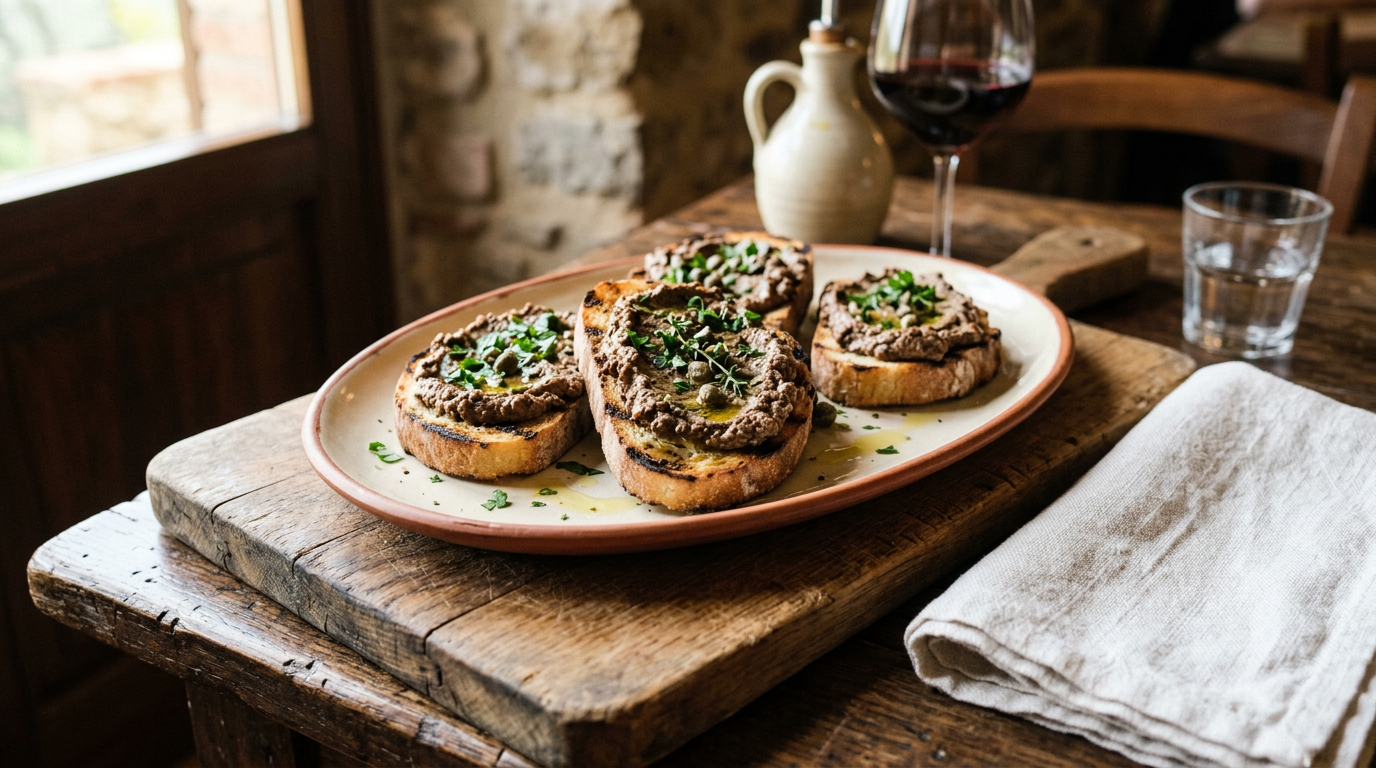
Chicken liver pate is the most classic Florentine topping. It is called fegatini di pollo and is made by cooking chicken livers slowly with onion, capers, anchovies, sage, and vin santo, then grinding the mixture to a coarse paste. The result is dark, rich, slightly bitter, and deeply savoury.
This is not sophisticated food. It is old food. It is food that was developed over centuries by people who wasted nothing. That history is part of what makes eating a proper crostino in Florence feel like an act of connection to something real.
What makes them different from bruschetta
The confusion between crostini and bruschetta is common among visitors, and it matters to understand the difference.
Bruschetta is grilled bread, typically a thick slice, rubbed with raw garlic while hot, dressed with olive oil, and topped with fresh tomatoes and basil. It is a summer dish, tied to the harvest when tomatoes are good. It is associated more with central and southern Italy broadly.
Crostini are thinner, smaller, and more delicate. The bread is sliced to about 1 centimetre or less, then toasted until dry and light. The toppings are cooked or cured rather than fresh. They are eaten in one or two bites.
In Florence specifically, the crostino neri, the black crostino with chicken liver pate, is the defining version. Calling this a bruschetta would mark you immediately as someone who does not know Florentine food. The distinction is local knowledge and it is respected here.
Other Florentine toppings include lard with rosemary and pepper, fresh ricotta with good olive oil, simple white beans, and in season, a spread of porcini mushrooms cooked with garlic and thyme. All of these are legitimate. None of them is the central tradition the way the fegatini are.
Trattorias where the real thing is served
In a proper Florentine trattoria, crostini arrive automatically at the start of the meal, often with the bread basket. They are part of the antipasto structure. You do not always order them separately. The waiter brings them while you look at the menu.
The quality of the crostini tells you a great deal about the kitchen. If the chicken liver pate is made in-house, it will be coarser, more complex, and more strongly flavoured than the commercial version. If it comes from a container, you will know by the uniformity and the slightly metallic edge.
Good crostini in Oltrarno can be found in the traditional trattorias around Via dei Serragli, Piazza del Carmine, and the side streets east of Piazza Santo Spirito. Any restaurant that has a handwritten menu and a kitchen that operates on seasonal ingredients is likely to make its own pate.
As a standalone antipasto, an order of crostini misti costs between 6 and 12 euros in a traditional trattoria. For this you receive four to six small toasts with different toppings. Combined with a glass of wine, it makes a reasonable light lunch.
Some wine bars in Oltrarno serve crostini alongside their wine list as a standard accompaniment. These tend to be simpler in execution but entirely adequate. A small plate with a glass of wine at aperitivo time costs between 8 and 14 euros in total.
How to make them briefly
The recipe for crostini neri is not complicated but it requires patience and quality ingredients.
Start with chicken livers from a good source. Soak them in cold water for 30 minutes to remove blood and bitterness. Pat dry. Cook a finely chopped white onion slowly in olive oil until very soft, about 15 minutes. Add the livers and cook until just done through, not overcooked.
Add a small glass of vin santo and let it evaporate. Add a few capers and a couple of anchovies. Season with salt and a little black pepper. Process everything coarsely with a knife or a brief pulse in a food processor. The texture should be rough, not smooth.
Spread on thin toasted bread slices while still slightly warm. The pate can be made ahead and kept refrigerated for two or three days. It improves after a day of resting.
The bread matters. Use genuine Tuscan unsalted bread, pane sciocco. Sliced thinly and dried in the oven at 160 degrees Celsius for about 12 minutes, it becomes the right vehicle. Do not use salted bread or commercial toast.
Where to find them in Oltrarno
Almost any traditional trattoria in Oltrarno will serve crostini as part of an antipasto. The question is quality, not availability. Look for places where the menu changes with the season and where the kitchen is clearly working from scratch.
The wine bars along Via dei Serragli and around Piazza della Passera serve simple crostini alongside their wine selection. These tend to be more casual and less elaborate than the restaurant versions. Both are worth experiencing.
If you want to buy the ingredients to make your own, the Mercato di Santo Spirito on weekday mornings has fresh chicken livers available from the butchers inside. Capers can be found at the small grocery shops on Via dei Serragli and Via Sant’Agostino. Tuscan bread is baked locally and sold from several small shops in the neighbourhood.
The Oltrarno food culture is built on this kind of knowledge: where to find things, how to make them, and when to eat them. Crostini are a small piece of that larger picture, but they represent the whole.
Where to stay
De’ Medici is a guesthouse in Oltrarno, where traditional Florentine cooking, including the crostini tradition, is still a living reality rather than a museum piece. You are a short walk from the trattorias and markets where these dishes are made and served every day.