Children's Theatre in Florence
Children’s theatre in Florence
Florence has a well-developed theatre culture for young audiences. The city’s theatres program dedicated children’s shows throughout the year, with a particular concentration during the school year (September through June) and seasonal peaks at Christmas, Easter, and October half-term.
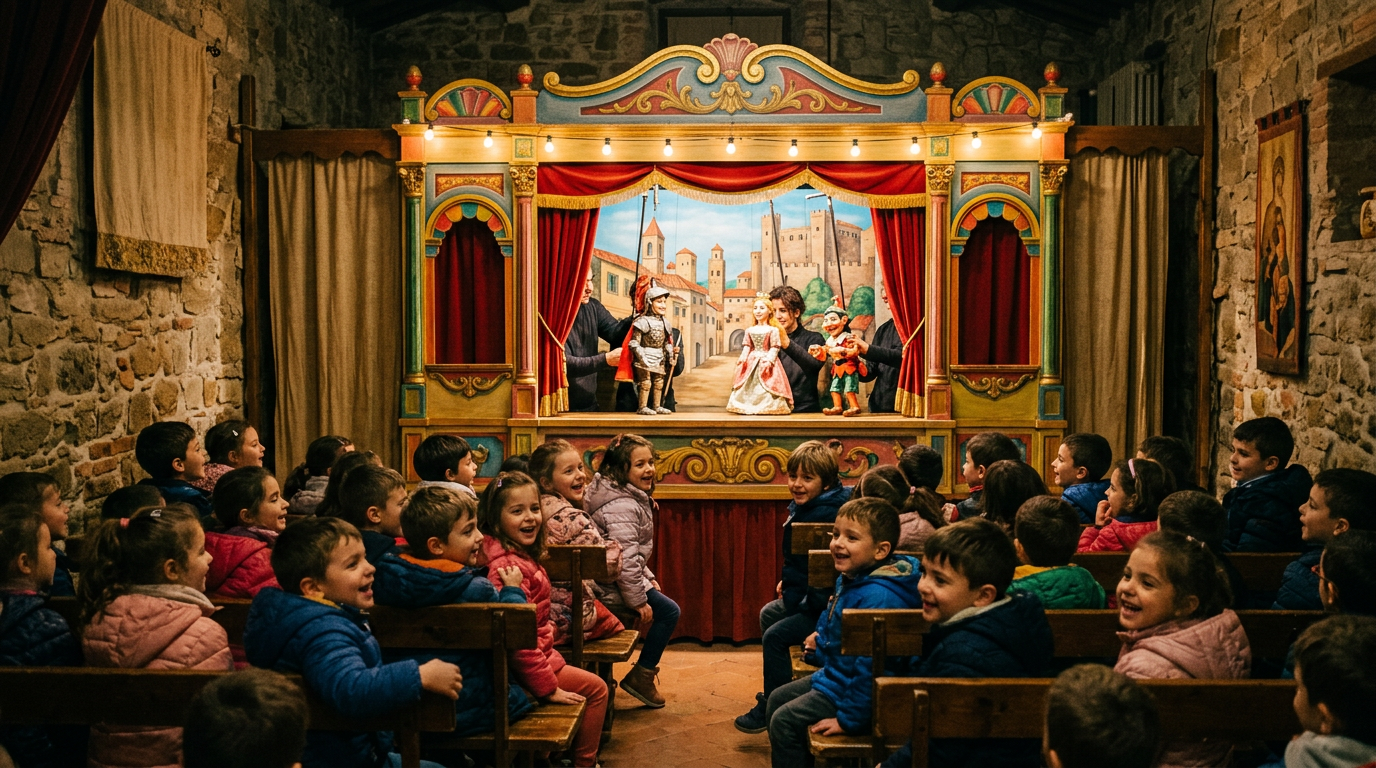
Theatre for children in Italy tends to use high-quality staging, physical performance, and puppetry alongside more conventional spoken drama. Many productions work well even for children who do not understand Italian, because the visual and physical storytelling carries the narrative without relying entirely on language.
For families visiting Florence, attending a children’s performance is an experience that connects you with local family life in a way that a museum visit does not. The audience is largely Florentine families with children. The atmosphere is informal and welcoming.
This guide covers the main theatres with children’s programming, the general structure of the theatrical season, how to book tickets, and what age children are ready for a first theatre visit.
Theatres with children’s shows
Several Florence theatres include children’s programming in their regular season.
The Teatro della Pergola (Via della Pergola 12) is one of the oldest and most prestigious theatres in Italy. While its main programme focuses on classical and contemporary adult theatre, the Pergola runs a dedicated children’s and family season. Productions are staged in the main theatre and in the smaller attached Teatro del Cocomero space. Children’s shows typically run on Sunday mornings between 10:30 and 12:00. Tickets cost between 8 and 12 euros per person for children’s matinees.
The Teatro Verdi (Via Ghibellina 99) is a large theatre (1,500 seats) that programs a varied range of productions including musical theatre, dance, and family entertainment. Family shows at the Verdi tend to be larger-scale productions with more visual spectacle. Tickets for family events range from 10 to 25 euros. The theatre has good access, including lift facilities for pushchairs and wheelchairs.
The Teatro di Rifredi (Via Vittorio Emanuele II 303), located in the residential Rifredi neighbourhood about 3 km north of the centre, is a smaller theatre (around 200 seats) that programs experimental and contemporary theatre. It has a long tradition of children’s theatre and puppet shows. Tickets are typically 6 to 10 euros for children’s performances. Reachable by tram line T2 from the centre.
The Teatro del Sale (Via de’ Macci 111) in the Sant’Ambrogio neighbourhood is a private dining and theatre club. Membership is required (approximately 7 euros per year per adult), but once a member you can attend performances and a shared dinner for around 25 to 30 euros per adult. Children’s events are scheduled periodically and are well-regarded by local families.
The season programme
The Florentine theatre season for children runs primarily from October through May. The summer months (June through August) see most theatres closed or running reduced programmes. Outdoor summer events and cinema partially fill the gap.
The high points of the children’s theatre year in Florence are the following periods. The Christmas season (December through early January) brings theatrical fairy-tale productions, puppet shows, and musical performances. These are the most heavily attended events and booking well in advance is necessary.
The Carnival period (February) is another peak. Productions themed around masks, transformation, and comedy are common. The Italian Carnival tradition has deep roots in theatrical culture and the productions from this period often draw on commedia dell’arte conventions.
The Easter period (March through April) is the third significant peak. Family productions that combine history and imagination, often drawing on Florentine Renaissance material, appear across multiple theatres.
Most theatres publish their full season programmes in September for the following 12 months. Checking theatre websites in September gives you the best advance view of what is available during your planned visit.
How to book tickets
Booking tickets for Florence children’s theatre in advance is strongly recommended for popular productions and weekend matinee performances.
Most Florence theatres have online ticketing through their own websites. The Teatro della Pergola and Teatro Verdi both use their own booking platforms. A service charge of 1 to 2 euros typically applies to online bookings.
Physical box offices are open approximately two hours before each performance. For popular children’s shows, the box office queue can be 20 to 30 minutes. Online booking avoids this.
Third-party platforms such as Vivaticket are used by several Florence theatres. These charge a booking fee of around 2 euros per transaction.
Telephone booking is available at most major Florence theatres. If you do not speak Italian, email in English is generally better received than a telephone call. Most box offices respond to English-language email inquiries within 24 to 48 hours.
Concession rates for children vary by theatre. The most common structure is a flat children’s rate for ages 3 to 12, typically 2 to 4 euros less than the adult price. Family packages (2 adults plus 2 children) are available at some theatres for roughly 15 to 20 percent less than four individual tickets.
Children under 3 are generally admitted free but are expected to sit on a parent’s lap. Confirm this with the specific theatre when booking.
What age to take children to the theatre
The appropriate age for a first theatre visit depends on the production format and your child’s experience with extended, focused activity.
For puppet and physical theatre productions, the recommended minimum age is 3 to 4 years. These shows use movement, colour, and music as primary storytelling tools. The running time is typically 45 to 60 minutes, which is within the sustained attention range of most 3-year-olds.
For spoken drama productions in Italian, a minimum age of 6 to 7 is more practical, even for children who do not understand the language. By this age, children can follow visual storytelling even when dialogue is not comprehensible.
For musical theatre productions, age 5 and above is generally appropriate. The combination of music, movement, and spectacle sustains attention more effectively than pure spoken drama.
For classical theatre or more demanding productions aimed at young people rather than young children (which is the category described in the separate guide on youth theatre), the appropriate age is usually 10 and above.
The best indicator is your child’s experience with other performing arts. A child who has attended concerts or circus performances has already developed the skill of sitting quietly and attending to a live event. For a child with no prior experience, a 45-minute puppet show is a better first theatre experience than a 90-minute musical.
Where to stay
Charlotte guesthouse in Florence is centrally positioned near the Teatro della Pergola and Teatro Verdi, both accessible on foot or by a short bus journey. If you are planning a theatre visit as part of your Florence stay, the central location makes this easy to incorporate.
The team at Charlotte can provide current recommendations for children’s theatre programmes during your specific dates.
Find out more about the guesthouse at Charlotte.