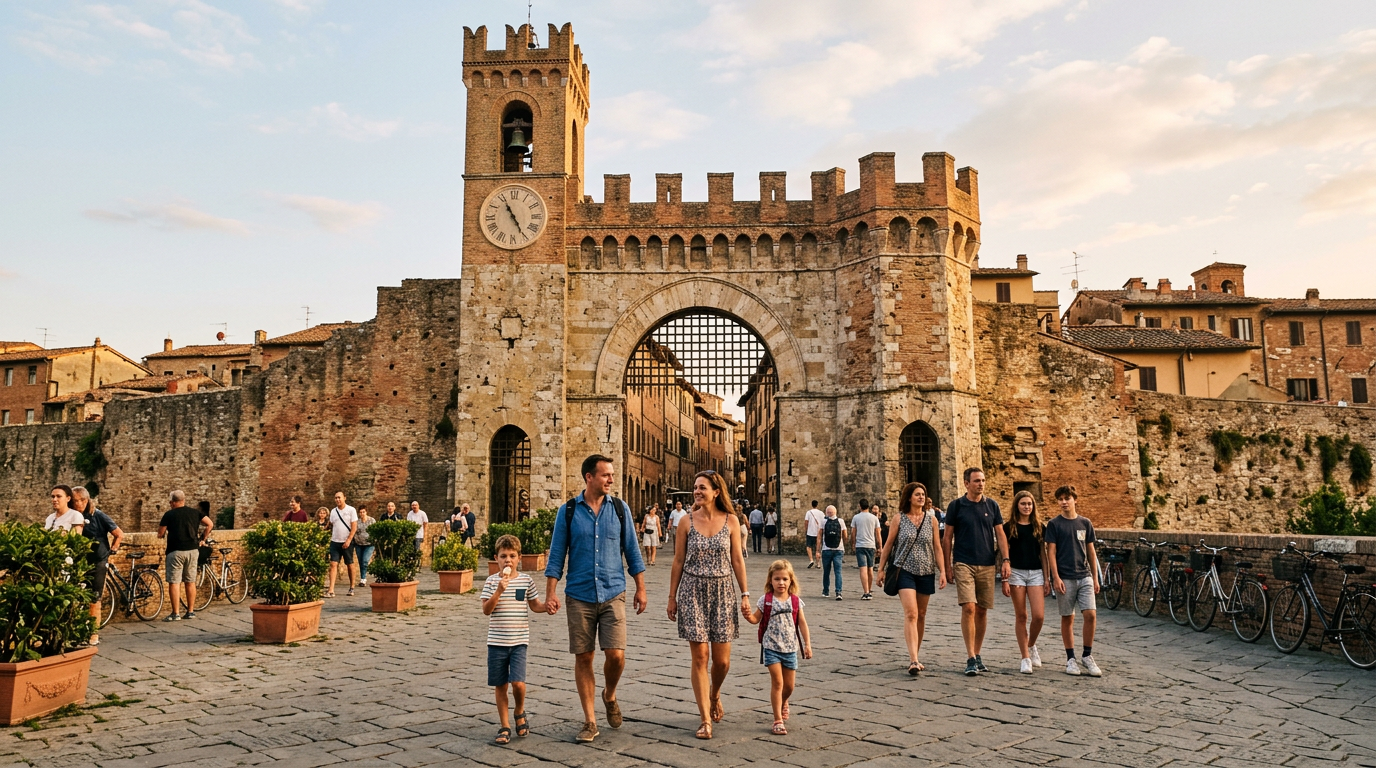
Porta Romana in Florence with Your Family
Porta Romana is one of the seven historic gateways in Florence’s medieval walls. It is the largest and the best preserved. It stands to the south of the historic center, at the start of the Viale dei Colli, the panoramic avenue that leads up to Piazzale Michelangelo.
For families it is a less crowded entrance point to the Boboli Gardens, and a quiet residential neighborhood with services and green spaces.
Porta Romana with your family
Porta Romana sits in Piazza della Calza, on the Via Romana that leads toward Rome (hence the name). It is built in stone and brick, with a double arch and the upper turret still intact.
The neighborhood around the gate is residential: 20th-century houses, supermarkets, schools, local bars. It is not a tourist area; it is where Florentines live.
For families it is a pleasant alternative to the more crowded parts of the center. Children can walk without being swept along by tour groups. Bar and restaurant prices are lower than in the historic center.
The history of the medieval gate
Florence’s city walls have a long history. The third and final ring of walls (the one that includes Porta Romana) was built between 1284 and 1340, when the city was at the height of its economic and demographic growth.
Porta Romana was completed in 1328. It was the departure point of the road to Rome, the most important route for trade and pilgrimage.
The gate had a practical function (controlling who entered and left the city) and a symbolic one (demonstrating Florence’s power to travelers arriving from the south).
On the inner walls of the gate there is still a 14th-century votive fresco depicting the Madonna and Child. It is not easy to spot but is still legible.
For explaining the gate to children: describe the walls as a great fence around the city. The gates were the entrance doors. Before you could enter, you had to say who you were and what you were carrying. Customs officers taxed the goods. It was like a medieval border crossing.
The Boboli Gardens through this entrance
The Boboli Gardens are one of the most important historic gardens in Italy. They belonged to the Medici family, who began building them in 1549. They have terraces, fountains, statues, geometric hedgerows, and a remarkable artificial grotto.
The main entrance is from Palazzo Pitti. But there is another entrance, far less busy: the one at Porta Romana, at Via Romana 37. From here you enter directly into the higher, greener part of the gardens.
Why use the Porta Romana entrance:
- Shorter queues compared to the main Palazzo Pitti entrance.
- You enter the upper section with its tree-lined avenues: better for children who want to run around.
- Views over the city and Brunelleschi’s dome from above.
Ticket: about 10 euros for adults, free for under-18s. The ticket covers the whole garden, including Palazzo Pitti. Check the Gallerie degli Uffizi website for updated opening hours.
Family services in the area
The neighborhood around Porta Romana has several useful services for families.
Parks and gardens: the Boboli Gardens are the main attraction. But nearby there is also the Giardino delle Rose (Viale Poggi), smaller and free. And the Giardino dell’Iris (Piazzale Michelangelo), open only in April-May during the iris flowering season.
Supermarket: there are several supermarkets in the area (Conad, Carrefour) for buying food or picking up snacks and water before entering the Boboli Gardens.
Bars: the bars on Via Romana have normal prices, much lower than in the tourist zones. A cappuccino costs 1.10-1.30 euros, a cornetto 1-1.50 euros.
Biblioteca delle Oblate (near Via della Condotta): not exactly next door, but reachable on foot in about 20 minutes. It has a terrace with a view of Brunelleschi’s dome and a children’s section. Free entry.
How to get there from the center
From Piazza della Signoria to Porta Romana is about a 20-25 minute walk, crossing the Ponte Vecchio and heading up Via della Calza.
From Piazza Santa Maria Novella it is about 25-30 minutes on foot through the Oltrarno.
By bus: line 11 runs along Via Romana. The C3 minibus connects the center to the Oltrarno. The nearest stop to Porta Romana is in Piazza della Calza.
By bike: there are several bike-sharing stations in the Oltrarno. The route from Ponte Vecchio to Porta Romana is almost flat.
With a pram: Via Romana is wide and tarmacked. There are no steps between the center and Porta Romana along the main route. The Boboli Gardens entrance at Porta Romana has a wide enough path for a pram, though some of the uphill sections are quite steep.
Where to stay
Charlotte is a bed and breakfast in the historic center of Florence designed for families. From Charlotte, Porta Romana is reachable on foot in about 20-25 minutes through the Oltrarno.
The Porta Romana area is perfect for a morning at the Boboli Gardens followed by lunch at a local bar, well away from the tourist crowds.
Find out more about Charlotte and plan your stay in Florence.