Ceramics Workshops for Children in Florence
Ceramics workshops for children in Florence
Ceramics is one of the oldest craft traditions in Tuscany. The region has a deep history of terracotta and majolica production, from the della Robbia workshop glazed roundels that decorate Florence’s Ospedale degli Innocenti to the terracotta farmhouse pots still produced in the Chianti countryside.
For children, a ceramics workshop in Florence offers something concrete: you arrive, you use your hands, you make something, and you leave with an object. That straightforwardness appeals across a wide age range. A 5-year-old can make a handprint tile. A 12-year-old can attempt a simple coil-built vessel. A teenager can use the wheel under guidance.
This guide covers where to find ceramics workshops for children in Florence, how a session works in practice, the recommended starting age, and what to expect in terms of cost.
Where to find workshops
Ceramics workshops in Florence are concentrated in two main areas: the Oltrarno neighbourhood on the south side of the Arno, and the streets around San Lorenzo north of the cathedral.
The Oltrarno has the highest density of working artisan studios in Florence. Several of these offer drop-in or bookable sessions for children and families. Via Maggio, Via de’ Serragli, and the streets between these two are the most productive area to look.
Studio Arte dei Colori, located near Via Sant’Agostino in the Oltrarno, specialises in hand-painted ceramics and offers family sessions for children from age 5 upward. A two-hour session costs approximately 30 to 35 euros per child including all materials and firing. The finished piece is fired in the studio kiln and can be collected after two to three days or shipped internationally for an additional fee.
La Ceramica Fiorentina, a small studio near the Ponte Vecchio area, runs sessions focused on traditional Florentine majolica decoration techniques. Children paint white bisque-fired pieces (small plates, bowls, or tiles) using traditional pigments. Sessions of 90 minutes cost around 25 euros per child. No prior experience is necessary.
The Museo dell’Opificio delle Pietre Dure, on Via degli Alfani near the Accademia, is a museum dedicated to Florence’s tradition of decorative stone and craft techniques. While primarily focused on hardstone, it sometimes collaborates with ceramics educators for school and family programmes. Check with the museum directly for 2026 workshop dates.
Several private ceramics teachers advertise family workshops on local and international expat community boards (such as the Florence Families Facebook group). These informal sessions, held in home studios, typically cost less (around 20 euros per child) and offer a more personal experience.
How a ceramics lesson works
A typical children’s ceramics workshop in Florence follows a consistent structure.
The first 10 to 15 minutes are spent handling clay and understanding its basic properties. Children learn that it dries out quickly when exposed to air and that it must be kept moist to remain workable. They are shown how to prevent cracks by keeping pressure even.
The main activity for children under 8 is usually hand-building: pressing a slab of clay into a mould, building a small pinch pot, or pressing a handprint or texture into a clay tile. These methods do not require fine motor control beyond what most children aged 5 and above possess.
Children between 8 and 12 can work with simple coil-building techniques. Rolling even coils and stacking them to build a small cylinder or bowl takes about 45 minutes and is satisfying to complete. Workshop instructors typically assist with smoothing and joining.
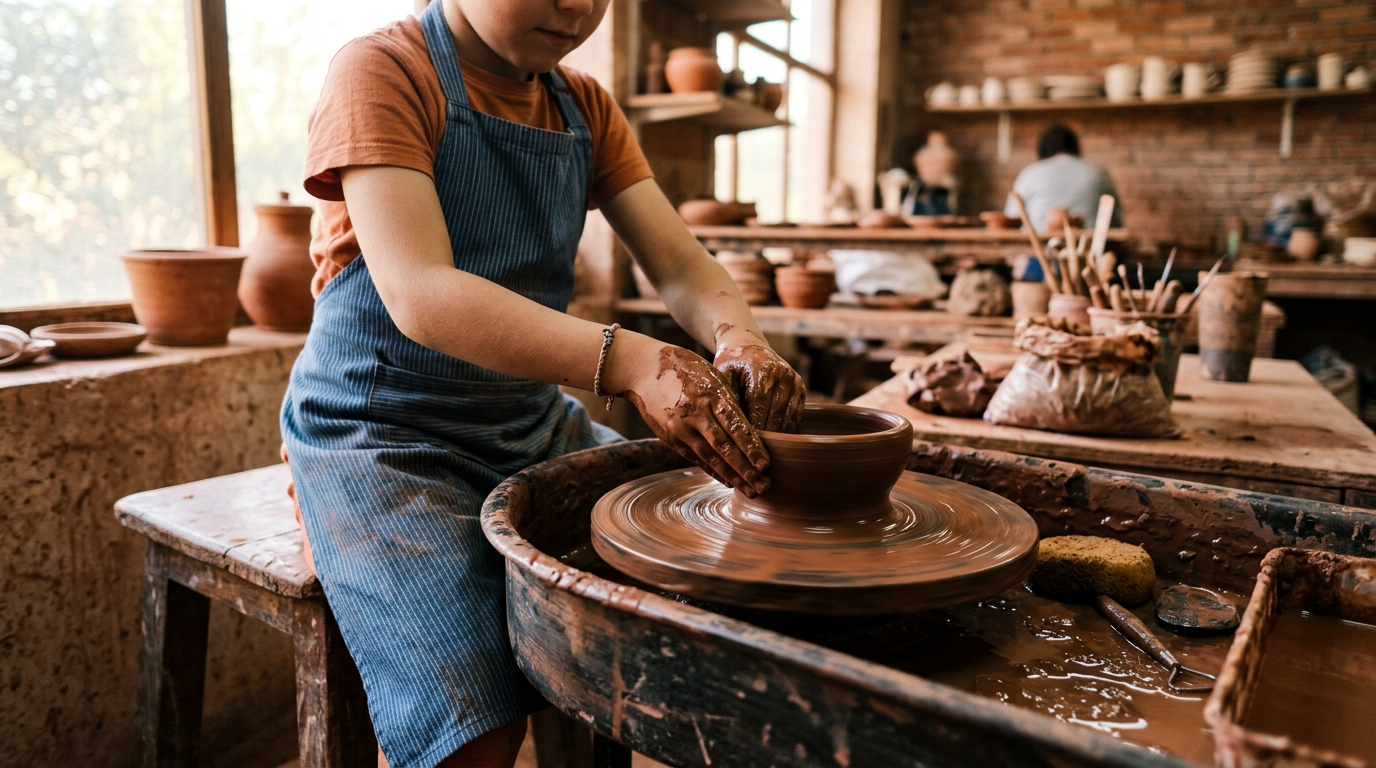
Children between 12 and 16 can often try the wheel for 15 to 20 minutes during a longer session. Full wheel throwing requires practice and the initial attempts produce wobbly results, but the experience of centring clay and feeling it rise is genuinely memorable. Not all studios include wheel time in standard sessions; ask when booking if this is important.
Decoration usually follows the forming stage. Options include incising patterns with wooden tools, applying coloured slip (liquid clay), or stamping with textured objects. In majolica-style workshops, decoration is applied with paint onto pre-fired white bisque ware.
Pieces are left to dry for at least 24 hours before being bisque-fired in the kiln. After bisque firing, any glaze or paint is applied and the piece goes through a second firing at a higher temperature. The total time from workshop to finished piece is typically three to five days. Most studios in Florence offer to fire and ship work to home addresses.
The right age to start
Ceramics is one of the more accessible craft forms for young children. The recommended minimum age for most Florence ceramics workshops is 4 to 5 years.
Children aged 4 to 6 work best with hand-building methods that do not require fine precision. A handprint tile or a simple coil bowl is satisfying and achievable. Session length should be kept to 60 to 75 minutes for this age group.
Children aged 7 to 10 can handle more complexity: pinch pots with added handles, simple slabwork, coil vessels. They benefit from direct instruction and have enough patience for a 90-minute session.
Children aged 11 to 14 can follow more technical instruction and begin to develop a personal approach. They can attempt wheel work, more detailed surface decoration, and more ambitious forms.
For teenagers aged 15 and above, a full two-hour session with wheel access is appropriate. Some Florence studios that primarily serve adult learners will accept accompanied teenagers for regular adult sessions.
Adult supervision is not always required for older children. For children under 10, an adult typically stays in the studio throughout the session. Most studios have seating or workspace for accompanying adults.
The most popular workshops in the city
Among the studios that regularly receive positive responses from visiting families, the following are the most frequently recommended in 2026.
Studio Zafferano, near Via dei Serragli in the Oltrarno, is a small studio run by an English-speaking ceramicist. Family sessions are offered on Saturday and Sunday mornings from 10:00 to 12:00. Prices are 35 euros per child (5 and above) and 30 euros per adult. Booking is by email or WhatsApp. Finished pieces are fired and can be collected the following week or shipped.
Bottega dell’Arte Ceramica near Via Santa Croce sull’Arno, about 10 minutes’ walk from Piazza Santa Croce, offers walk-in painting sessions on pre-fired bisque pieces during most weekday afternoons. This is a lower-commitment option: you paint, you pay (from 15 euros per piece), and the studio fires and ships the finished item. No booking required. Good for children who resist structured sessions.
The Istituto d’Arte in the Oltrarno occasionally opens its ceramics rooms to family workshops during school holidays. Contact the institute directly for dates.
Where to stay
Charlotte guesthouse is a short walk from several of the best ceramics studios in Florence, particularly those in the Oltrarno and the Ponte Vecchio area. After a morning workshop, you can cross the bridge and be back at the guesthouse in 10 to 15 minutes.
The team at Charlotte can suggest specific studios and help with booking contacts for ceramics workshops during your stay.
Find more details and availability at Charlotte.