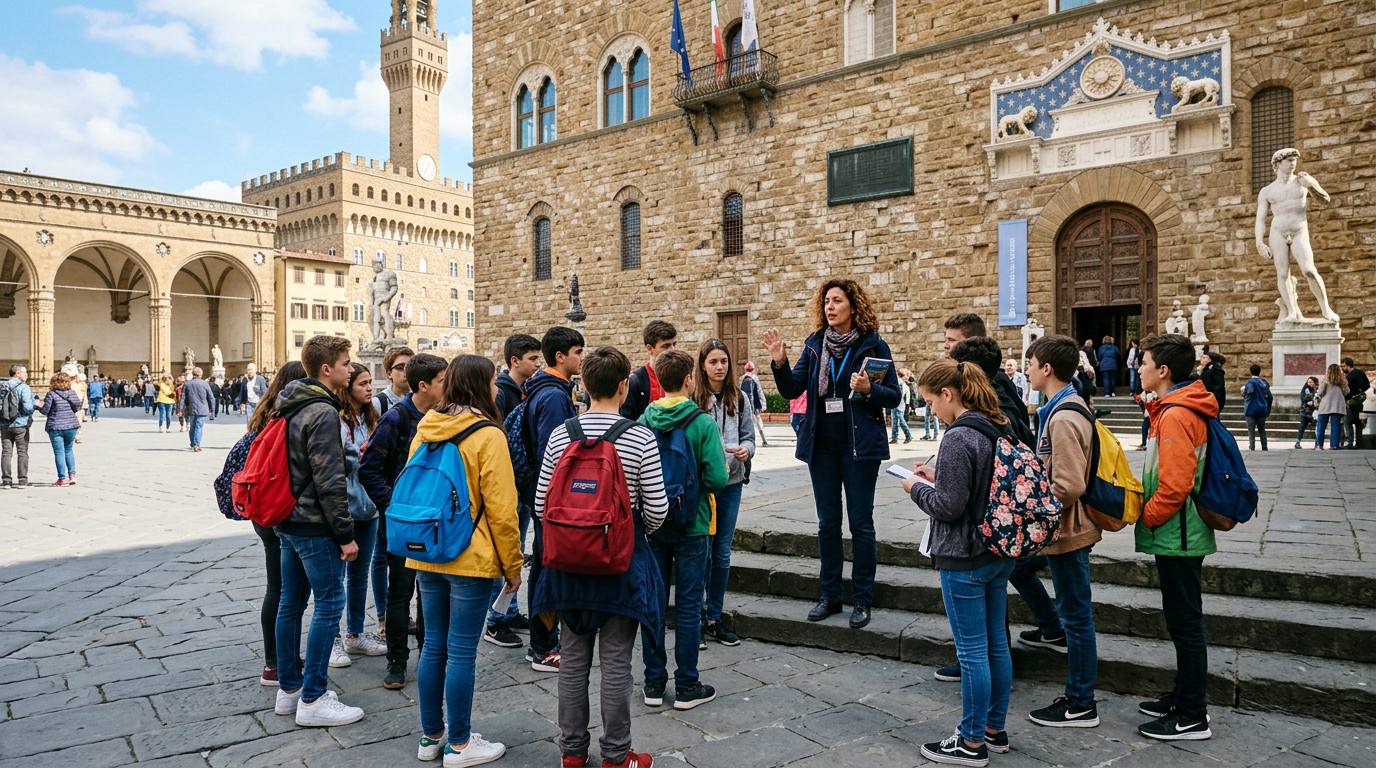
School Trip to Florence: Planning Guide
Florence is one of Europe’s most important educational destinations for school groups. The city’s museums, churches, and historic streets offer direct contact with art, architecture, science, and history that cannot be replicated in a classroom.
Planning a school trip to Florence takes preparation, but the museums and cultural institutions are experienced at welcoming groups and offer dedicated services for schools. This guide covers the key choices and logistics for teachers and group leaders.
School trip to Florence
Florence is home to over 70 museums. For a school trip, focusing on three or four carefully chosen venues is far more effective than trying to cover many in a short time.
The best school trips to Florence are structured around a theme. Choosing a coherent thread, such as Renaissance art, scientific history, or medieval urban development, helps students engage more deeply and leaves a stronger lasting impression.
Most major Florence museums offer specific educational programmes for school groups. These are run by trained educators and are separate from standard guided tours. They involve participatory activities, workshops, and guided discovery sessions tailored to different age groups.
Recommended museums for schools
The Uffizi Galleries are the centrepiece of a Florence school trip focused on Renaissance art. For schools, the Uffizi offers dedicated guided visits led by museum educators. Groups of up to 25 students can book a thematic tour lasting about 90 minutes. Entry for students on official school visits is 1 euro per student. Teachers and one adult per 10 students enter free.
The Museo Galileo (formerly known as the History of Science Museum) near Piazza della Signoria is one of the best science museums in Italy. It holds Galileo’s original telescopes and instruments, anatomical wax models, and a wide range of scientific instruments from the 15th to 19th centuries. Groups of students aged 10 and up benefit enormously from a guided visit. School group admission is 6 euros per student.
The Palazzo Vecchio offers a “Kids at the Palazzo Vecchio” educational programme and a range of themed school visits. Topics include medieval civic life, Renaissance power structures, and the art of Vasari. School group entry costs 4 euros per student.
The Museo di Storia Naturale (Natural History Museum) on Via La Pira is excellent for science and nature-focused trips. It includes a significant natural history collection, a geology section, and botanical specimens. Admission for school groups is around 4 euros per student.
Themed trails for classes
The Uffizi offers a downloadable “discovery trail” for schools that guides students through specific works using guided questions. These work as self-directed activities for groups with a teacher and reduce the need for a professional guide.
The Centro di Documentazione at Palazzo Medici Riccardi offers a dedicated itinerary for schools exploring the Medici family’s role in Renaissance Florence. The programme includes archival document handling for older students.
The Fondazione Romualdo Del Bianco runs educational programmes specifically designed for international school groups visiting Florence. The foundation creates tailored cultural itineraries and learning frameworks for groups of all ages and nationalities.
Several independent educational tour operators in Florence offer themed school walks of 2 to 3 hours. Topics include Renaissance art history, Dante’s Florence, the history of science, and Roman Florence. Prices for professional educational guides start at around 150 euros per group for a 2-hour session.
Logistics
Florence historic centre is compact and most major sights are within a 20-minute walk of each other. Organise your schedule to walk between venues rather than using coaches inside the ZTL (limited traffic zone).
Book all museum visits at least 3 weeks in advance. The Uffizi and Palazzo Vecchio often have limited slots for school groups, particularly from April to October.
Lunchtime logistics matter significantly with large groups. The covered Mercato Centrale first floor offers a self-service cafeteria section that can accommodate large groups. Alternatively, many schools bring packed lunches and use Piazza Santa Croce or the gardens of Piazza d’Azeglio as eating areas.
Accommodation for school groups is available at several hostels and guesthouses in Florence that offer multi-room arrangements and communal facilities.
Educational services at museums
The Uffizi Galleries’ educational department (the Uffizi Edu team) develops specific programmes by age group. Primary school programmes focus on observation and storytelling. Secondary school programmes include art analysis, historical context, and writing activities.
The Museo Galileo runs laboratory-format workshops for schools. Students can handle replicas of historical instruments and conduct simple experiments based on Renaissance-era scientific methods. Workshop places are limited to 20 students at a time.
The Accademia Gallery, home to Michelangelo’s David, offers a short educational introduction designed specifically for school groups. The guide focuses on how Michelangelo worked and what the statue meant in its time. School groups of up to 25 visit at a student rate of 2 euros per person.
Where to stay
Charlotte is a family guesthouse in Florence that welcomes school groups travelling with teachers and parents. The location is central and practical for early morning starts at museums and galleries across the city.