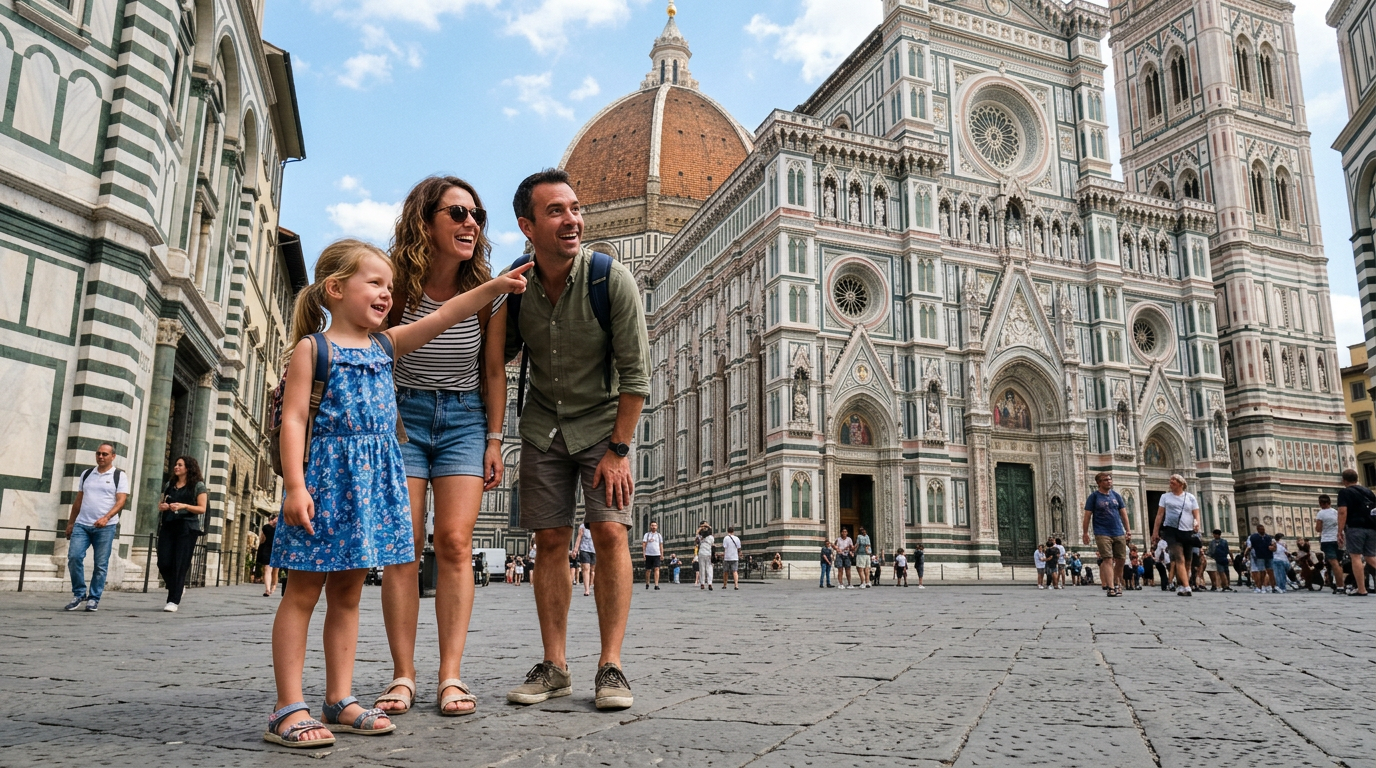
Florence with Children: What to Do
Florence with children: it can be done
Florence is a city built on centuries of art, architecture, and stone. Many parents assume it is better suited to adults. That assumption is worth setting aside before you arrive.
Children respond to Florence in ways that are hard to predict. They notice the height of the cathedral dome, the echo of their footsteps on narrow streets, the goldsmith workshops lining Ponte Vecchio. The city offers sensory richness that children absorb at their own pace.
The key is not choosing between culture and fun. The key is pacing. Short stretches of walking, one main attraction per half-day, and regular breaks for gelato or a park stop make a significant difference.
This guide gives you concrete activities, practical logistics, and honest information about what works for children of different ages in Florence.
Activities for all ages
Florence has a range of activities that suit children from age 4 upward. The question is not whether there is enough to do, but how to sequence it without exhausting anyone.
For children between 4 and 7, the best experiences are sensory and physical. Walking across Ponte Vecchio takes about 10 minutes and holds genuine fascination for small children. The goldsmith shops on either side create a corridor of light and colour. The view from the bridge toward Ponte Santa Trinita is one of the most photographed in the city.
For children between 8 and 12, interactive and historical content starts to land well. The Museo dei Ragazzi at Palazzo Vecchio runs guided visits specifically designed for this age group. Sessions last approximately 75 minutes and are available in English. Booking in advance is strongly recommended between April and October.
Teenagers tend to engage more with neighbourhood exploration, food experiences, and some independence. The San Lorenzo market area, the Oltrarno district, and the Mercato di Sant’Ambrogio offer interesting texture for older children who can navigate with a degree of autonomy.
Museums that children actually enjoy
Not every museum in Florence works for young visitors. Choosing the right ones saves time and avoids frustration.
The Museo dei Ragazzi is the most directly child-focused option. It is located inside Palazzo Vecchio, on Piazza della Signoria. The museum runs themed visits for children between ages 5 and 14. Themes include “The Secret of the Duke” and “Cloaks and Daggers,” both of which treat the Renaissance as an adventure story rather than a history lesson.
Entry to the children’s programme costs approximately 6 euros per child in 2026. A combined family ticket for Palazzo Vecchio and the children’s visit is around 14 euros per family unit. Check the official Palazzo Vecchio website for current prices before visiting.
The Museo di Storia Naturale has several branches across the city. The La Specola section at Via Romana 17 includes an unusual collection: anatomical wax models from the 18th century alongside zoological specimens. Children between 9 and 14 often find this visit memorable and slightly unsettling in the best possible way. It is a 10-minute walk from Ponte Vecchio.
The Stibbert Museum, located about 3 km north of the centre near Via Montughi, houses one of Europe’s most complete collections of armour and weapons from Europe, Asia, and the Islamic world. Children interested in knights or samurai tend to find this visit exceptional. Entry is 8 euros per adult and 6 euros per child. Opening hours in 2026 are Thursday to Tuesday, 10:00 to 14:00, closed on Wednesdays.
Parks and open spaces
Children need space to run, especially after time spent inside museums. Florence has several good options within or near the historic centre.
The Giardino di Boboli stretches across 45,000 square metres behind Palazzo Pitti. The garden contains long straight paths, fountains, sculptures, and a grotto. Children between 6 and 12 generally stay engaged for 60 to 90 minutes. The Grotto of Buontalenti, a 16th-century cave decorated with sculpted figures and shells, tends to capture children’s attention. Entry in 2026 is 10 euros per adult. Children under 18 from EU countries enter free. The garden is open from 08:15 until dusk.
Le Cascine park is the largest public green space in Florence. It stretches 3.5 km along the Arno river, west of the city centre. The park contains a small amusement area, a swimming pool open in summer, cycling paths, and a Tuesday morning market. Children between 3 and 10 do well here. The park is reachable by tram from the central station in about 15 minutes.
The Giardino dell’Iris, open only in April and May when the irises bloom, is a smaller garden on the south side of the city near Piazzale Michelangelo. Entry is free. It is about a 20-minute walk from the centre via Porta San Miniato. The views over the city rooftops from this garden are among the best in Florence.
How to manage family logistics
Moving around Florence with children requires some preparation. The historic centre is compact but almost entirely paved with stone, and some streets are narrow.
A pushchair is manageable in the main piazzas and on wider streets. For older parts of the city, a carrier or backpack for smaller children is often more practical. Children who can walk independently manage most of the centre without difficulty from age 5 or 6.
Public transport uses buses and a tram line. Single tickets cost 1.70 euros and are valid for 90 minutes. A family day ticket costs around 5.50 euros. Children under 6 travel free. The tram connects Santa Maria Novella station to the Cascine park and western suburbs.
Eating with children in Florence is straightforward. Pizzerias and trattorie typically welcome families without fuss. Look for restaurants open by 12:00 for lunch. Many open only at 12:30. For a quick midday stop, the covered Mercato Centrale on Via dell’Ariento has an upstairs food hall open from 10:00 to midnight with a wide variety of fresh options.
Gelato is a serious matter in Florence. Look for signs reading “artigianale” or “produzione propria.” Gelateria dei Neri on Via dei Neri and Gelateria Edoardo near the Duomo are both reliable within the centre. Servings cost between 2.50 and 4 euros depending on size.
Afternoons between 14:00 and 16:00 tend to be the hottest and most crowded in summer. Scheduling a rest period during this window, or visiting an indoor location like a museum, helps manage energy for the whole family. Mornings before 10:00 are by far the best time to see popular sites like Ponte Vecchio without crowds.
Plan one major activity per morning and one per afternoon. That rhythm works well for most families with children under 12. Trying to pack in three or four major sites in a single day tends to end badly for everyone.
Where to stay
Charlotte guesthouse sits in central Florence, within walking distance of the main family-friendly attractions described above. The rooms are comfortable, the team is helpful with local recommendations, and the location means you spend less time in transit and more time exploring.
Families who stay centrally find the pace of a Florence trip much easier to manage, especially with younger children who tire quickly.
You can find more about the guesthouse and availability at Charlotte.